
What Is the Most Effective Pool Filter? Sand, Cartridge & DE Compared
Ask three pool professionals which pool filter is the most effective and you will get three answers. All three can be right, because “most effective” means one thing to a hotel engineer with a health inspector on the phone and another to a facility manager who simply wants clear water without losing an hour every weekend.
This guide compares the three technologies that have shaped pool filter design for decades — sand, cartridge and diatomaceous earth (DE) — on the numbers that decide a purchase: what size particle each holds back, how fast water may pass through, what it costs to run, how much water it wastes, and how much of somebody’s time it eats. It is written for people who specify equipment rather than live with it: contractors, resort engineers, facility managers, distributors and OEM buyers.
One point up front, because it is the most expensive misunderstanding in this category: the finest pool filter is not automatically the right pool filter. Selection is a hydraulic decision long before it is a water-quality one.
What Is a Pool Filter?
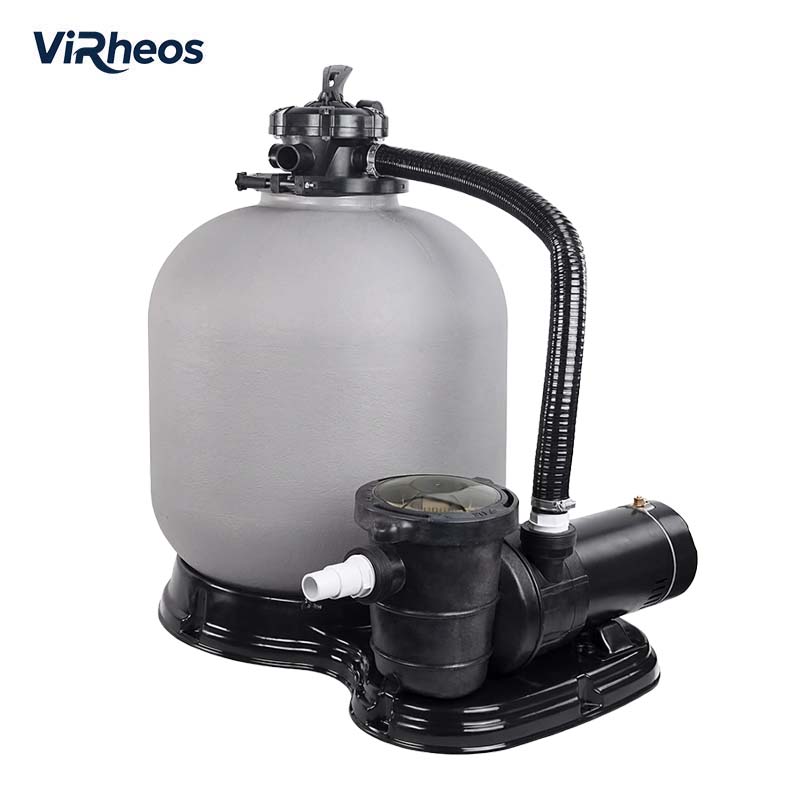
A pool filter is the pressure vessel and medium that sit between the pump and the pool return. The pump moves water; the filter makes it clear. In practice a pool filter is bought as one part of a circulation system, and pump, filter, valves and pipework have to be sized as a single hydraulic circuit — complaints that start with “the filter isn’t working” usually turn out to be a mismatch elsewhere in that circuit.
Every type works on the same principle: force water through a medium whose openings are small enough to hold back the particles you care about. What differs is the medium, how fine it is, how much area it presents to the water, and how you get the trapped dirt back out.
What a pool filter does not do is disinfect. Filters remove particles; sanitiser kills pathogens. Public health guidance is blunt about the gap: sand media holds back particles above roughly 25 microns while chlorine-tolerant organisms sit at 4–6 microns, so filters are specified inside a treatment train with disinfection, and commercial venues add flocculants or UV and ozone when risk rises (CDC Healthy Swimming programme).
How a Pool Filter Works
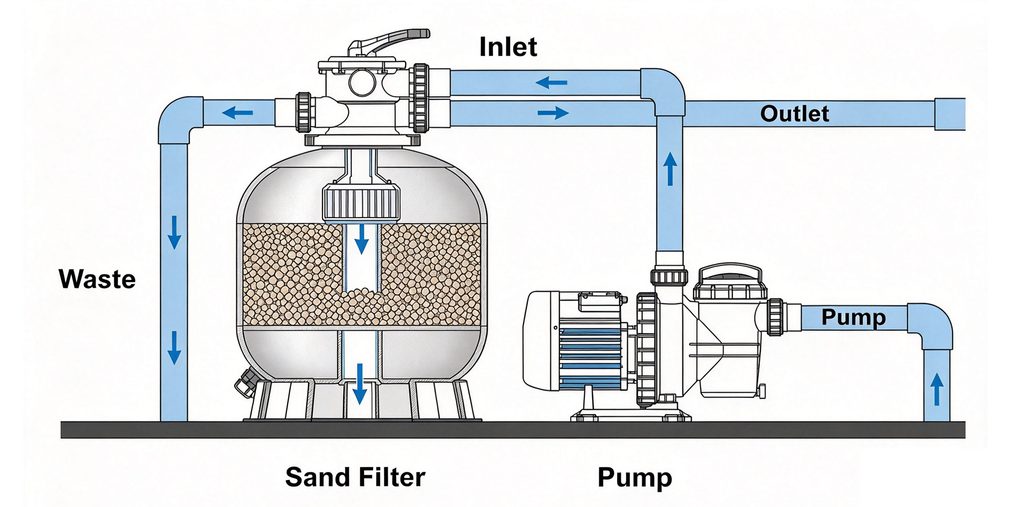
The cycle is a closed loop and it is the same for all three technologies:
- Water leaves the pool through the skimmer and main drain and passes the pump strainer basket, which catches leaves, hair and grit.
- The pump pushes water into the filter housing.
- Water passes through the medium — sand bed, pleated cartridge or DE-coated grid — and particles are held back.
- Clean water leaves through the outlet and goes back through the return jets, aimed to keep the whole body of water moving.
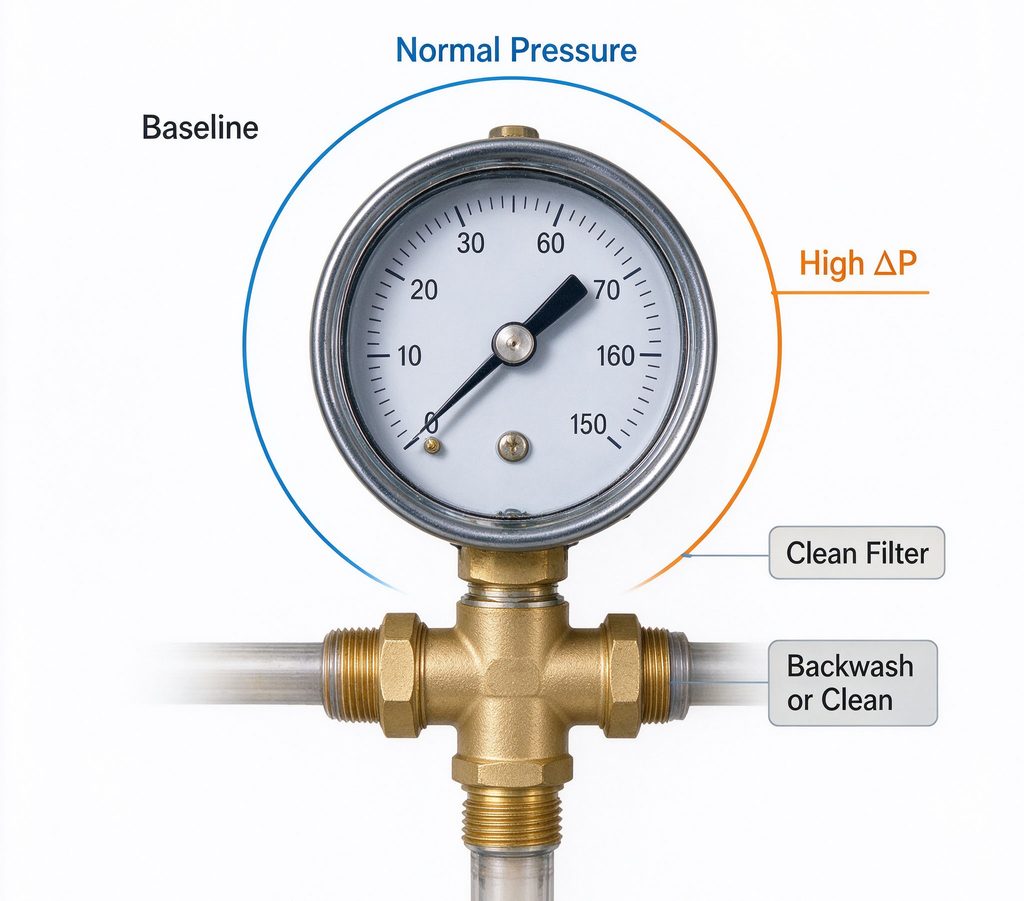
Two ideas make the rest of this article make sense. Turnover: the time it takes to pass the entire pool volume through the filter once. And the pressure gauge — for most installations the only instrument fitted, and the one that tells you when to clean.
Here is the part that trips up new buyers: rising pressure is not just a nuisance. A light layer of trapped dirt on the medium — the filter cake — catches finer particles than clean media does, which is why operators clean on pressure rather than on a calendar.
What Pool Filters Actually Do
- Silt, pollen, dead algae and the fine dust that leaves water looking dull even when every chemical reading is in range.
- Carry chemicals. Filtration is the distribution network for chlorine and pH correction. Balanced chemistry with poor circulation still gives you algae in the corners.
- Skim the surface. The same loop pulls floating debris into the skimmer. Switch it off for a week in summer and you see how much of a clean pool is just movement.
- Protect downstream equipment. Heaters, salt chlorinators and UV or ozone units sit after the filter and have flow switches.
And one effect that rarely makes it into a specification but shows up in every power bill: a pool filter sets the system’s pressure. Every metre of head it adds is energy the pump pays for, every day, for the life of the installation.
The Three Types of Pool Filter
Sand filters
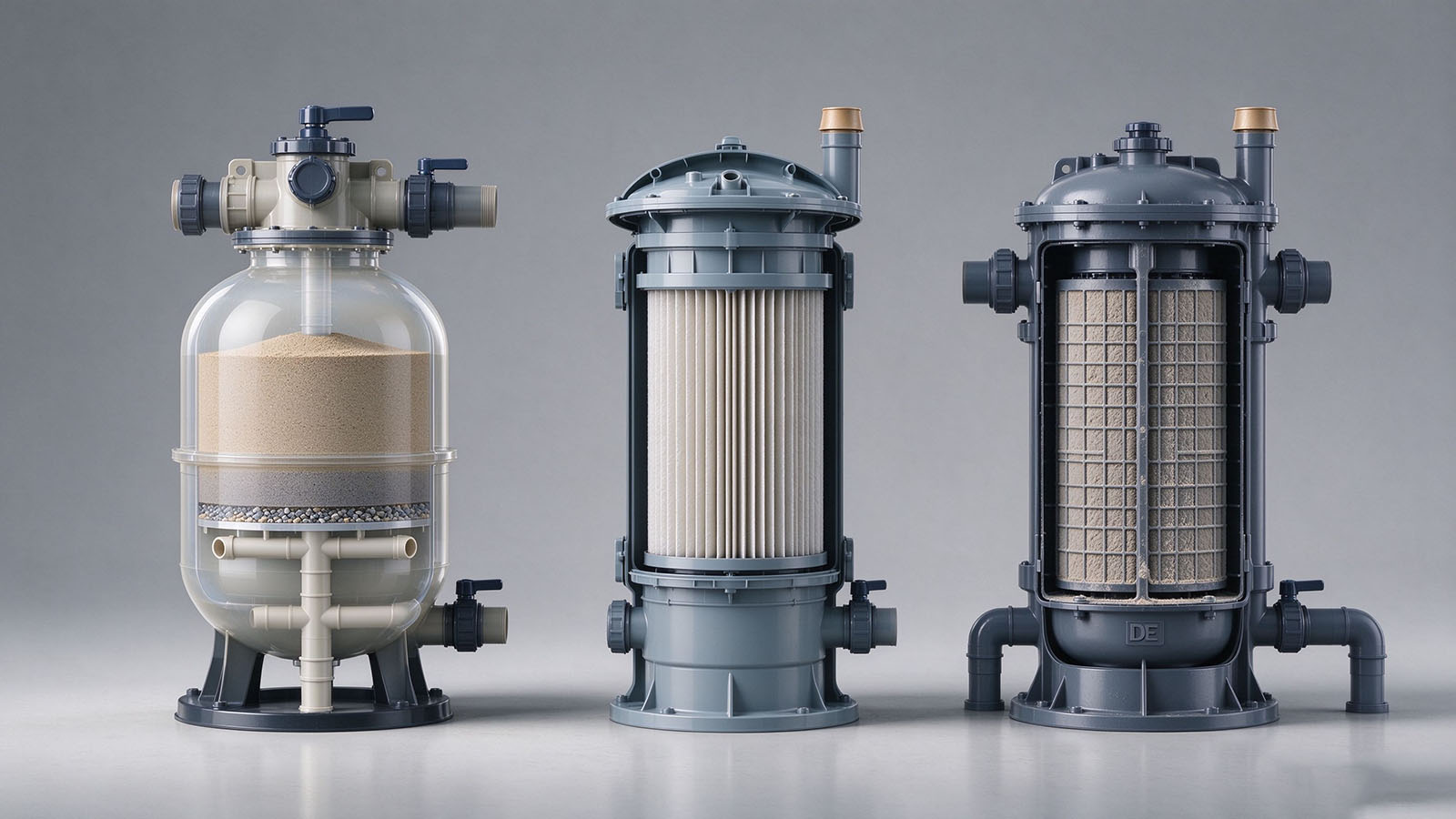
A tank packed with graded silica sand — #20 grade, effective size around 0.45–0.55 mm — filled to roughly two-thirds height. Water enters at the top, percolates down and leaves through slotted laterals at the bottom. In service a sand pool filter holds back particles in the 20–40 micron range.
Cleaning is backwashing: reverse the flow, flush to waste, then a short rinse to re-settle the bed. The sand needs replacing every few years because the grains round off and the bed begins to channel — no amount of backwashing fixes that.
Cartridge filters
A pleated polyester element, or several, inside a canister. No backwash valve, no media to dose. Cleaning means isolating the filter, lifting the element out and rinsing it with a hose. In service a cartridge pool filter catches roughly 10–20 microns.
The elements are consumables: a couple of years in residential service, closer to six months on commercial plant running all day under real bather load. The strong card is water — cleaning sends nothing to waste.
DE filters
Diatomaceous earth is a powder made from fossilised diatoms, coated onto fabric-covered grids inside the tank to form a microscopic sieve that catches particles in the 2–5 micron range — the finest filtration available from a conventional pool filter. Cleaning means backwashing, recharging with fresh powder, and a grid inspection once or twice a year.
DE also carries a regulatory wrinkle the other two do not: many jurisdictions require a separation tank so spent powder is captured rather than discharged, and several regions treat used DE as a controlled waste stream.
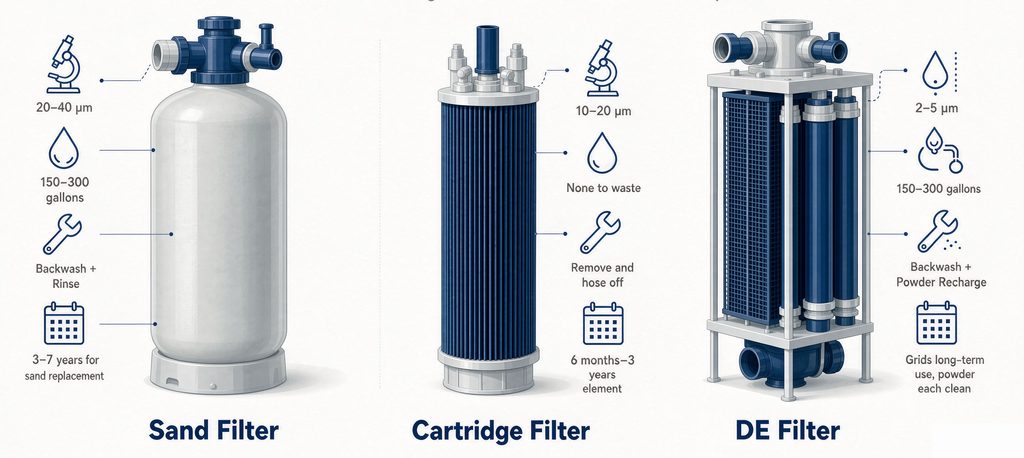
Table 1. Sand vs. cartridge vs. DE: what changes in service
| Factor | Sand | Cartridge | DE |
| Particles held back | 20–40 microns | 10–20 microns | 2–5 microns |
| Typical design filter rate | 15–18 gpm per sq ft | 0.375 gpm per sq ft | 2 gpm per sq ft |
| How it is cleaned | Backwash + rinse | Remove and hose off | Backwash + recharge powder |
| Water sent to waste | 150–300 gallons per cycle | None to waste | 150–300 gallons per cycle |
| Consumable life | Sand every 3–7 years | Element 6 months–3 years | Grids last years; powder each clean |
| Cleaning trigger | +8–10 psi over clean | +8–10 psi over clean | +8–10 psi over clean |
| Extra plant required | None | None | Separation tank in many areas |
| Strongest argument | Lowest upfront cost, forgiving | No water waste, simple plumbing | Finest clarity available |
Where Each Pool Filter Type Earns Its Keep
- Residential pools. Cartridge is the default on new builds in water-conscious regions; sand is the value choice where debris load is high; DE appears where the owner cares most about how the water looks.
- Hotels, resorts and apartment complexes. Duty cycles of 12–18 hours, heavy bather load, audited turnover records. Here the filter is specified for area and serviceability — one needing hours of hands-on cleaning during operating hours is a design fault.
- Public pools, water parks and leisure centres. Turnover is a compliance metric. The CDC Model Aquatic Health Code (5th edition, 2024) sets reference maximum turnover times of six hours for most pools, two hours for activity pools and lazy rivers, one hour for wading pools and 30 minutes for spas, adopted in whole or in part locally (CDC MAHC, 5th ed., 2024).
- Spas and hot tubs. Cartridge is almost universal: compact, high area in a small footprint, no backwash plumbing.
- Aquaculture, hatcheries and irrigation. Coarse sand media as pre-filtration ahead of biological stages or drip lines — same vessel, different media grade.
- Cooling tower sidestream and process water. Sidestream filtration keeps suspended solids down so heat exchange surfaces stay clean.
Standards and Limits Worth Checking
Two things get checked on any pool filter specification: the rate the filter may run at, and whether the unit is certified. A filter running above its design rate simply bypasses water past the medium.
Rate limits are set by jurisdiction and differ by media. A typical US state code caps high-rate sand at 18 gpm per square foot (or the maker’s rating, whichever is less), rapid sand at 3 gpm/ft², DE at 2 gpm/ft² and cartridge at 0.375 gpm/ft² — Oregon’s pool rule OAR 333-060-0140 is a representative example. Certification is the other half: NSF/ANSI 50 covers material health, corrosion resistance, structural testing and flow verification, and requires the claimed effective filtration area to sit within 5% of the measured value (NSF International).
Table 2. Compliance and specification reference
| Item | Typical limit or requirement | Why it matters to the buyer |
| High-rate sand filter rate | 18 gpm/ft², or maker’s rating if lower | Above this, water channels through the bed instead of filtering. |
| Rapid sand filter rate | 3 gpm/ft² | Much larger footprint for the same flow; used where clarity rules are strict. |
| DE filter rate | 2 gpm/ft² | Sets the grid area — and therefore tank size and price. |
| Cartridge filter rate | 0.375 gpm/ft² | Explains why cartridge units are physically large: area is the product. |
| NSF/ANSI 50 certification | Materials, structural and flow testing | Required for public pools in most US jurisdictions; check model numbers, not just the factory. |
| Data plate information | Area, max design flow, working pressure | Without these the filter cannot be legally specified on public work. |
| Effective filtration area | Claim must be within 5% of measured | The one published number that quietly decides whether the unit is really big enough. |
Buying Guide: Sizing a Pool Filter
Step 1. Find the flow the pool needs
Required flow = pool volume ÷ target turnover time. A 150 m³ (about 40,000 gallon) hotel pool on a six-hour turnover needs 25 m³/h, roughly 110 gpm. Everything follows from that number.
Step 2. Convert flow into filter area
Divide required flow by the design rate for the type you are considering. The same 110 gpm needs about 6 ft² of sand bed, 55 ft² of DE grid, or close to 300 ft² of cartridge. That is why cartridge units look oversized next to sand tanks: area is the product, and its rate is low by design.
Step 3. Match the pump, then read the curve
A pump delivers whatever the plumbing allows, so read its curve at the real total dynamic head — lift, friction, filter and heater resistance, elevation. A unit rated 30 m³/h at zero head may give 20 m³/h on a roof plant; that gap is how undersized systems get specified. Then check the backwash flow required, since fluidising a bed or clearing grids needs a genuine surge.
Step 4. Price the whole life, not the box
- Consumables: sand every few years, cartridge sets on a cycle, DE powder after every clean.
- Water: backwashing sand or DE sends a few hundred litres of balanced water to waste each time. In water-restricted regions that is a real operating cost.
- Labour: pulling and rinsing cartridges takes the filter offline; a spare set keeps commercial plant running.
- Energy: more filter area means lower pressure and a slower, cheaper pump speed.
- Paperwork: certification naming the model, plus a parts diagram so the unit is still serviceable in year five.
A Worked Comparison on One Real-Type Pool
Take a 150 m³ hotel pool on a six-hour turnover — 25 m³/h, about 110 gpm. Three ways to filter it:
- Sand: about 6 ft² of bed area, a tank around 900 mm. Backwashed weekly in season, each cycle sending 200–300 gallons to waste — call it 40–60 m³ a year of treated water to replace and re-balance.
- Cartridge: close to 300 ft² of element area, typically four large cartridges. Nothing to waste; cleaning is a hose and a couple of hours, with a spare set so circulation never stops.
- DE: about 55 ft² of grid area. Backwashed like sand, plus powder after every cycle, a grid teardown once or twice a year, and in many jurisdictions a separation tank in the plant room.
On energy, the type matters less than the pump behind it. That pool on a 1.5 kW single-speed pump running twelve hours a day uses about 18 kWh daily, roughly 6,570 kWh a year. On a variable-speed unit running sixteen hours at low speed plus twenty minutes at high speed for backwash, the figure lands near 5 kWh daily, about 1,900 kWh a year — a reduction of roughly 70%, in line with what US EPA ENERGY STAR cites for replacing older single-speed equipment (US EPA ENERGY STAR pool pump programme).
Using a Pool Filter: The Routine That Prevents Most Failures
Start-up
- Valve in the operating position and fully seated; open the air relief and close it once water runs steady.
- Fill the pump strainer housing, secure the lid, open all suction and return valves.
- Start the pump, let it prime, then write down the clean pressure. That number is your cleaning trigger all season.
Routine
- Read the gauge and clean at 8–10 psi above the clean reading — not on a fixed schedule.
- Empty skimmer and pump baskets; a half-blocked basket costs more flow than expected.
- Sand: backwash, then always rinse, or fine sand goes back into the pool.
- Cartridge: isolate, lift, rinse between pleats; soak periodically to remove oils and scale.
- DE: backwash, then recharge with the specified quantity; check grids for tears at teardown, since a damaged grid puts powder back in the pool.
Seasonal
- Replace sand every 3–7 years, sooner if pressure stays high after backwashing or the bed channels.
- Replace cartridges when they no longer rinse clean; hard water and scale shorten that cycle.
- In freezing climates drain the vessel and exposed pipework or the first frost will split it.
Quick troubleshooting
- Pressure high after cleaning — tired or channelled media, or a blocked lateral. Means replacement, not more cleaning.
- Short cycles between cleanings — undersized for the flow, or a load it was never specified for.
- Cloudy water, clean filter — check chemistry and circulation first.
- Media in the pool — cracked lateral on sand, torn DE grid, or a skipped rinse.
Frequently Asked Questions
- Which pool filter gives the clearest water?
- DE, at roughly 2–5 microns. In a pool that is already balanced and clear, though, the visible gap between DE and a good cartridge pool filter is smaller than the numbers suggest, because every filter catches finer particles once a light filter cake forms.
- Which pool filter is cheapest to own?
- Sand wins on purchase price and loses on water; cartridge wins on water and costs more in elements and labour; DE wins on clarity and costs most in consumables and attention. Where water is expensive or restricted, cartridge often wins on total cost despite the higher sticker price.
- How often should a pool filter be cleaned?
- When the gauge reads 8–10 psi above the clean baseline — the only trigger that applies to all three types. On a calendar you either waste water and filter performance, or run the pump harder than it should.
- Can I change filter type without replacing the tank?
- No. Each type uses a different housing and different internals, so changing type means changing the vessel and the plumbing around it, not just the media inside.
- Does a finer pool filter make the pool safer?
- Not on its own. Filtration removes particles; disinfection controls pathogens, and the organisms behind most pool outbreaks are smaller than any conventional pool filter can hold back. Fine filtration supports safe water by keeping it clear enough for the sanitiser to work.
- Is a bigger filter always better?
- For filters, essentially yes. More area means lower pressure, longer intervals between cleanings, better clarity and longer media life. The limits are space, budget, and whether the pump can deliver the backwash flow a bigger unit needs.
So Which Is the Most Effective?
If “effective” means the finest water, DE wins. If it means the best result per unit of water, labour and attention, cartridge wins in most residential and many commercial settings. If it means the lowest barrier to a working system, sand still wins — and sand remains the volume leader of the category for exactly that reason.
What separates a good installation from a troublesome one is rarely the technology. It is whether the filter area was sized to the flow, whether the pump curve was read at the real head, and whether the clean pressure got written down on day one. Get those right and all three types perform to their rating.
If you are specifying a system, send a manufacturer four figures rather than a model number: pool volume, required turnover time, available power supply and an honest estimate of total dynamic head. A competent engineering team can then return the filter area each type needs, the pump to drive it, the backwash flow required and the certification package for your market.
References
Abstract: This study tested sand, cartridge and DE/precoat filters for Cryptosporidium removal. Precoat filters achieved 2.3–4.4 log removal; sand and cartridge removed ≤0.19 log, showing weak capture of chlorine-resistant oocysts.
2.Title: Evaluation of Swimming Pool Filtration Systems
Abstract: DE, cartridge and sand filters were compared on pathogen removal. DE outperformed the others; sand and cartridge showed low microbial capture, rising only with larger particle size.