
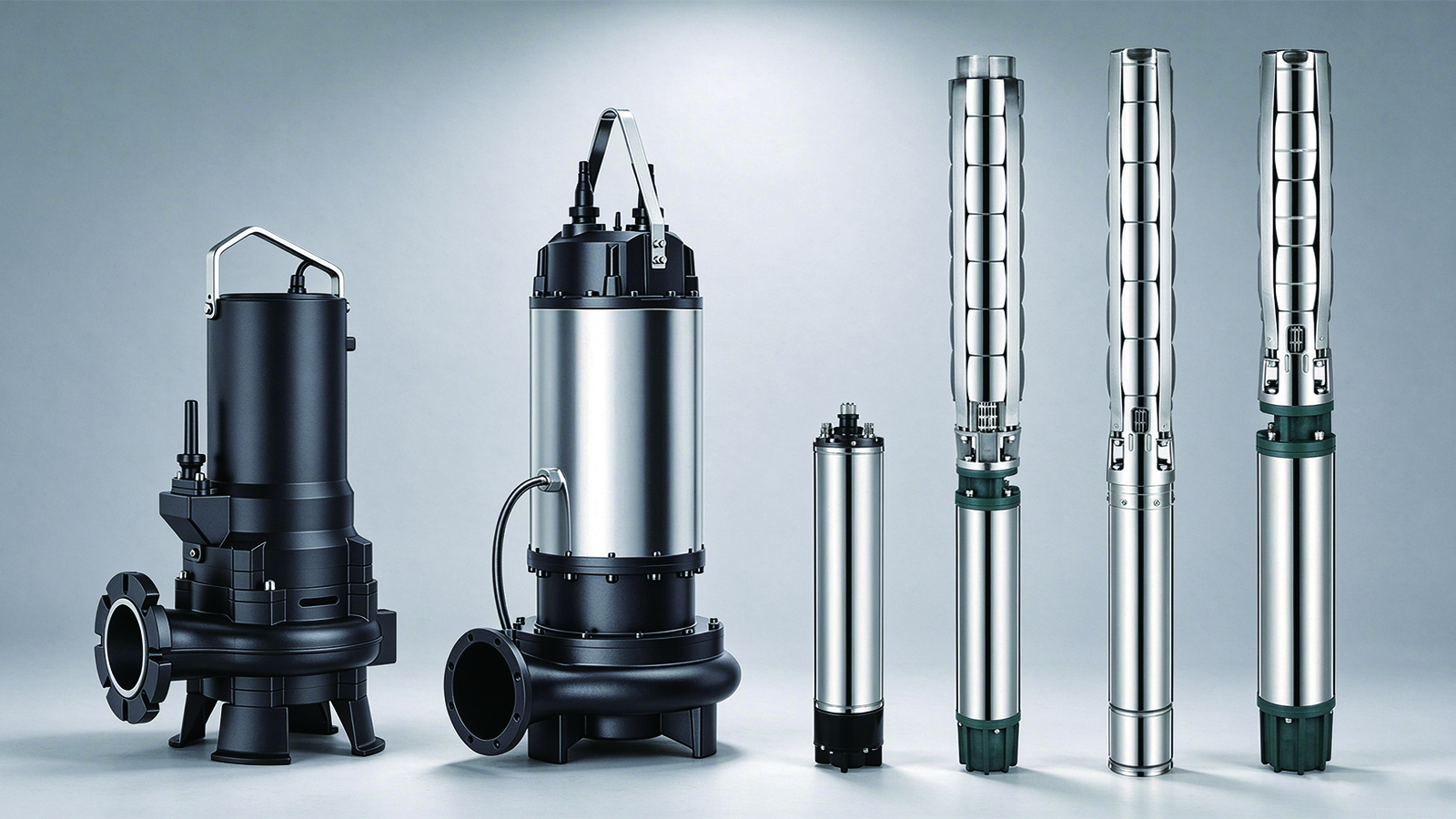
Sewage Pump vs Submersible Pump: What’s the Difference?
If one quote said “sewage pump” and another said “submersible pump” and the prices were nowhere near each other, the confusion makes sense. Most comparison articles line these two up as rivals. They are not.
A sewage pump is named for what it moves: wastewater carrying soft solids, toilet paper and whatever else goes down a drain. A submersible pump is named for where it works: bolted to the floor of a basin or hanging in a borehole, entirely underwater, motor included.
Two separate questions — what does it pump, and how is it installed. Because they are separate, the answers overlap constantly. The best-selling sewage pump in the world is a submersible sewage pump, both at once.
- Wastewater with solids, pump sits below the water line → submersible sewage pump
- Clean or lightly dirty water, source below the pump → submersible pump (well, drainage or sump duty, not sewage-rated)
- Wastewater with solids, but you want a dry, walk-up motor → self-priming sewage pump above the pit
- Clean water, source above the pump → neither; end-suction or jet pump
Sorted that way, spec sheets stop fighting each other.
What is a sewage pump?
A sewage pump moves unscreened wastewater — what leaves a building through a drain — without choking on the solids in it.
The number that defines the category is solids-handling size: the largest sphere the pump can pass. Residential work is almost always 2 inches (50 mm), and plumbing codes generally require a 2-inch minimum discharge on any sewage pump connected to a toilet. Municipal specifications often step up to 3-inch (75–80 mm) sphere passage with 4-inch discharge piping; large channel impellers are regularly specified at 50–100 mm.
For scale: a sump pump handles particles under about ½ inch, an effluent pump handles screened septic liquid up to ¾ inch, and a sewage pump handles raw waste and the 2-inch solids that come with it. Anything rated below 2 inches on a toilet connection is a call-back waiting to happen.

How a sewage pump works
- Wastewater arrives by gravity into a sealed, gas-tight basin.
- Level rises, float switch closes — tethered float, vertical float on a rod, or a pressure diaphragm switch.
- The impeller works. Centrifugal force throws liquid outward and up the discharge line.
- A check valve holds the column. Without one, the riser drains back and the pump restarts immediately — the short-cycle that cooks motors.
- Level drops, pump cuts off.
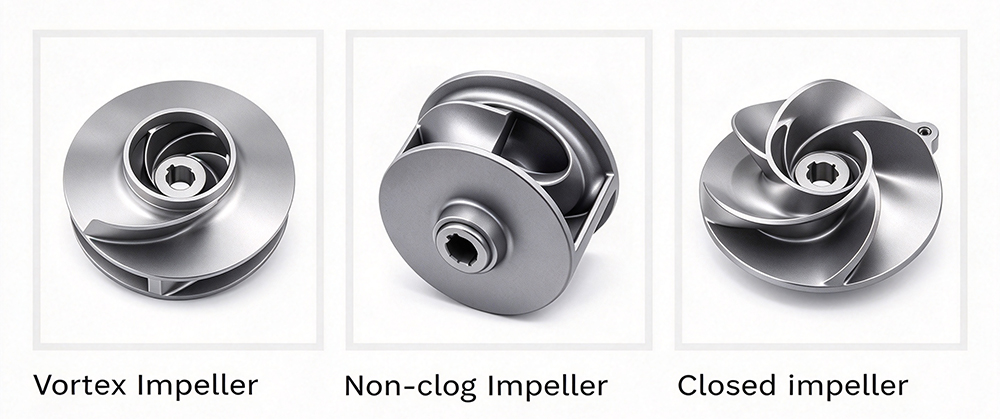
The impeller is where a sewage pump earns its keep:
- Vortex (recessed)— swirls most solids past without touching the vanes. Widest free passage, lowest clog risk, lowest efficiency.
- Channel / non-clog— a defined passage with a stated sphere size and better efficiency. The municipal default.
- Grinder (cutter)— hardened teeth shear solids into slurry before the impeller, so you can run a small-bore pressure main and reach much higher heads. Costs more power and adds a wear part.
What is a submersible pump?
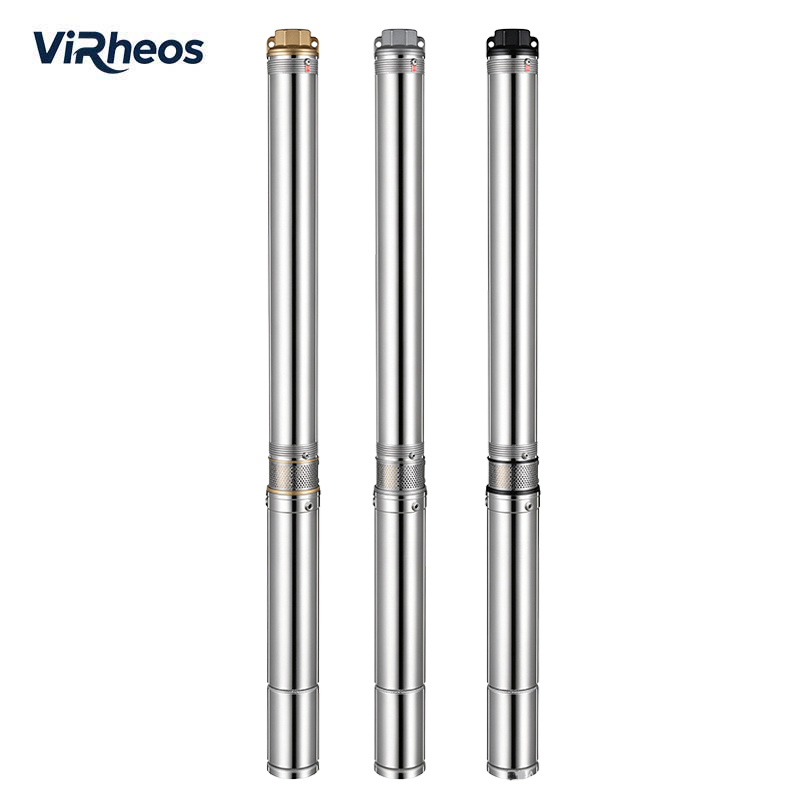
Defined purely by installation: motor and hydraulic end close-coupled into one sealed unit sitting *in* the liquid. It pushes rather than sucks, so there is no priming, no suction piping, no foot valve, no shaft alignment.
The advantages are real: no suction-side losses, quiet operation because the water damps vibration, flood-proof stations, and no pump room or ventilation to build.
The trade-off dominates the ownership experience: you cannot see it, and the liquid is the coolant. Everything depends on sealing. Serious submersible motors carry IP68 under IEC 60529 — dust-tight plus continuous immersion. Worth knowing: that standard does not fix a universal depth or duration for the “8”. It only requires conditions more severe than IP67 (1 metre for 30 minutes); actual depth and duration are declared by the manufacturer. A data sheet saying “IP68” with no depth and no time is incomplete — ask for the test report.
Behind the rating you will usually find tandem mechanical seals in an oil chamber, a moisture probe in the seal cavity, thermal switches in the stator windings and a compression cable-entry gland. Those are the difference between a 12-year pump and a 4-year pump.
Where the two labels actually diverge
| Sewage pump | Submersible pump (non-sewage) | Submersible sewage pump | |
| Defined by | What it pumps | How it is installed | Both |
| Liquid | Raw wastewater, soft solids | Clean or lightly dirty water | Raw wastewater, soft solids |
| Solids passage | 2 in residential; 3 in+ municipal | Not rated for solids | 2 in residential; 3 in+ municipal |
| Impeller | Vortex, channel, grinder | Closed/semi-open, efficiency-first | Vortex, channel, grinder |
| Typical duty | 30–60 GPM at 15–25 ft TDH | 8–20 GPM at 150–400 ft (4–6 in well) | 30–60 GPM at 15–25 ft TDH |
| Motor power | 0.5–1 HP residential | 0.5–2 HP residential well | 0.5–1 HP and up |
| Service access | Lift from the pit | Lift from the well or basin | Lift from the pit |
| Common mistake | Specified for clean water | Specified for toilet waste | Assuming “submersible” implies sewage duty |
Table 1 — How the three labels relate. The two right-hand columns are both submersible; only the far right is sewage-rated. *Typical duty figures from published residential pump specification tables and municipal pump station design manuals.*
Read the last row twice. “Submersible” tells you nothing about solids. A 4-inch submersible well pump is excellent engineering and it will bind solid the first time a washcloth reaches it.
The main types of sewage pump
Six families cover almost every sewage pump you will be quoted.
- Solids-handling submersible sewage pump. The residential default — 2-inch sphere, usually 0.5–1 HP, basin-mounted with a float switch. This is what a basement bathroom below the sewer line needs.
- Vortex / recessed impeller. Chosen when waste is unpredictable and clogging is the dominant risk — small commercial buildings, stations with a history of ragging. Efficiency is the price.
- Channel non-clog. The municipal workhorse: higher efficiency, defined sphere passage, and with back-swept vanes it handles a surprising amount of fibrous material.
- Grinder pump. For long force mains and small-diameter pressure sewers. Residential grinders deliver roughly 50–70 ft of head at rated flow, commercial units 130 ft or more, and because solids leave as slurry you can run 1¼–2 inch discharge. Expect more power — a grinder doing 60 GPM at 70 ft needs 1.5–2 HP where a non-clog pump at 60 GPM and 25 ft runs on 0.75–1 HP — plus blade inspection.
- Effluent pump. Not a sewage pump: it sits after a septic tank and moves screened liquid (¾ inch or finer) to a drain field.
- Self-priming sewage pump. Mounted above the liquid, primed once. You lose the quiet and gain a dry motor you can service without a crane. Popular for emergency bypass, construction dewatering and mobile units.
Where each one gets used
- Below-grade bathrooms and laundry— submersible sewage pump, 2-inch passage, gas-tight basin with its own vent.
- Septic systems— sewage pump ahead of the tank, effluent pump after it.
- Municipal lift stations— submersible non-clog pumps, usually duplex with duty/standby alternation and VFDs sized for peak wet-weather flow.
- Restaurants and commercial kitchens— fats, oils, grease and food solids. Specify a grinder or chopper; budget for more maintenance.
- Industrial effluent— material drives the decision: cast iron for standard sewage, high-chrome white iron for abrasive slurry, 316L or duplex stainless where chlorides are present.
- Clean water where “submersible” is the only requirement— wells, irrigation, stormwater, dewatering. A sewage-rated pump here is overspecification; a clean-water submersible in sewage duty is under-specification.
Standards worth asking about
You need not memorise these, but a supplier who cannot answer them is telling you something.
| Standard | What it governs |
| ISO 9906:2012 | Hydraulic performance acceptance tests — grades 1B/1E/1U (tightest), 2B/2U, 3B (broadest) |
| ANSI/HI 11.6 | Rotodynamic submersible pumps — mechanical and electrical acceptance tests; the pump is guaranteed and tested as a complete close-coupled unit |
| ANSI/HI 9.8 | Pump intake and wet-well design, to prevent vortexing and air entrainment |
| IEC 60529 | IP enclosure ratings — IP68 for continuous submersion, depth and duration declared by the manufacturer |
| NEMA MG1 / IEC 60034-30-1 | Motor design and efficiency classes (IE3, IE4) |
| NSF/ANSI/CAN 61 | Wetted parts in drinking-water service |
| FM / UL 674, 1207 | Hazardous (Class I, Group C/D) location listings |
Two details come up constantly. Motors that cannot be removed from the machine and tested separately — submersible pump motors among them — sit outside the IE3/IE4 obligation in the EU Ecodesign regulation, so an “IE3 submersible” claim needs checking against how it was tested. And municipal specs routinely ask for L10 bearing life of 50,000 hours, a 1.15 service factor, Class H insulation and 12–15 starts per hour. Silence on those is worth a question.
Buying guide: eight checks before you sign
Buying a sewage pump is mostly about the numbers on the curve, not the nameplate.
- Start with the fixtures, not the pump.If the group includes a toilet, you are in sewage-ejector territory by code — 2-inch solids, 2-inch minimum discharge, gas-tight and separately vented basin. Greywater only? A smaller drain pump is cheaper and cycles better.
- Size flow in GPM.Add drainage fixture units (toilet 4, shower 2, lavatory 1, laundry tub 2), or budget 20–45 GPM for a single-family basement.
- Calculate total dynamic head.Static lift plus friction; add roughly 30% to pipe length to cover the check valve, isolation valve and elbows. Worked example: 12 ft static plus about 2.3 ft friction on 60 ft of 2-inch pipe at 40 GPM gives 14.3 ft TDH — specify at 40 GPM against 15 ft.
- Check velocity.Keep discharge velocity at or above about 2 ft/sso solids stay in suspension. At 40 GPM, 2-inch Schedule 40 gives roughly 3.8 ft/s.
- Size the basin for cycling, not just volume.Starts per hour matters more than basin size. For 6 starts per hour at 40 GPM you need about 100 gallons of drawdownbetween float on and off levels. This is the number most often skipped, and it is why basement pumps burn out in three years — short cycling kills motors through starting current, not running hours.
- Choose materials for the liquid.Grey cast iron for standard sewage and most residential work; hardened high-chrome iron where sand and grit are present; 316L or duplex stainless for coastal, brackish or high-chloride service.
- Decide on controls.Float type (wide-angle tether needs basin room; vertical float suits tight basins), a high-water alarm independent of the pump control, and above residential duty, duplex with lead/lag alternation. One extra pump is cheaper than one emergency call-out.
- Price the life, not the box.Typical US residential quotes run roughly $350–$1,500 for a non-grinder unit and $1,100–$3,200 for a grinder, with installation and permits taking a straightforward replacement to about $1,200–$3,800and a complex grinder or high-head job to $3,400–$6,600. Weigh that against energy: purchase price is typically 2–5% of lifecycle cost while energy runs 60–85%. The cheapest unit on the shelf is rarely the cheapest to own.
Typical service life is 8–15 years, past 20 with good water, correct sizing and annual service, and 3–5 years with sand, dry running or chronic short cycling. Municipal stations with disciplined maintenance commonly report 12–20 years.
Using one: a short practical routine
Before first start. Clear the basin of debris. Check the float swings freely and cannot catch the wall or the discharge pipe. Fit a check valve, typically 12–18 inches above the discharge rather than screwed straight into the outlet. Use a dedicated GFCI-protected circuit sized for locked-rotor current.
First run. Fill the basin with clean water and watch one complete cycle. It should start crisply, run without a metallic grind and stop cleanly. Time it, write it down — that is your baseline a year from now.
Every day. Only flush the three Ps: pee, poo and paper. Toilet paper is engineered to break apart in water; wet wipes are not. UK Water Industry Research found wet wipes contribute to 94% of sewer blockages, costing water companies around £200 million a year to clear. The evidence is physical too: the 2017 Whitechapel fatberg under east London was a 250-metre, 130-tonne mass built largely from wet wipes, not fat.
Not sure whether something is safe? Put it in a jar of water, stir for 30 seconds, see if it falls apart. If it doesn’t, it doesn’t go down the toilet.
Every quarter. Pour clean water into the basin and confirm the pump starts and stops on its own. Check the intake. Listen.
Every year. Inspect the mechanical seal, check cable insulation and log running current against the nameplate. Rising amps at the same flow is the earliest honest signal of wear.
Frequently asked questions
Will a sewage pump handle toilet paper?
Yes — that is what the 2-inch solids rating exists for. Toilet paper is manufactured to break apart in water, and a properly sized sewage pump moves it without trouble. What it will not handle is the list behind most call-outs: wet wipes (including “flushable” ones), paper towels, feminine hygiene products, cotton swabs, dental floss, cat litter and cooking grease. Floss and wipes are worst because they wrap the impeller shaft instead of passing through. If wipes are a habit in the building, stop it — or specify a grinder sewage pump, and accept that a grinder moves maintenance from the impeller to the cutting assembly.
What is the major disadvantage of a submersible pump?
Access. The pump sits at the bottom of a pit, in the dark, in the liquid. You cannot glance at it on the way past, and you cannot service it in place — inspection means lifting the whole unit out, usually with a guide rail, chain or crane, often under a confined-space permit.
Two consequences follow. Failure is detected late, by symptom rather than sight. And maintenance cost is real: a widely cited survey of wastewater agencies found submersible pumps repaired 20–40% more often than dry-pit pumps, with a typical repair bill of $4,000–$8,000. The same survey put the submersible motor roughly 8% below a conventional dry-well motor, netting about 7% in system efficiency once you credit the submersible for having no suction piping.
None of that makes submersible wrong. It makes a high-water alarm, a logged amp baseline and a spare-parts plan the right companions to it.
What are the common problems with submersible water pumps?
Roughly in order of frequency: seal failure and water ingress into the motor; overheating from dry running or low flow past the motor; clogging from wipes, rags and fibrous material; cable damage at the entry gland or from abrasion; short cycling from an undersized basin or leaking check valve; sand wearing the impeller; and electrical faults — low voltage, phase imbalance, bad capacitor. On three-phase units, reverse rotation after any work on the supply is a classic destructive one.
Nearly all are prevented by the same three things: correct sizing of the sewage pump, a basin that limits starts per hour, and an annual inspection that logs current draw.
What is the average lifespan of a submersible pump?
Plan on 8–15 years in normal residential service. Well-sized, well-maintained units in clean water routinely reach 15–20 years; lift station pumps with preventive maintenance and duty/standby rotation commonly report 12–20 years.
Harsh conditions cut hard. Sand and grit is the biggest killer and can shorten life to 2–5 years; short cycling, running dry and voltage problems are close behind. Stainless construction buys years over plain cast iron in aggressive or chloride-bearing water.
Practical rule: treat year 10 as the point where you plan replacement on your own schedule rather than waiting for it to fail at 2 a.m.
What are the signs that a submersible pump is going bad?
- Rising running current at the same flow and head — the earliest measurable sign.
- Longer run times for the same job — the pump is losing efficiency.
- More frequent starts, or the float behaving inconsistently.
- Breaker trips or thermal cut-outs, especially if intermittent at first.
- New noises— grinding, or the gravel rattle of cavitation.
- Air sputtering at fixtures, or a drop in delivered pressure.
- Sand or grit in the water.
- Moisture or seal-leak alarm, or milky oil in the seal chamber.
- A higher electricity bill with no change in usage.
Numbers 1, 2 and 9 are the ones to catch early — they appear months before anything dramatic and turn an emergency replacement into a scheduled one.
The bottom line
“Sewage pump versus submersible pump” is a false argument, and treating it as one is how projects get mis-specified. Ask the two real questions separately — does it need to pass solids, and does it need to sit underwand basin drawdown doing the actual selecting.
ater — and the answer usually lands on a submersible sewage pump, with solids size, duty point Get those three right, insist on a sewage pump tested as a complete unit to a recognised standard, and plumb in the check valve, the alarm and the maintenance log. That is most of the difference between a pump that quietly works for fifteen years and one that floods a finished basement in year four.
Next step: send your supplier the fixture list, static lift, pipe run and available drawdown volume — not a horsepower guess — and ask for a certified curve at your duty point. If they cannot produce one, keep looking.
References
1.Title: Development of Sewage Pumps with Numerical and Experimental Support
Abstract: Sewage pump impeller design balances efficiency and resistance to fibrous clogging. This work optimises a two-channel semi-open impeller via CFD and laboratory testing, comparing geometric modifications to reduce ragging while retaining acceptable hydraulic performance for raw wastewater service.
2.Title: Influence of hydraulic components wear on the performance of a sewage pump
Abstract: Wear on sewage pump flow parts gradually degrades hydraulic efficiency. This study uses 3D scanning, simulation and bench tests on an aged centrifugal sewage pump; replacing worn impeller and shroud seal recovers head, volumetric and hydraulic efficiency significantly.
Abstract: “Flushable” wet wipes disintegrate far slower once snagged in sewers. The paper quantifies poor dispersion under real sewer conditions and argues current testing standards overestimate breakdown, explaining why wipes drive pump and sewer blockages.