
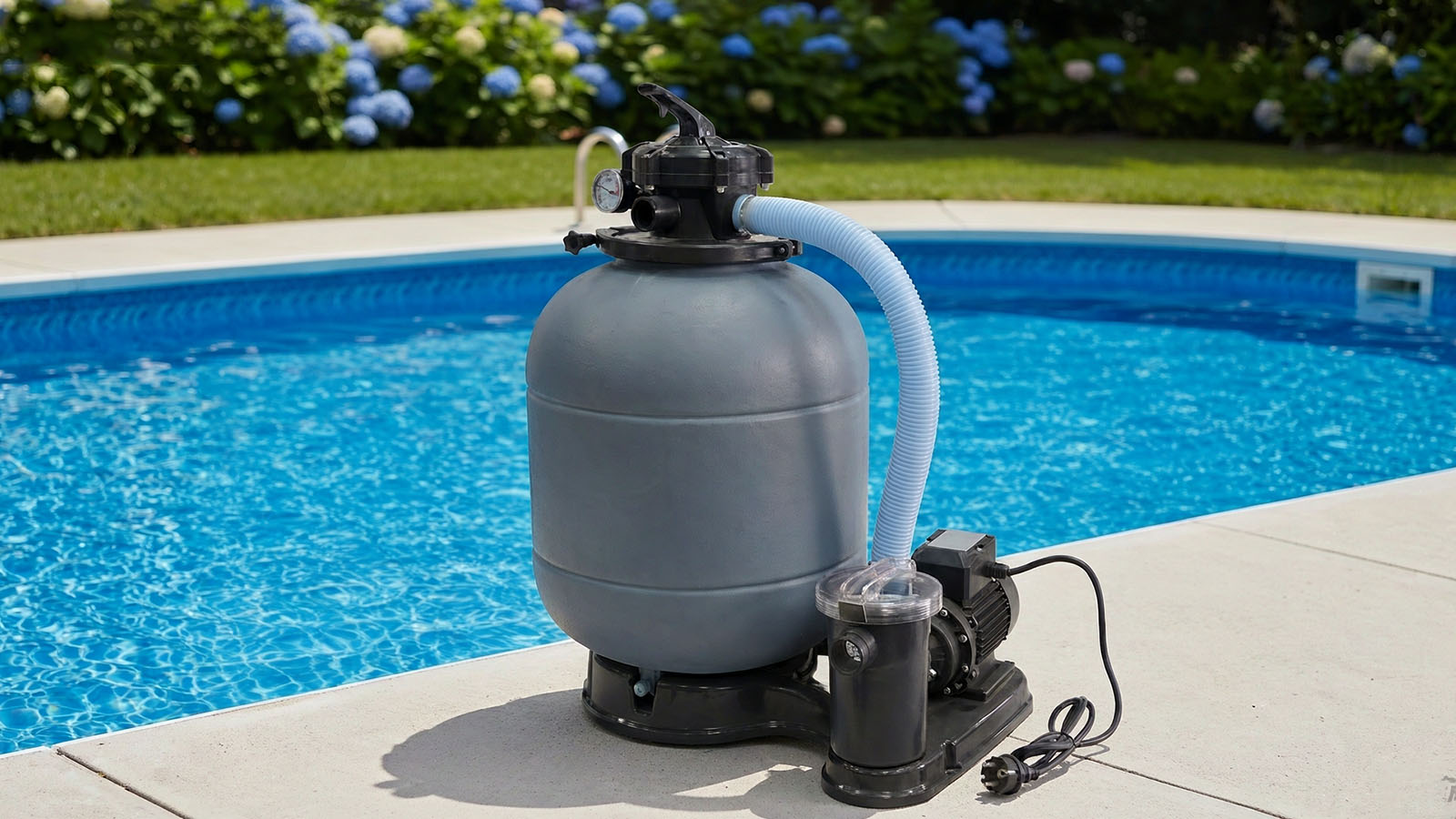
How Do Sand Filter Pumps Work? A Complete Working Principle Guide
A sand filter pump is the piece of equipment that stops a pool from turning green. The job sounds simple — pull water out of the pool, push it through a bed of sand, send it back clean — and then repeat that several thousand times a season.
Right up until the gauge creeps up, the jets go weak, and the water looks flat. This guide is for the people who specify, buy or service sand filter pumps: contractors, hotel engineers, facility managers, distributors and OEM buyers. It covers the working principle, the main types, the standards that matter when importing, sizing with real numbers, and a maintenance routine that fits on one page.
What Is a Sand Filter Pump?
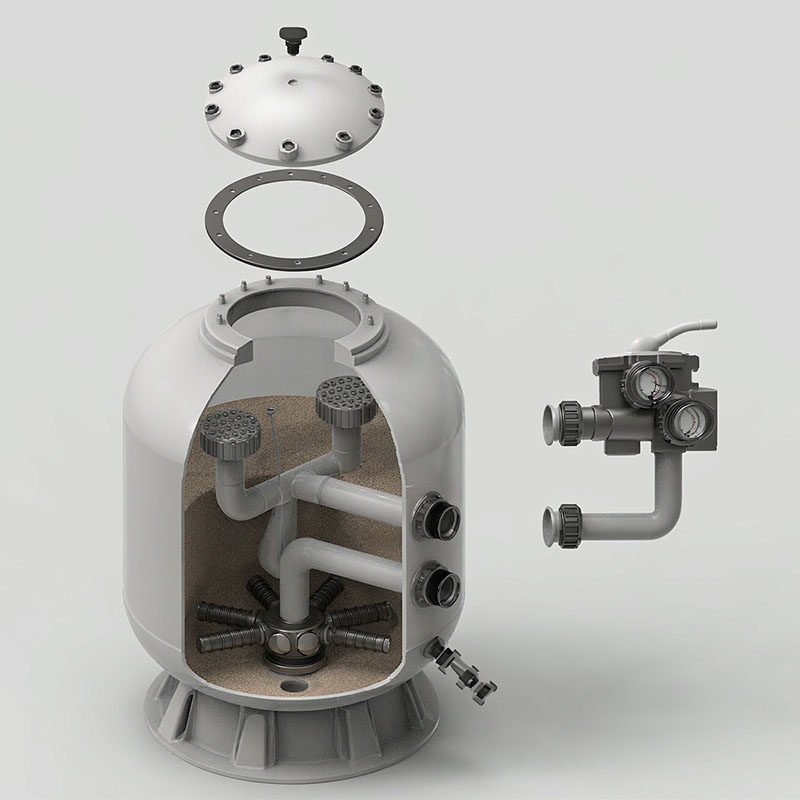
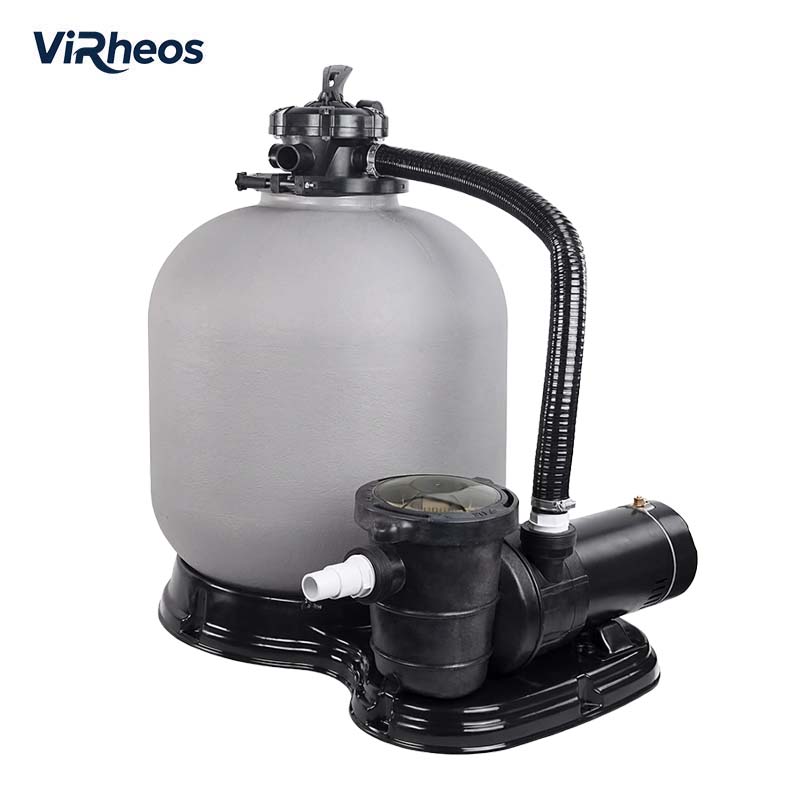
Sand filter pumps are really two machines sold as one system: the pump creates flow, the tank holds the sand that does the cleaning. They must be hydraulically matched — most field problems blamed on “a bad filter” are a mismatch between pump curve and filter rating. Five parts do the work:
- Pump and strainer basket. Draws water from skimmer and main drain; the basket catches leaves, hair and grit first.
- Filter tank. A pressure vessel in moulded FRP or polyethylene for residential units, steel for commercial plants, filled to about two-thirds height.
- Filter media. Pool-grade silica sand, graded #20, effective grain size about 0.45–0.55 mm. Grains are angular, not rounded; the gaps between them are the filter.
- Laterals and standpipe. Slotted arms at the bottom that pass water but hold sand — the usual culprit when sand reaches the pool.
- Multiport valve and gauge. The valve selects Filter, Backwash, Rinse, Waste, Recirculate or Closed; the gauge says in one number how loaded the bed is.
One clarification that saves confusion in an RFQ: a sand filter pump does not pump sand. The media stays in the tank and is only loosened during backwashing. Knowing which of the five parts above is failing is most of the diagnosis work on site.
How Sand Filter Pumps Work: The Cycle Step by Step
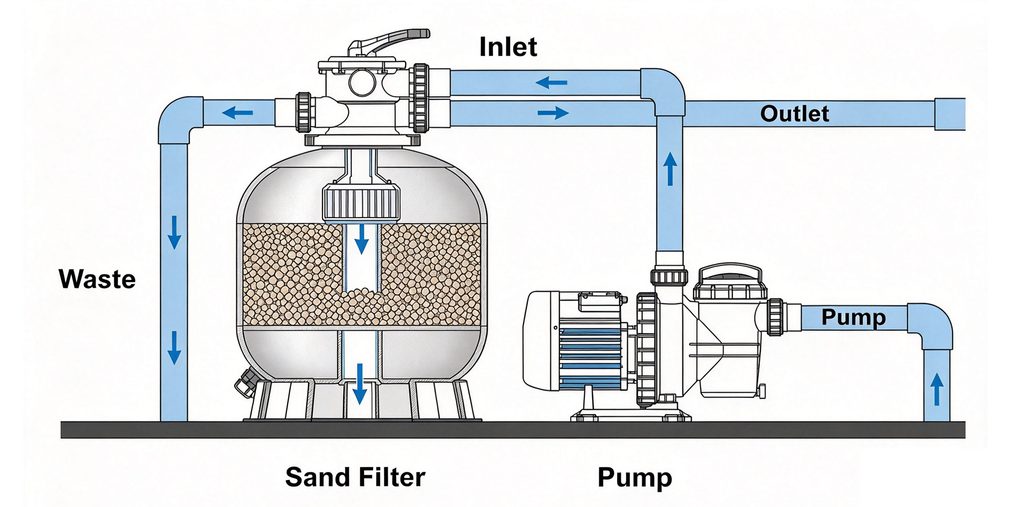
Filtration is a closed loop — water leaves the pool, passes through the system, comes back. Between those two points:
- Water is drawn from the surface through the skimmer and from the floor through the main drain. A clogged basket shows up at once as lost flow.
- The pump basket removes coarse debris.
- Pressurised delivery. The impeller turns motor rotation into flow and pressure and pushes water into the top of the tank.
- A diffuser spreads water evenly over the bed. Without it, the inlet jet digs a channel and unfiltered water short-circuits to the outlet.
- Depth filtration. Water percolates down through the sand. Oversized particles are strained out; finer ones cling to grain surfaces, and the trapped layer — the filter cake — starts catching finer material than clean sand could.
- Clean water reaches the laterals, rises up the standpipe and exits through the valve.
- Water re-enters through the jets, aimed to circulate the whole pool so no corner stagnates.
That loop repeats until the whole pool volume has passed through once. That is a turnover, and turnover time is the number that sizes the equipment.
One detail surprises first-time buyers: a slightly dirty bed filters better than a freshly backwashed one, because the filter cake does real work. That is why experienced operators backwash on pressure, not on a calendar.
Backwashing: How the System Cleans Itself
As the bed loads up, resistance rises and the gauge climbs. The trade rule is to backwash at 8–10 psi (0.55–0.7 bar) above the clean reading logged after the last backwash — typically a trigger near 20–25 psi on a system that starts clean at 10–15 psi.
- Pump off. Never move a multiport handle while it runs — the spider gasket tears.
- Valve to Backwash, waste line aimed somewhere that can take the discharge, restart.
- Run 2–3 minutes, or until the sight glass runs clear.
- Pump off, turn to Rinse, run 30–60 seconds to re-settle the bed and keep fine sand out of the pool.
- Pump off, back to Filter, restart, and log the new clean pressure.
A residential backwash sends roughly 200–500 gallons (0.75–1.9 m³) to waste, so the pool needs topping up. In drought-restricted regions that water use is a real selection factor — the honest trade-off against cartridge filtration, which never backwashes.
What Sand Filter Pumps Actually Do
- Remove suspended solids. In service, sand filter pumps capture down to roughly 20–40 microns — silt, pollen, most algae, and the haze that makes water look dull.
- Distribute chemicals. Filtration is the delivery mechanism for chlorine and pH correction. Good chemistry with poor circulation still leaves algae in the far corners.
- Skim the surface. The circulation loop pulls floating debris into the skimmer. Switch the pump off for a week in summer and you see how much of a clean pool is just movement.
- Protect downstream equipment. Heaters, salt chlorinators and UV or ozone units sit after the filter and have flow switches; stable flow stops them tripping.
What they do not do: sand filtration alone does not make water safe — disinfection does. Public health guidance is blunt: sand media removes particles above roughly 25 microns while chlorine-tolerant organisms sit at 4–6 microns, so filters are specified inside a treatment train with sanitiser and, in commercial venues, often a flocculant programme or UV or ozone (Pennsylvania Department of Health filtration guidance; CDC Healthy Swimming materials).
Types of Sand Filter Pumps
Suppliers slice the category in different ways, but for anyone buying sand filter pumps five distinctions actually change what goes on the order.
1. Top-mount vs. side-mount
Top-mount units carry the multiport valve on the lid — compact, cheaper, serviced from above, and the default for pools up to about 100 m³. Side-mount units put the valve on the tank wall, which lowers overall height for tight plant rooms and gives access through a top manhole; they are the usual choice from 600 mm tank diameter upward.
2. Standard-rate vs. high-rate
Standard-rate beds run at about 10–12 gpm per square foot of bed area; high-rate designs are rated up to about 20 gpm/ft². High-rate tanks are smaller for the same flow, saving space and upfront cost, at the price of shorter contact time, more frequent backwashing and higher pressure. On a hotel plant running 16 hours a day, standard-rate usually wins on lifecycle cost.
3. Component systems vs. integrated skids
Large venues use horizontal or vertical steel tanks, often in banks of two to six with face piping and a shared backwash line, specified against public health codes and run by trained operators. At the other end, above-ground and small pools use a combined skid — pump, tank, valve and base as one package, typically 0.25–1 HP with 25–75 litre tanks — which removes the guesswork from matching pump to filter.
4. Single-speed, two-speed, variable-speed
Single-speed pumps are cheap and hard to justify. Power draw falls with the cube of speed, so halving speed cuts energy to about one-eighth — the affinity law US EPA ENERGY STAR quotes. It rates certified in-ground pumps at about 20% less energy than a standard model, roughly $50 a year, and cites up to 70% savings when replacing older single-speed units; Australian retrofit trials measured 50–70%. Above four hours a day, variable speed is the default.
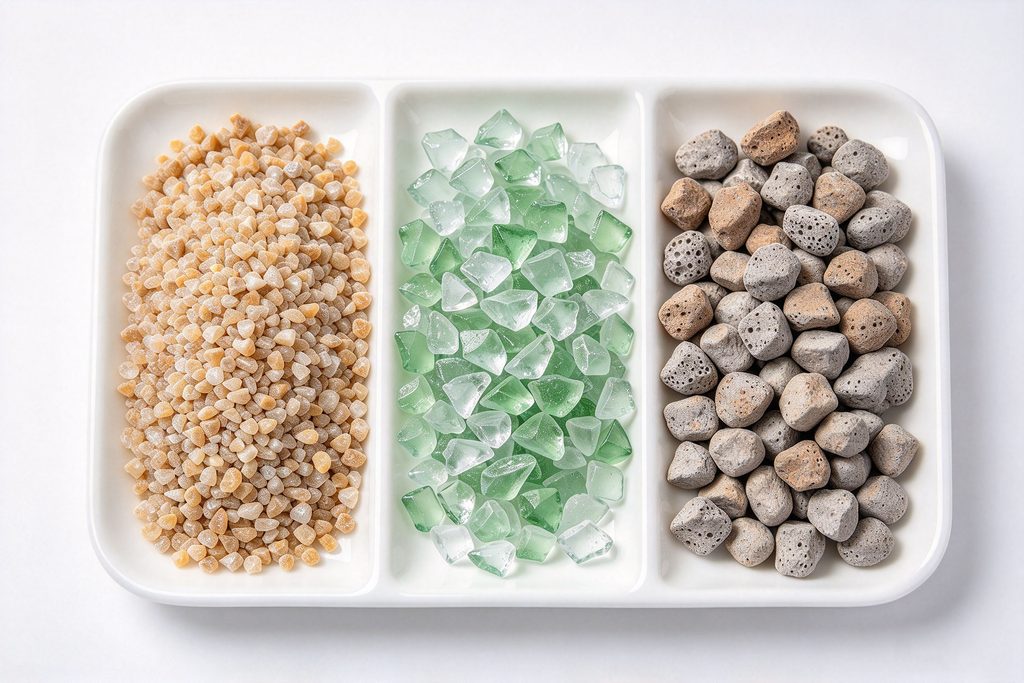
5. Silica sand vs. alternative media
Recycled glass and zeolite are drop-in upgrades that filter finer and need less frequent backwashing. They cost more per kilogram but cut water use, and the working principle is unchanged — only grain shape and surface charge differ.
Where Sand Filter Pumps Are Used
Swimming pools are the obvious home for sand filter pumps, but the same equipment turns up well beyond the backyard.
- Residential pools — the core market, and the one most sensitive to noise, footprint and price.
- Hotels, resorts and apartment complexes — duty cycles of 12–18 hours, high bather loads, turnover records. Redundancy matters more than price.
- Public pools, water parks and leisure centres — turnover is a compliance metric. The CDC Model Aquatic Health Code (5th edition, 2024) sets reference maximum turnover times of six hours for most pools, two hours for activity pools, one hour for wading pools and 30 minutes for spas; local health departments adopt these in whole or in part.
- Spas and hot tubs — small volumes, very short turnover targets, hotter water, so material compatibility gets checked harder.
- Aquaculture, hatcheries and irrigation — pond, canal or cistern water carries silt that blocks drippers and nozzles. A sand filter pump ahead of the header is standard farm practice: same machine, coarser strainer.
- Cooling tower sidestream and process water — keeps solids down so heat exchange surfaces stay clean.
Granular media stays dominant: industry tracking puts sand filters near 60% of the pool filtration device segment by product type, with residential use around 85% of demand (YH Research, 2025 market study). Not superior performance — robustness, low skill requirement, a price that survives value engineering.
Standards and Certifications Worth Checking
Standards are where B2B purchases of sand filter pumps quietly go wrong: a unit can work perfectly and still be unsellable because the paperwork does not line up. The short list below belongs in an RFQ.
Table 1. Standards and certification reference for sand filter pumps
| Standard / scheme | What it covers | What to ask the supplier for |
| NSF/ANSI 50 (US) | Materials health, corrosion resistance, structural and flow testing for pool and spa equipment, including granular media filters and filter media. | Listing number, listed model numbers, and confirmation the certificate covers the production batch. |
| CDC Model Aquatic Health Code, 5th ed. (2024) | Voluntary US model code. Sets reference turnover times by venue type and requires third-party certification to NSF/ANSI 50 for granular media filters, filter media and flow meters. | Evidence the selected model meets the local authority’s turnover requirement at the site’s real system head. |
| EN 16713 series + CE marking (EU) | European standards for domestic pool water systems covering circulation, filtration and treatment; CE marking is required to place equipment on the EU market. | EU Declaration of Conformity, applicable directives, and the EN test reports behind them. |
| IEC 60034-30-1 + EU ecodesign | Motor efficiency classes (IE1 to IE5) and minimum efficiency requirements for water pumps placed on the EU market. | IE class or energy index of the motor, plus ecodesign compliance documentation. |
| RoHS / REACH | Restriction of hazardous substances and chemical registration for the EU market. | Material declarations for plastics, coatings, seals and control boards. |
| ISO 9001 / ISO 14001 | Factory quality and environmental management — not product performance, but a proxy for batch-to-batch consistency. | Current certificate scope, issuing body, and a site address matching the shipping factory. |
Buying Guide: Sizing and Selecting Sand Filter Pumps
Step 1. Work out the flow you need
Required flow = pool volume ÷ target turnover time. A 65 m³ (17,200 gallon) pool on eight hours needs 65 ÷ 8 = 8.1 m³/h, about 36 gpm. Everything else is built on that number.
Step 2. Check the filter can accept it
Divide required flow by bed area. A 500 mm tank has about 0.20 m² (2.1 ft²), so 8.1 m³/h lands near 17 gpm/ft² — inside the high-rate band. Through a 400 mm tank you are above 22 gpm/ft²: higher pressure, shorter cycles, hazier water. Unlike pumps, an oversized filter is never a penalty.
Step 3. Match the pump to the system, not the pool
Pumps deliver whatever the plumbing allows, so read the curve at total dynamic head — lift, friction, filter and heater resistance, elevation. Residential installs land at 8–15 m; a pump rated 12 m³/h at zero head may give 7 m³/h on a real roof plant. That gap is how undersized systems get specified. Also confirm the backwash flow required, since fluidising a bed needs a genuine surge.
Two sand filter pumps with identical flow ratings can differ by years of service life. The details below are what separate them.
Step 4. Check the details that decide lifetime cost
- Tank material and pressure rating, and whether it is rated for spa temperatures.
- Motor efficiency class, and whether the variable-speed drive is integrated or add-on.
- Local spares: spider gaskets, laterals, gauges.
- Certification for the destination market — check model numbers on the certificate, not just the factory.
- Warranty on the tank shell. It is the part that fails years later, not months later.
Table 2. Sizing reference: matching pool volume to tank and pump
| Pool volume | Turnover target | Required flow | Typical tank diameter | Indicative pump power |
| 40 m³ / 10,600 gal | 8 h | 5.0 m³/h / 22 gpm | 400 mm | 0.37 kW / 0.5 HP |
| 65 m³ / 17,200 gal | 8 h | 8.1 m³/h / 36 gpm | 500 mm | 0.55 kW / 0.75 HP |
| 95 m³ / 25,100 gal | 8 h | 11.9 m³/h / 52 gpm | 600 mm | 0.75 kW / 1.0 HP |
| 150 m³ / 39,600 gal | 6 h | 25.0 m³/h / 110 gpm | 900 mm | 1.50 kW / 2.0 HP |
| 250 m³ / 66,000 gal | 6 h | 41.7 m³/h / 184 gpm | 1200 mm | 2.20 kW / 3.0 HP |
A Worked Example
A 120 m³ apartment pool on a 1.5 kW single-speed pump running eight hours a day: 12 kWh per day, roughly 4,380 kWh a year.
The same pool on a variable-speed unit at 1,450 rpm for 12 hours (about 0.28 kW) plus 20 minutes at 2,850 rpm for backwash (about 1.3 kW): 3.36 + 0.43 ≈ 3.8 kWh per day, about 1,390 kWh a year.
That is close to a 68% cut in pump energy for more circulated water — in line with the up-to-70% figure ENERGY STAR quotes against older single-speed equipment. At commercial tariffs it pays back inside two years, and lower speed means less noise, which in a residential complex is often the complaint that triggers the purchase.
Operating Sand Filter Pumps: A Simple Routine
Most warranty claims on sand filter pumps trace back to three habits: moving the valve under pressure, never logging clean pressure, and never changing the sand. The routine below avoids all three.
Start-up
- Confirm the valve is on Filter and fully seated; open the tank air relief and close it once water runs steady.
- Fill the strainer housing with water, secure the lid, open all suction and return valves.
- Start and let it prime. No prime in two minutes means stop and hunt the suction-side air leak.
- Write the clean pressure on the tank — that is your backwash trigger all season.
Weekly
- Empty skimmer and pump baskets; a half-blocked basket costs more flow than expected.
- Read the gauge and backwash at 8–10 psi above clean.
- Keep water at mid-skimmer height; low water pulls air.
Seasonal
- Change the sand every 3–5 years. Grains round off, the bed channels, and quality drops though the sand looks clean. Backwashing will not fix it.
- In freezing climates, drain pump, tank and exposed pipework or the first frost splits the vessel.
- Inspect the laterals whenever sand is changed — cracks are the usual reason sand reaches the pool.
Quick troubleshooting
- Pressure high after backwashing — aged or channelled media, or a blocked lateral. Usually means new sand.
- Sand in the pool — cracked lateral, wrong grain size, or the rinse step skipped.
- Cloudy right after backwash — rinse missed, or the bed has not re-settled.
- Repeated loss of prime — air on the suction side: lid o-ring, low level, cracked line.
- Weak return flow with a normal gauge reading — blockage after the filter, or a valve not fully open.
Frequently Asked Questions
- How many hours a day should sand filter pumps run?
- Long enough for one full turnover daily — typically 6–10 hours for a residential pool, more during heat waves, heavy use or after storms. Running longer at low speed costs less than running shorter at full speed.
- Can sand filter pumps run 24 hours a day?
- Yes, and on a variable-speed unit at low rpm it is often cheaper than eight hours at full speed. On a single-speed pump it is expensive and rarely necessary, though commercial venues bound by health-code turnover limits may have no choice.
- What size sand filter pump do I need for a 50,000-litre pool?
- 50 m³ at eight hours is 6.25 m³/h, about 28 gpm — a 450–500 mm tank and roughly 0.5 HP at typical residential head. Go up a size if the pool is heated, has long pipe runs, or sits in full sun.
- Do sand filter pumps remove bacteria?
- Not reliably on their own. Sand media removes particles above roughly 25 microns, while chlorine-tolerant organisms are 4–6 microns. That gap is why filters are always paired with disinfection, and why commercial venues add flocculants or UV and ozone when pathogen risk rises.
- How often should the sand be changed?
- Every 3–5 years in normal residential service, sooner on heavily loaded commercial pools. Tired media shows up as short cycles between backwashes, pressure that stays high after backwashing, and water that will not clear despite decent chemistry.
- Why is my pool still cloudy after backwashing?
- Usually a skipped rinse step — or the problem is chemistry, not filtration. Check sanitiser and pH first, then confirm the cycle actually ran Backwash, Rinse, Filter in that order.
Bringing It Together
Sand filter pumps have stayed the default for decades because the principle is forgiving: graded sand, water pushed through under pressure, a backwash that resets it. Little about that needs to change. What has changed is everything around it — variable-speed motors invert the running-cost equation, health codes turn turnover into a documented number, and certification decides which markets a model enters at all.
Treat them as a commodity and you still get a working system; you just pay more to run it and replace it sooner. If you are specifying one, send a manufacturer four numbers rather than a model number: pool volume, target turnover time, available power supply and an honest estimate of total dynamic head. A competent engineering team returns a matched selection, the required backwash flow and the certification package for your market — and you avoid the mismatch behind most of the problems above.
References
Abstract:Lab sand filter trials examine algae removal efficiency under fixed filtration velocity; sand grain size strongly controls capture rate and head loss.
2.Title: Comparing crushed recycled glass to silica sand for dual media filtration
Abstract:Field comparison of recycled glass versus silica sand media; silica sand delivers marginally better fine-particle removal than crushed glass over six months.