
What Size Pool Pump for a 25,000 Gallon Pool? HP & GPM Chart
Ask ten sources what size pool pump a 25,000-gallon pool needs and you will get the same answer almost every time: “1.5 HP.” Some say 2 HP. Almost none of them explain where the number comes from, and that is a problem, because horsepower alone does not tell you how much water a pump will actually move in your yard.
Here is the honest short answer. A 25,000-gallon pool needs a pump capable of roughly 35 to 70 gallons per minute against the resistance your plumbing presents. On typical residential plumbing that points to a 1.5 HP variable-speed pool pump, which can cover the whole range by changing speed rather than by being oversized at a single speed. The GPM figure is what matters. Horsepower is only the rough label attached to it.
This guide explains where that range comes from, shows the full HP and GPM chart, and walks through the three checks that decide whether the pool pump you are about to buy is the right one.
Where the 35–70 GPM Range Comes From
Pool pump sizing is not guesswork. It is also not really about horsepower. The governing residential standard, PHTA-5 Standard for Residential Inground Swimming Pools (effective 2024-11-01), sets the filtration flow window in terms of turnover time[1]:
- Maximum filtration flow rate:the rate that would turn the pool volume over in six hours, or 36 GPM, whichever is greater. Mathematically, pool volume ÷ 360.
- Minimum filtration flow rate:the rate that turns the pool over in twelve hours.
- The standard adds that lower filtration flow rates and longer filtration times are encouraged, because they produce energy savings.
For 25,000 gallons that works out cleanly:
- Maximum: 25,000 ÷ 360 = 4 GPM
- Minimum: 25,000 ÷ 720 = 7 GPM
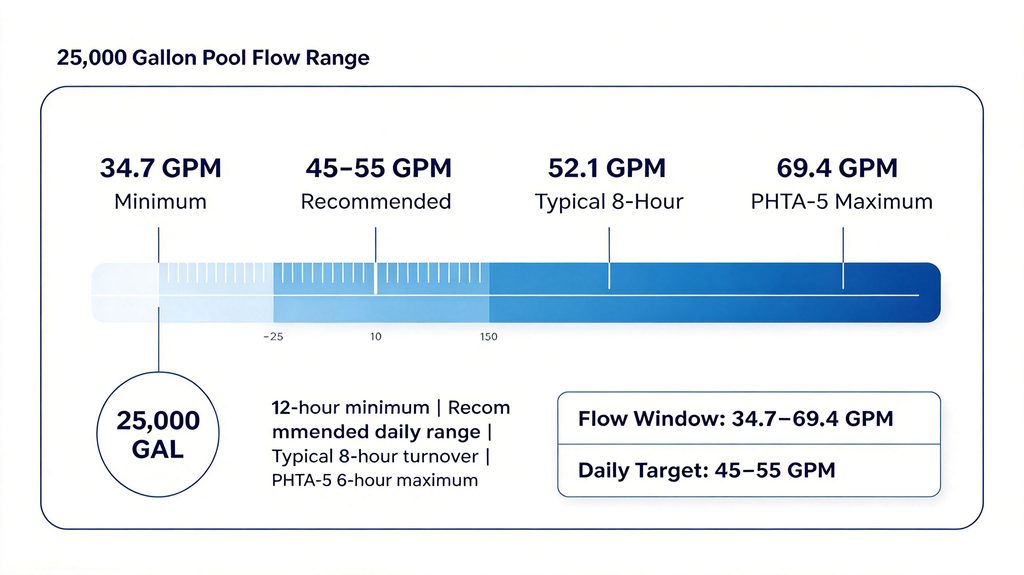
So the legitimate design window for a 25,000-gallon residential pool is 34.7 to 69.4 GPM. Anything inside that band meets the standard. Above it, you are oversized by definition, and the standard nudges you toward the lower half anyway.
That one calculation is more useful than any horsepower chart, and very few competing pool pump guides mention it.
The HP & GPM Chart for a 25,000 Gallon Pool
Table 1 — Turnover target, required GPM, and the horsepower class that gets you there
| Turnover target | Required GPM | Typical HP class* | Daily run time | Best suited to |
| 12 hours (standard minimum) | 34.7 | 0.75–1.0 HP | 12 h | Overnight low-speed filtration; lowest energy use; quietest |
| 10 hours | 41.7 | 1.0 HP | 10 h | Variable-speed pump at medium-low RPM |
| 8 hours (residential default) | 52.1 | 1.5 HP | 8 h | Standard filtration, plus solar or a heater in the loop |
| 6 hours (PHTA-5 maximum) | 69.4 | 2.0 HP | 6 h | Heavy bather load, pool/spa combos, fast recovery after storms |
*HP classes assume typical residential total dynamic head of roughly 40–55 ft on 2-inch plumbing. Your actual flow comes from the pump curve, not the nameplate. See the next section.
Two practical ceilings sit on top of this table, and they override whatever the pool pump nameplate says:
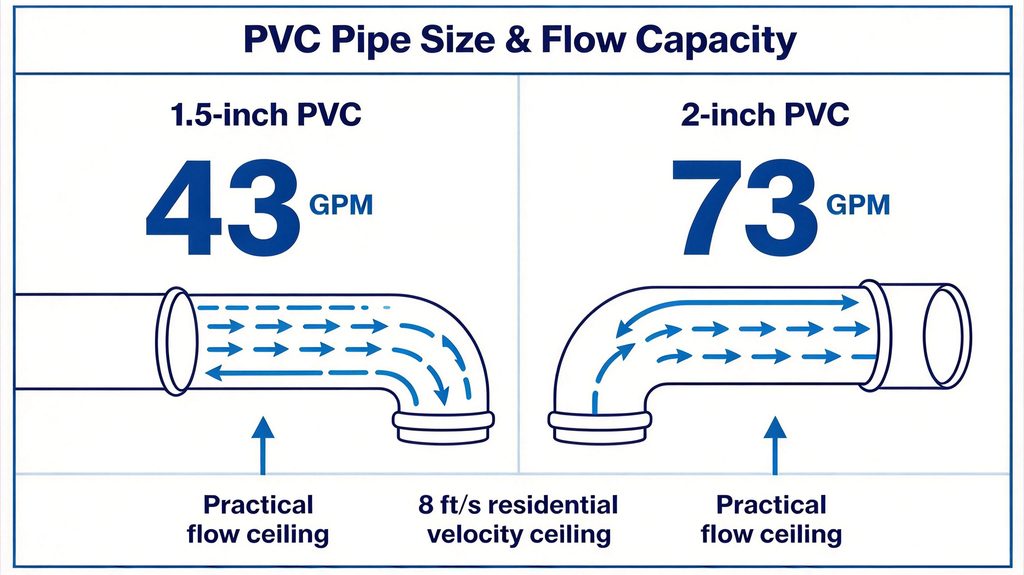
- Pipe size.At the 8 ft/s velocity ceiling used in pool circulation codes, 1.5-inch PVC carries roughly 43 GPM and 2-inch PVC roughly 73 GPM. A 2 HP pump on 1.5-inch plumbing cannot deliver its rated flow, no matter what the box says.
- Filter rating.The filter’s maximum rated flow must exceed the pump’s operating flow. PHTA-5 requires filters to be at least the size specified in NSF-50 for the maximum flow through them[1].
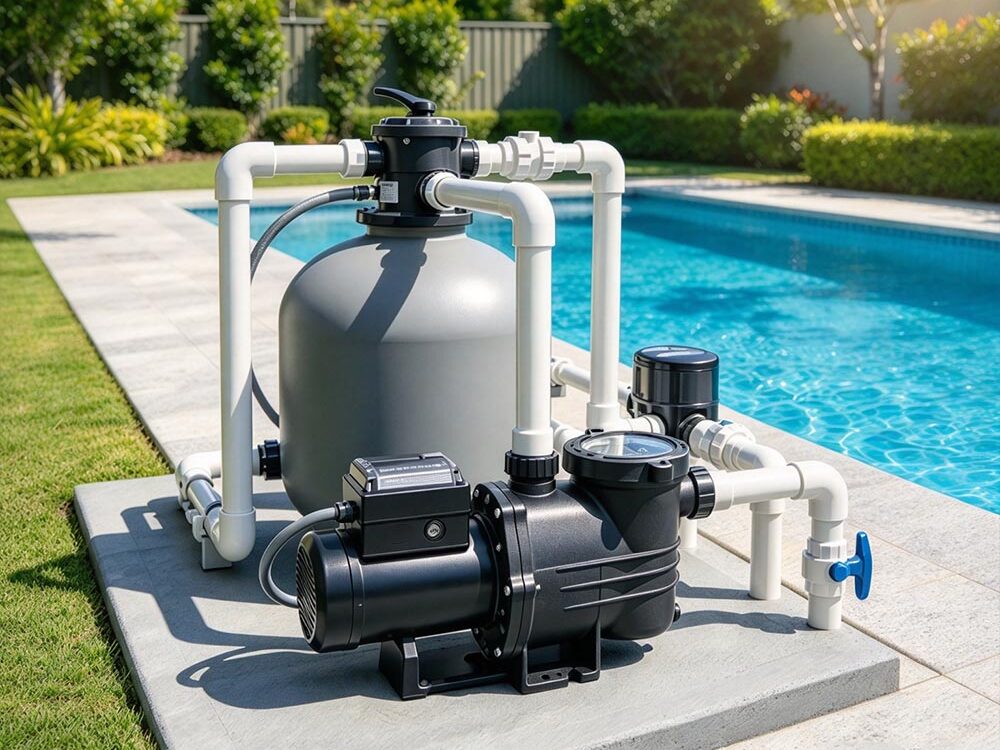
Where those three overlap — turnover window, pipe capacity, and filter rating — you find your real operating range. For most 25,000-gallon pools with 2-inch plumbing and a properly sized filter, that range lands between about 40 and 70 GPM, which is exactly why a 1.5 HP variable-speed unit is the usual recommendation.
Why Horsepower Is the Wrong Question
Horsepower describes the motor on a pool pump, not the water it moves.
Two pumps both labelled “1.5 HP” can behave very differently once they are plumbed in. One might deliver 65 GPM at 30 feet of total dynamic head; another might deliver 40 GPM at 60 feet. Same nameplate, completely different machine in your equipment pad. The difference is the pump curve — a chart showing how much flow that pump produces at each level of system resistance.
Total dynamic head is the resistance your pump fights. It comes from four places:
- Static lift— how far the pump has to raise water, which matters a lot if the equipment pad sits above the pool or you have solar panels on the roof.
- Pipe friction— longer runs, more elbows, and narrower pipe all increase it. Friction rises sharply with flow, so a bigger pump makes the problem worse.
- Equipment— the filter, heater, chlorinator, and any cleaner in the loop each add resistance. A dirty filter can add 15–25 feet on its own.
- Fittings and valves— every elbow, tee, and partially closed valve is resistance.
So the right way to read a datasheet is to find your required GPM on the horizontal axis, follow it up to your estimated head, and see which curve passes through that point. Skip this and you are buying a label rather than a flow rate.
Three Checks Before You Buy
- Confirm your turnover GPM.Divide your pool volume by your target turnover hours, then by 60. This is the number your pool pump has to hit. For 25,000 gallons and 8 hours: 25,000 ÷ 8 ÷ 60 = 52.1 GPM. Check that this sits inside the 34.7–69.4 GPM window.
- Check the filter’s maximum flow.This is the constraint people forget most often. A sand filter rated at 60 GPM cannot absorb a pump pushing 70 GPM, and the result is short filter cycles, media disturbance, and poor water clarity. As a rule, the filter’s maximum rated flow should be at least 20% above your intended operating flow.
- Check your pipe size honestly.Measure it. Plenty of pools running a 2 HP pump are plumbed with 1.5-inch pipe, which caps the whole system near 43 GPM. The extra horsepower is being paid for twice: once at purchase, then every month on the power bill.
If you have a heater, solar panels, a spa spillover, or a pressure-side cleaner, add their requirements before finalizing. Those features usually push the required flow toward the upper half of the window.
Single-Speed, Two-Speed, or Variable-Speed?
For a 25,000-gallon pool this decision matters more than the horsepower number, because it changes what the pool pump costs to run by hundreds of dollars a year.
A pump’s flow rises in step with its speed, but the power it draws rises much faster. Halve the speed and the electricity drawn falls to a small fraction of what it was. That is the whole argument for running a pool pump slowly for longer instead of flat out for a short burst. It is also why a variable-speed pool pump can filter for twelve hours at low RPM and still cost less to run than a single-speed unit doing the same job in eight hours.
Table 2 — What the pump type actually saves: three independent measurements
| Pump type | How it runs | Energy vs single-speed | Measured annual saving | Payback | Source |
| Single-speed | One speed, always full | Baseline | — | — | — |
| Two-speed | High / low switch | Lower on the low setting | 2,300 kWh and $280 per year | 0.8 years | ENERGY STAR |
| Variable-speed | Programmable across a wide RPM band | 60% less | 2,800 kWh and $340 per year (national average); 5,821 kWh per home (Texas utility program, FY2024) | 1.6 years | ENERGY STAR; CPS Energy FY2024; Focus on Energy 2024 |
The spread between those last two figures is worth understanding rather than smoothing over. ENERGY STAR’s national average is 2,800 kWh per year[4]. CPS Energy’s FY2024 evaluation measured 5,821 kWh per residence across 30 participating homes, more than double, because Texas pools run longer hours through a longer cooling season and because the units being replaced were often badly oversized[2]. Wisconsin’s statewide program puts the saving at 60% against a single-speed unit[3]. All three are correct for their context. If you live somewhere hot and run your pump ten months a year, expect to land nearer the higher figure.
Variable-speed pumps are also the practical answer to the sizing problem itself. A single-speed pump has to be sized for your worst-case flow and then lives there permanently. A variable-speed pool pump can run at 1,200 RPM for overnight filtration and jump to 3,000 RPM when you vacuum or backwash, which means one machine covers the entire 34.7–69.4 GPM window instead of forcing you to pick a point on it.
What Size Filter Does a 25,000 Gallon Pool Need?
The pool pump and the filter have to be sized together, or the more powerful of the two simply bullies the other.
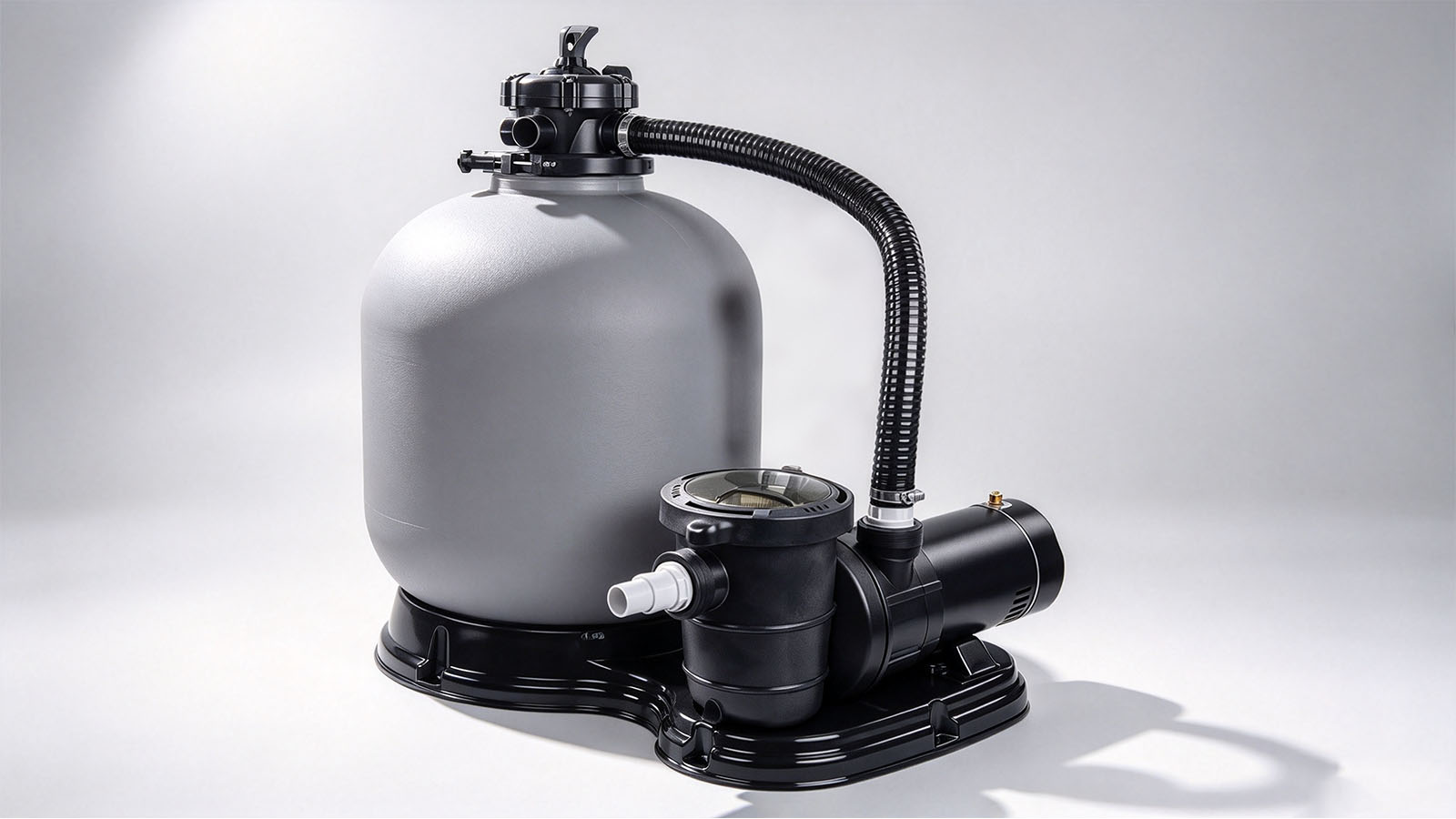
- Sand filter.High-rate sand is typically designed at 15–20 GPM per square foot of filter area. At 52 GPM, that calls for roughly 2.6–3.5 square feet, which generally means a 24-inch to 30-inch tank. Round up rather than down: a slightly oversized sand filter extends the time between backwashes and lowers the pressure the pump works against.
- Cartridge filter.Cartridge elements run at far lower flow per unit area, around 0.375 GPM per square foot, so a 25,000-gallon pool usually lands in the 300–400 square foot range. Cartridge filters suit areas with water restrictions because they never need backwashing.
- DE filter.Designed around 2 GPM per square foot, putting a 25,000-gallon pool near 36 square feet for comfortable operation rather than at the maximum.
Whichever you choose, remember the ordering rule: size the filter to the pump’s actual operating flow, not to the pump’s horsepower rating.
Three Sizing Mistakes That Cost Real Money
Oversizing “just to be safe.” This is the most common error in the category. A 2.5 HP pool pump on a system whose filter and plumbing tap out at 60 GPM does not deliver more water. It delivers more velocity, more noise, more filter pressure, and a higher bill. Oversizing also pushes the pump away from its efficient operating range, so it converts electricity into heat and vibration instead of flow.
Buying by horsepower and ignoring head. A pool with a rooftop solar array and a long suction run can easily sit at 70+ feet of head. A pump that looked generous on paper may deliver barely 38 GPM there, leaving the pool under-circulated and prone to algae. If your head is high, you need to read the curve at your head, not trust the label.
Fitting a variable-speed pump and leaving it at full speed. Programmable speed is the entire benefit. Running a variable-speed pool pump flat out for eight hours gives you single-speed running costs with a variable-speed purchase price.
What to Specify When You Source a Pool Pump
For distributors, contractors, and buyers specifying a pool pump, the checklist that matters is not the one on the retail box:
- Certified performance curve, showing GPM against head, rather than a nameplate horsepower claim.
- Self-priming or non-self-priming, matched to whether the pump sits above or below the water line.
- Motor type.A variable-speed unit with a permanent-magnet motor is now the baseline expectation in most regulated markets, and federal minimum efficiency standards for dedicated-purpose pool pumps have applied since July 2021 under 10 CFR 431.465.
- WEF ratingfor the US market, plus ENERGY STAR certification where utility rebates apply. Utility programs in 2024 and 2025 were offering roughly $100–$350 back on certified variable-speed models.
- Wetted materialsmatched to the water chemistry, particularly for salt-chlorinated pools where corrosion resistance drives service life.
- Integrated timer and freeze-protection defaults, which are part of the federal prescriptive requirements for certain pump categories.
- A matched sand filter tank, rated above the pump’s operating flow rather than merely close to it.
Suppliers offering OEM and ODM programs should be able to supply all of the above on request. If the only number a supplier can give you is horsepower, keep looking.
Frequently Asked Questions
- What size pool pump do I need for a 25,000 gallon pool?
- A pump that delivers roughly 35–70 GPM at your system’s head, which on typical residential plumbing means a 1.5 HP variable-speed pool pump. Aim for about 52 GPM if you want the common eight-hour turnover.
- How many GPM should a 25,000 gallon pool pump be?
- Between 34.7 GPM (twelve-hour turnover, the standard minimum) and 69.4 GPM (six-hour turnover, the standard maximum). For most residential pools, 45–55 GPM is the practical target.
- Is a 1 HP pool pump enough for 25,000 gallons?
- Yes, if you are comfortable with a longer turnover. A 1 HP pump moving around 42 GPM turns 25,000 gallons over in about ten hours. That is compliant and, with a variable-speed model, cheaper to run than a larger pump cycling harder for fewer hours. It is not enough if you also run spa jets, a pressure cleaner, or rooftop solar.
- Is 1.5 HP or 2 HP better for a 25,000 gallon pool?
- 5 HP is the better default. It covers the eight-hour turnover at around 52 GPM without pushing past what most 2-inch residential plumbing and a correctly sized filter can absorb. Move to 2 HP only if your total dynamic head is high or your pool has additional features that need the extra flow.
- How long should I run a pool pump on a 25,000 gallon pool?
- Long enough for one full turnover. At 52 GPM that is about eight hours; at 35 GPM, about twelve. Run longer in hot weather and after heavy use, and run a variable-speed pump at low RPM for a longer stretch rather than at high RPM for a shorter one.
- What size sand filter do I need for a 25,000 gallon pool?
- At a 15–20 GPM per square foot design rate and roughly 52 GPM of flow, you need about 2.6–3.5 square feet of filter area, typically a 24-inch to 30-inch tank. Oversizing is safer than undersizing.
- Can a pool pump be too big?
- Yes, and it is the most expensive mistake in pool equipment. An oversized pump exceeds the filter’s rated flow, drives pipe velocity past safe limits, wastes electricity, and shortens equipment life. The residential standard sets a maximum filtration flow rate for exactly this reason.
- Is a variable-speed pool pump worth it?
- On a 25,000-gallon pool, almost always. ENERGY STAR puts the saving at 2,800 kWh and $340 per year with a payback of about 1.6 years, Wisconsin’s statewide program cites 60% less energy, and a Texas utility measured 5,821 kWh per home in FY2024. Add the ability to match flow to the season instead of being locked at one speed.
The Bottom Line
Stop asking how many horsepower and start asking how many gallons per minute. For a 25,000-gallon pool the defensible range is 34.7 to 69.4 GPM, and the standard actively encourages the lower end of it. On ordinary residential plumbing that means a 1.5 HP variable-speed pool pump, set to deliver around 45–55 GPM for daily filtration, with the headroom to run faster when you vacuum or backwash.
Check your pipe size and your filter rating before you check the horsepower. Those two, not the motor label, decide what your pool pump can actually do.
References
- [1] PHTA-5 *Standard for Residential Inground Swimming Pools*, effective 2024-11-01, Section 9.1.3 (Turnover and water clarity) — maximum filtration flow rate = pool volume ÷ 360, or 36 GPM, whichever is greater; minimum based on a 12-hour turnover; lower flow rates with longer filtration times encouraged; filters sized per NSF-50 for the maximum flow through the filter.
- [2] CPS Energy, *Evaluation, Measurement, and Verification of CPS Energy’s FY 2024 DSM Portfolio*, 2024 — pool pump measure: 30 residences, average gross savings of 5,821 kWh per residence, 1,758,001 kWh total.
- [3] Focus on Energy (Wisconsin), *2024 Electronically Commutated Motor (ECM) Variable-Speed Pump Rebates*, effective June 1, 2024 — variable-speed pool pumps use 60% less energy than single-speed counterparts; rebate tiers of $50 (<100 W), $160 (100–500 W) and $320 (500+ W).
- [4] ENERGY STAR, *Pool Pump Fact Sheet* — variable-speed: $340 annual saving, 2,800 kWh annual saving, $2,200 lifetime saving, 1.6-year payback; two-speed: $280 annual saving, 2,300 kWh annual saving, $2,000 lifetime saving, 0.8-year payback.
1.Title: Whole System Design of an Energy Efficient Residential Pool System
Abstract: This whole-system analysis shows variable-speed pumps can cut power >80%. Pipe fittings form most head loss; turnover flow matching is critical.
Abstract: CFD shows theoretical turnover time overstates actual water exchange. Dead zones retain contaminated water even after reaching design turnover.