
Is a Hot Water Recirculating Pump Worth It? Costs, Drawbacks & Problems
What a hot water recirculating pump does
A hot water recirculating pump keeps heated water moving through the hot line, so hot water is already at the fixture when you open the tap. The cooled water in the pipe goes back to the heater through a return path instead of down the drain.
Two ways to build that path. A dedicated return line is a third pipe from the farthest fixture back to the heater, usually installed during construction or a gut remodel. The retrofit version uses a thermal bypass valve, also called a comfort valve, under the farthest sink: it bridges the hot and cold lines so the cold line carries cooled water back. Far cheaper and no new piping — but the cold tap runs warm briefly.
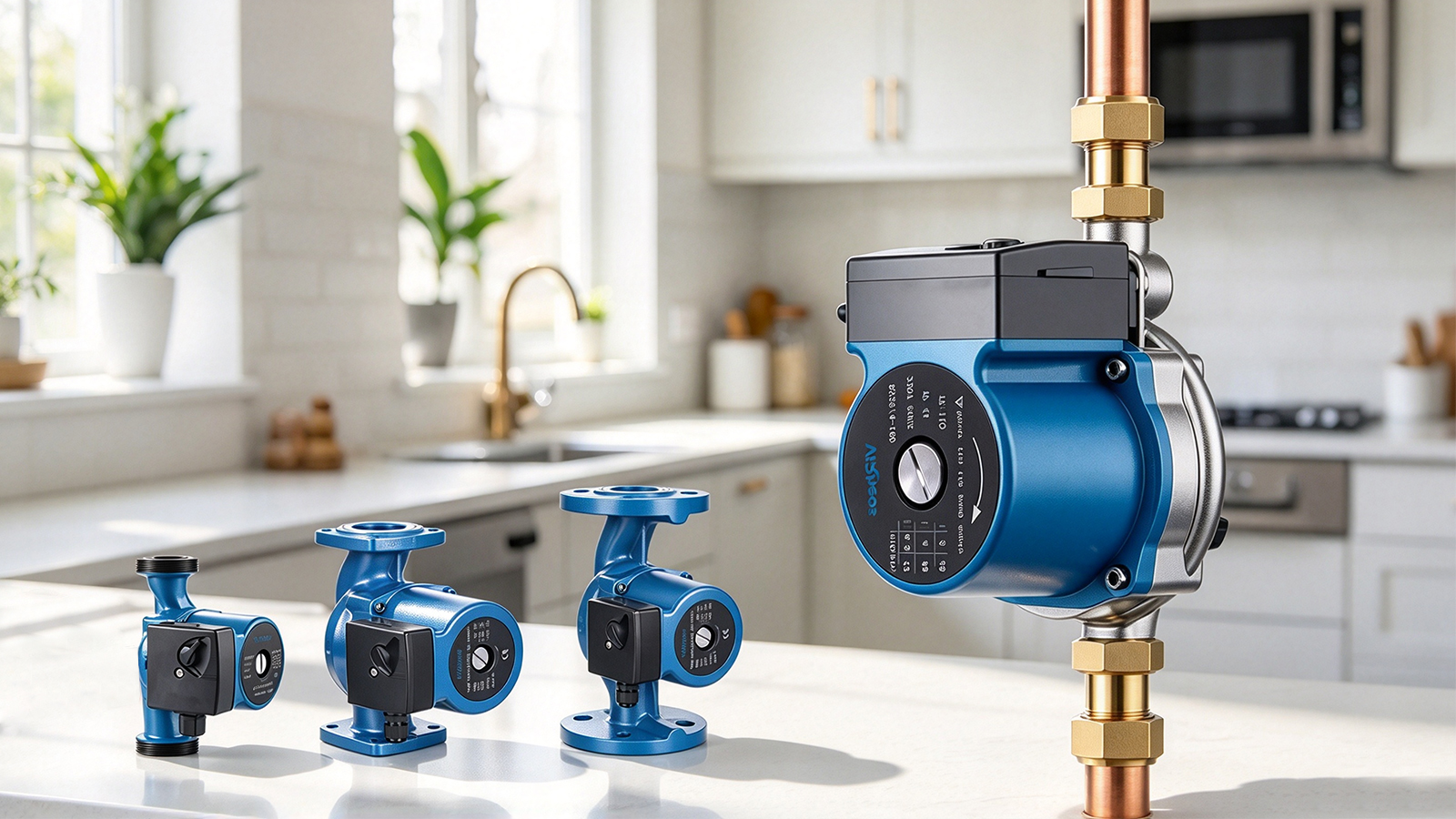
The hot water recirculating pump itself is small. Residential units draw 15 to 100 watts depending on the motor: older permanent split capacitor motors at the top of that range, modern electronically commutated motors at the bottom. The pump is not the expensive part. The loop is.
The waste you are trying to kill
Open a hot tap on a long run and you are not just emptying the pipe. Hot water mixes with the cold water ahead of it, so you typically flush about twice the pipe volume before the water at the tap is actually hot. In a large house that wait routinely passes a minute.
Federal efficiency programs have turned this into a hard number. Under the Department of Energy’s Efficient New Homes requirements, a hot water distribution system should store no more than 0.5 gallons between the source and any fixture, and field verification allows no more than 0.6 gallons to run out before the temperature rises by at least 10°F.
Put a household on top of it. Ten hot draws a day at roughly 1.3 gallons wasted each is about 13 gallons a day, close to 4,700 gallons a year, most of it at least partly heated before it goes down the drain. The Environmental Protection Agency puts average indoor household water use at about 82 gallons per person per day.
Then there is the time. Ten draws a day at 70 seconds each is roughly 71 hours a year standing at a sink or shower waiting. Nobody puts that in a spreadsheet, but it is why most people buy a hot water recirculating pump.
What a hot water recirculating pump costs installed
Hardware prices quoted online stop at the pump, which is misleading. The most credible cost picture for a code-compliant residential system with on-demand controls comes from the 2024 IECC cost analysis published by Home Innovation Research Labs in January 2025.
| Cost component | Unit cost | Qty | Cost |
| Recirculation pump kit | $358.60 ea | 1 | $359 |
| Plumbing labor for pump kit | $179.85 ea | 1 | $180 |
| Electrical circuit for pump | $54.05 ea | 1 | $54 |
| GFCI breaker, 15-amp | $58.15 ea | 1 | $58 |
| Dedicated return pipe, ¾” PEX, material | $1.01 / ft | 40 ft | $40 |
| PEX pipe labor | $13.28 ea | 1 | $13 |
| PEX adapter, ¾” | $35.15 ea | 2 | $70 |
| On-demand low-voltage control circuit | $41.50 ea | 3 | $125 |
| Total to builder | $899 | ||
| Total to consumer | $1,034 |
Two things jump out. The pump kit is only about 40% of the total — labour, the electrical circuit and control wiring make up the rest. And this sits far below the $1,500 to $3,000 figures circulating online, which usually include opening walls for a return line in a finished house.
The cost nobody quotes: heat loss from the loop
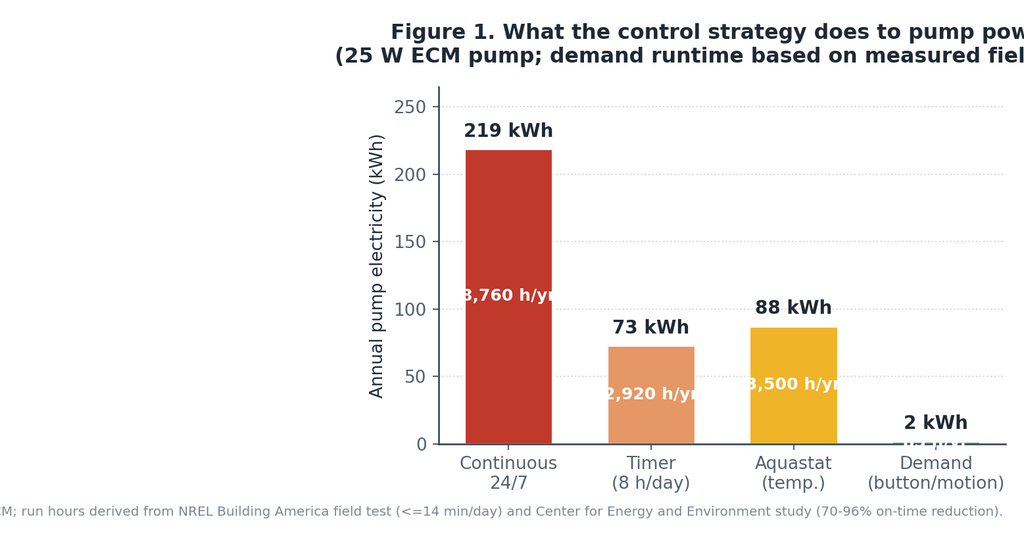
The pump’s own electricity is trivial. A hot water recirculating pump with a 25-watt ECM motor running 24/7 uses about 219 kWh a year, roughly $36 at the 2024 U.S. average residential price of 16.48 cents per kWh. What makes recirculation expensive is that you have turned every foot of hot water piping into a radiator running all day.
A 2023 hydronics design journal worked a real example: 300 feet of bare ¾” copper carrying 120°F water through a 55°F crawl space loses about 27 Btu per hour per foot, or 8,100 Btu/h for the loop [citation:55]. Scale that to a 100-foot residential run and you still lose roughly 2,700 Btu/h continuously — about 23.6 million Btu a year, over 230 therms of gas. Insulating the loop cuts that by roughly two-thirds.
Field data confirms it at building scale. A 2025 CalNEXT report found the median heat loss of a domestic hot water loop is about 93 watts per apartment, equal to 25% to 50% of the heat the water heating system must produce. It also cites an Efficiency Vermont study where standby losses hit 14.8 kBtu/h in one building — 13% of the building’s energy use intensity and more than $2,000 a year.
From the other direction, DOE’s Building America program reported survey work across more than 50 multifamily and commercial buildings in which only about 35% of the energy put into central hot water systems reached the end user: roughly 33% lost in the recirculation loop, 31% at the water heater, 1% in branch piping.
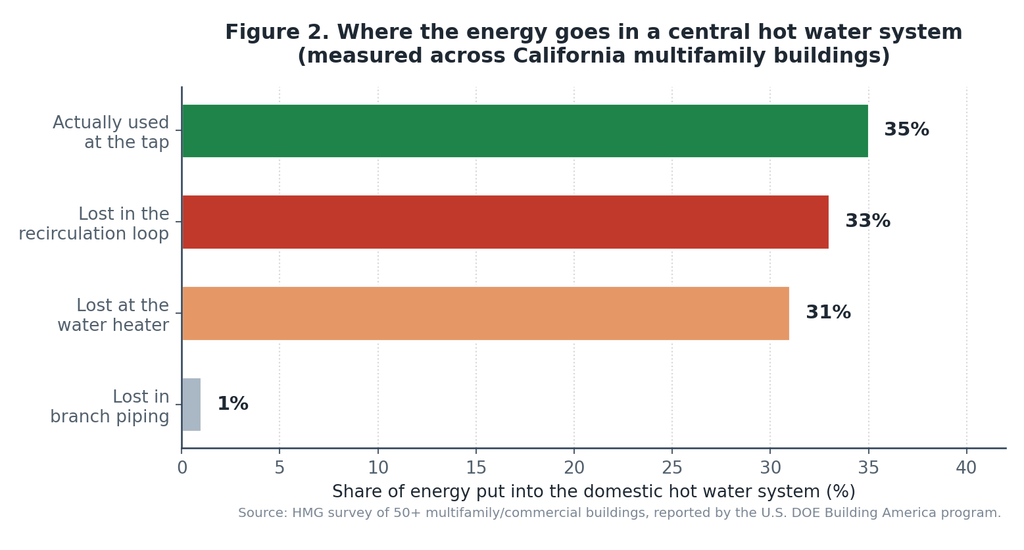
That is the honest drawback of a hot water recirculating pump: it solves a water problem by creating an energy problem. Whether the trade is good depends on the next section.
Control strategy is the whole ballgame
A pump running 24 hours a day eliminates the wait and costs the most to operate. A pump that runs only when someone wants hot water gives up a few seconds and removes most of the penalty. The measured gap is not small.
In a DOE Building America field study in Brooklyn, demand control cut hot water fuel use by 7% and fuel cost by 8% versus constant circulation; demand control combined with temperature modulation cut fuel use by 15% and cost by 14%, with pump runtime falling to 14 minutes or less a day. A Center for Energy and Environment study monitoring six Minnesota sites — hotels, schools and an office — measured a 70% to 96% reduction in pump on-time and a 13% to 19% cut in hot water energy.
Efficiency Maine’s FY2025 report makes the hardware point: it rebated 16,143 ECM circulator pumps in one year and states ECM circulators can cut operating costs by 85% versus the fixed-speed pumps they replace.
| Control strategy | Typical runtime | Wait at tap | Relative loop heat loss | Best suited to |
| Continuous 24/7 | 8,760 h/yr | 0 seconds | 100% (baseline) | Healthcare, hotels, 24-h occupancy |
| Timer (2 daily windows) | ~2,920 h/yr | 0 s in window; 30-90 s outside | ~35-45% | Fixed household routines |
| Aquastat / temperature | ~3,000-4,000 h/yr | 5-20 seconds | ~45-60% | Retrofits where wiring is impractical |
| Demand (button, motion, flow) | ≤14 min/day measured | 5-30 seconds | ~30-40% | Most homes; what codes prefer |
| Adaptive / learning schedule | Follows occupancy | 5-30 seconds | ~30-40% | Automation without buttons |
Codes settle the argument. ASHRAE 90.1-2019 requires automatic controls limiting recirculation pump operation, and the 2021 IECC and California Title 24 impose similar rules. The DOE Efficient New Homes program goes further: systems activated only by a timer or temperature sensor do not qualify. Buy a hot water recirculating pump that can be triggered by demand — a switch, a motion sensor or an adaptive schedule.
The real disadvantages of a recirculating pump
Strip away the marketing and five disadvantages of a hot water recirculating pump keep showing up in field data and service calls.
Added energy use — not the pump, the loop. Every hour the water is hot and moving, heat leaves the pipe. On an uninsulated loop running continuously, this can be the largest water-heating cost in the building.
Bypass systems borrow your cold line. A comfort valve sends cooled hot water back through the cold pipe; once its internal check valve wears out, the cold tap runs warm.
It is hard on old copper. Sustained recirculation at high velocity erodes thin-walled copper from the inside. Pinhole leaks after a retrofit usually trace back to an oversized pump on a loop never designed for continuous flow.
It fights modern water heaters. Heat pump and condensing units work best heating cold incoming water; return water at 105-110°F shrinks the temperature lift. CalNEXT’s 2025 work measured a residential heat pump water heater at a system COP of 1.4 under continuous recirculation, versus 2.5 once the pump went on demand control. Same heater, nearly double the efficiency.
It can sit in a temperature band bacteria like. Legionella grows best between 95°F and 115°F — exactly where a badly set loop idles for hours. ASHRAE Standard 188 and WHO guidance point the other way: store at 140°F or above, keep return at 124°F or above, and use thermostatic mixing valves to deliver 120°F or less at the tap.
None of these are reasons to avoid the technology. They are reasons to specify it properly: insulated loop, right-sized pump, demand control, mixing valve if storage temperature is raised.
Common problems with hot water recirculating pumps
This is where ownership actually lives — the failures plumbers and facility engineers see most often.
Warm water from the cold tap
The check valve inside a comfort valve has stopped sealing and hot water is bleeding into the cold side. Replace the cartridge. If it fails again inside a year, suspect water pressure and debris: a valve that keeps failing is a symptom, not the disease.
The pump runs constantly, or never stops
On a timer model the schedule is wrong or the clock reset. On an aquastat model the sensor has slipped off the return line, or the setpoint is too low to satisfy. On a demand system a stuck sensor holds the pump on. Verify the pump is receiving a call before replacing it.
Hot water still takes forever at the far bathroom
Three candidates: the pump is undersized for the loop’s head loss, the loop was never balanced so flow short-circuits along the easiest path, or the branch past the recirculation tee is too long. A loop puts hot water at the tee; it does nothing for a long branch run beyond it.
Noise: humming, clicking, or gravel
A steady hum is usually vibration transmitted into framing — isolate the mounts or add a flexible connector. Gravel-like noise is cavitation or debris in the impeller. Clicking every minute or two is the control cycling: normal on a bare loop, hard on the motor.
Leaks at the pump body or flanges
Shaft seal wear on a dry-rotor design, or a gasket that was not seated. Catch it early — water reaching the motor turns a cheap seal into a full pump replacement.
Pinhole leaks in copper after installation
Flow velocity is too high for the tubing, usually because someone oversized the pump to be safe. Throttle the loop with a balancing valve and lower the differential; that also stops the erosion going forward.
Rising bills with no change in comfort
The classic sign of a pump that reverted to continuous operation after an outage, a control failure or a timer reset. Log the runtime for a week before spending money on anything else.
Where should a hot water recirculating pump be installed?
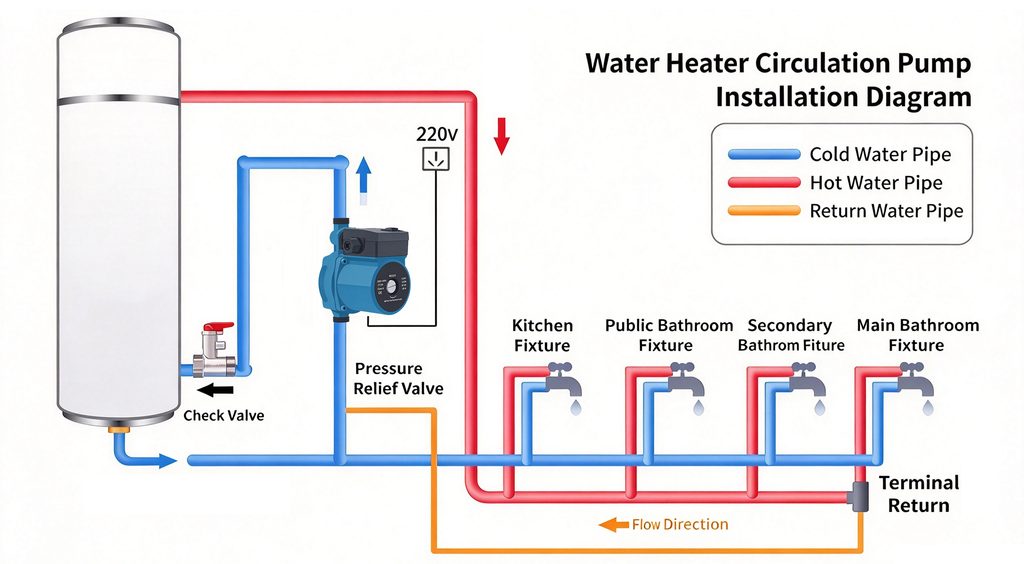
On the return side, close to the water heater, pumping toward the heater rather than away from it. Beyond that, layout depends on the piping you already have.
With a dedicated return line: mount the pump on the return near the heater, tie the return into the cold inlet or a dedicated tapping, keep a check valve in the return, and insulate everything.
Without a return line: fit a comfort valve under the farthest sink and mount the pump at the heater. Cheap and reversible, at the cost of briefly warm cold water at that sink.
With a tankless heater: use a pump and control package the heater maker approves. There is no buffer tank, and short-cycling the burner causes nuisance faults and heat exchanger wear.
Multi-story or long runs: add a balancing valve to each return branch so the farthest riser gets flow, otherwise the pump circulates along the path of least resistance.
Two details get missed constantly. The pump needs a proper electrical connection, usually a new GFCI-protected circuit — a licensed electrician’s job in most jurisdictions, and a line item in Table 1 for that reason. And every foot of loop, fittings included, needs insulation.
How long does a hot water recirculating pump last?
A well-built residential hot water recirculating pump runs 8 to 15 years. Wet-rotor designs, where water lubricates the bearings, reach the top of that range; dry-rotor designs need periodic lubrication and usually fail at the shaft seal first. Hard water, high operating temperature and constant cycling shorten life most.
Maintenance is light: once a year, check for leaks at the body and flanges, listen for bearing noise and clean any strainer. In hard water areas, suspect scale on the impeller first when output drops.
Two outcomes: one worked through, one measured
A house first. A 2,700 sq ft two-story home, heater in the garage, master bath about 80 feet away: before, roughly 80 seconds and 1.3 gallons wasted per draw, ten draws a day. After a hot water recirculating pump with demand controls, an insulated loop and a bypass valve at about $1,050 installed, the wait drops under 30 seconds, pump electricity lands in single-digit kWh a year, added loop heat loss runs $60 to $110 a year, and water savings of 4,000 to 4,700 gallons a year offset much of that. The money roughly washes; the 70 hours a year of not standing around is the real return. Illustrative case built from the figures above.
Now measured buildings. In Minnesota, monitoring six sites showed demand control cut pump on-time by 70% to 96% and hot water energy by 13% to 19%. In Brooklyn, the DOE Building America retrofit cut fuel use by 15% and cost by 14%, with the pump running under 14 minutes a day. In buildings, unlike houses, a hot water recirculating pump retrofit can pay back on energy alone.
So, is a hot water recirculating pump worth it?
Buy one if the heater is far from the fixtures, the household draws hot water many times a day, and you will insulate the loop and run the pump on demand. Water savings roughly cancel the energy penalty, and you get your 70 hours a year back.
Skip it if the longest hot water run is under about 30 feet, if the heater is central to the home, or if the loop cannot be insulated. That is $900 to $1,100 spent on a wait that was never the problem.
And if you already own a hot water recirculating pump that runs 24/7, the cheapest upgrade is not a new pump. It is a control, plus a Saturday afternoon with pipe insulation. Field data puts the runtime saving from that alone at 70% to 96%.
FAQ
1. Is a hot water recirculating pump worth it?
- For a large or long-run home with frequent hot water use, yes — mainly for comfort and water savings rather than energy savings. Budget $900 to $1,100 installed for a compliant system with demand controls. In a small home with a central heater, rarely worth it.
2. Where should a hot water recirculating pump be installed?
- On the return side of the loop near the water heater, pumping toward the heater, with a check valve in the return and insulation on every foot of pipe. Homes without a return line use a bypass valve under the farthest fixture. It needs a GFCI-protected circuit, so expect an electrician too.
3. What are the disadvantages of a recirculating pump?
- Extra energy use from continuous pipe heat loss; warm water in the cold line on bypass systems; erosion and pinhole leaks in older copper at high velocity; reduced efficiency on heat pump and condensing water heaters; and a Legionella-friendly temperature band if the loop is set too low.
4. What are the common problems with hot water recirculating pumps?
- Failed check valves causing warm cold water; pumps stuck on because a timer or sensor failed; undersized or unbalanced loops that never reach distant fixtures; cavitation or debris noise; shaft seal and flange leaks; pinhole leaks in copper from excessive velocity.
5. How much does a hot water recirculating pump cost?
- About $899 to the builder and $1,034 to the consumer for a complete residential installation with on-demand controls, per the Home Innovation Research Labs 2025 cost analysis. Retrofits needing walls opened for a return line run $1,500 to $3,000.
6. How long does a hot water recirculating pump last?
- Eight to fifteen years is typical, with wet-rotor designs generally outlasting dry-rotor ones. Hard water, high operating temperature and constant cycling are the main life-shorteners.
References
1.Title: Controlling Legionella pneumophila growth in hot water systems by reducing dissolved oxygen levels
Abstract: Lab test examines Legionella growth in recirculating plumbing within 106–111°F, showing low dissolved oxygen suppresses pathogen proliferation.
2.Title: Domestic Hot Water Production with Ground Source Heat Pump in Apartment Buildings
Abstract: Simulation finds DHW recirculation pipe insulation is critical for heat pump water heater efficiency; uninsulated loops erase most heat pump energy gains.