
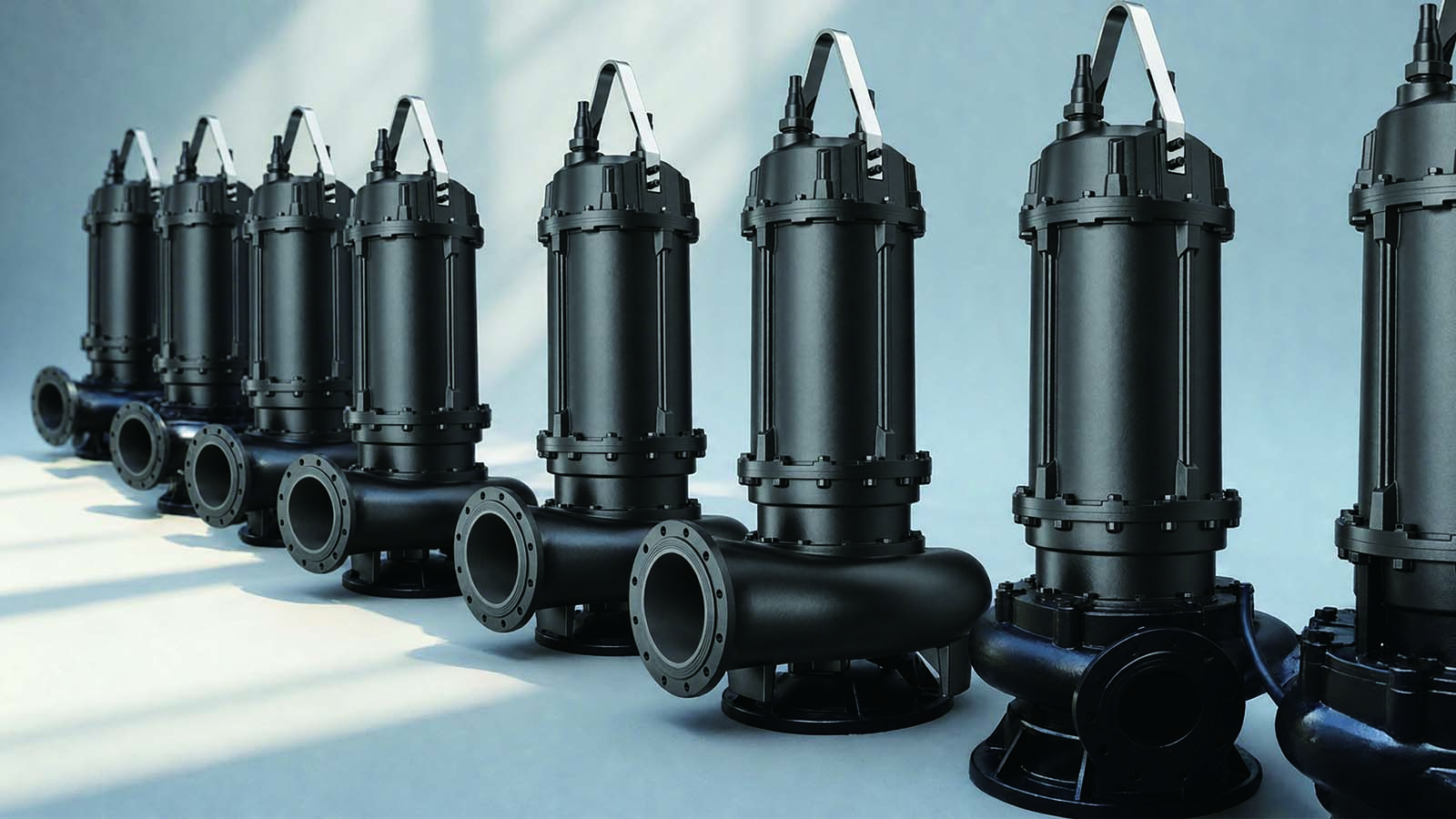
Can You Use a Sump Pump as a Sewage Pump?
A sump pump cannot do a sewage pump’s job, and the reason has nothing to do with brand or build quality. It is geometry.
A sump pump moves groundwater. A sewage pump moves wastewater carrying solids — and the space inside it has to be wide enough for those solids to get through. Put a narrow-passage pump on a toilet line and it does not “work badly.” It jams, draws locked-rotor current and trips thermal overload, usually while the basin is still filling.
The swap fails in the other direction too, less violently. A sewage pump will move clean groundwater, but it is the wrong tool: lower efficiency on thin liquid, higher power draw, and a basin and discharge arrangement that make no sense for stormwater.
So the rule is simple enough to write on the quote itself:
- Groundwater only→ sump pump
- Anything from a fixture→ sewage pump
- Toilet in the group→ sewage pump rated for 2-inch solids, minimum 2-inch discharge, sealed and vented basin
What a sewage pump actually is
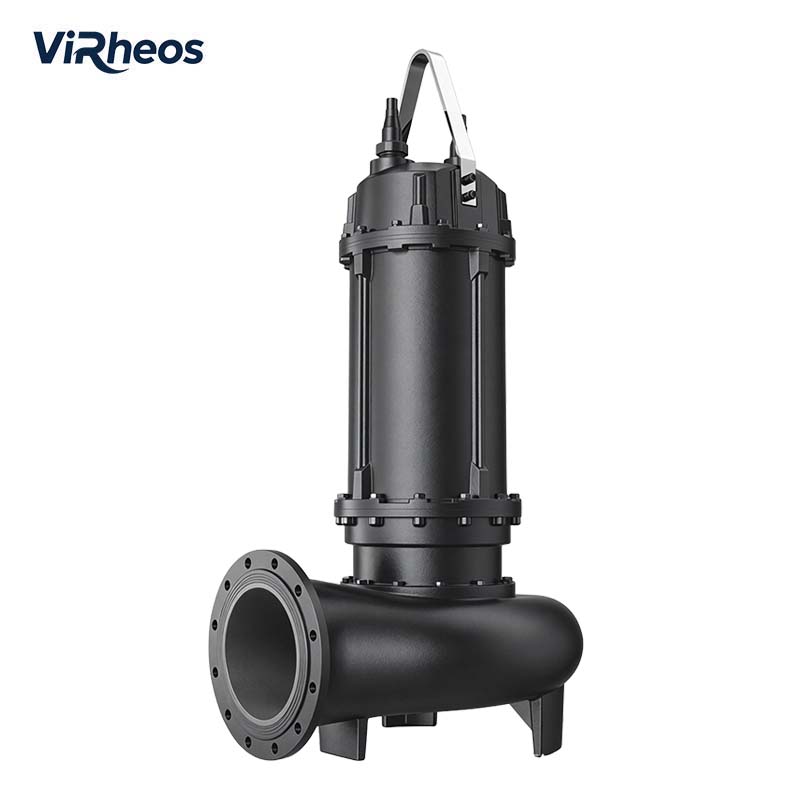
A sewage pump — a sewage ejector pump in residential work — moves unscreened wastewater from fixtures below the sewer line up to a gravity drain, sewer main or septic tank.
The number that defines it is solids passage: the largest sphere it can pass. For anything receiving a water closet, that is 2 inches (51 mm).
The cycle is straightforward:
- Wastewater drains by gravity into a sealed basin.
- Level rises; a float switch — tethered, vertical on a rod, or a diaphragm type — closes the circuit.
- The impeller spins, and centrifugal force throws liquid up the discharge line.
- A check valve holds the column so it cannot drain back and retrigger the pump.
- Level drops, the pump stops.
The impeller is where a sewage pump separates itself from the rest of the aisle. A vortex (recessed) impeller sits back in the volute and swirls most solids past without touching the vanes — widest passage, lowest clog risk, lowest efficiency. A channel or non-clog impeller gives a defined passage with better efficiency. A grinder adds hardened teeth that shear solids to slurry first, letting you run a smaller force main and reach much higher heads, at the cost of power and a wear part.
What a sump pump is built for
A sump pump’s job is to keep a basement dry. Its basin takes groundwater from drain tile or a subdrain; the pump discharges to daylight, a storm drain or a yard line.
Typical residential units run 1/3 to 1/2 HP and move roughly 40–70 GPM at about 10 feet of head. They pass grit and fine particulate — around 1/4 to 1/2 inch at most — because that is all groundwater brings. Discharge is usually 1¼ or 1½ inch. The basin is open or lightly covered and not vented, because there is no sewer gas to contain.
Every one of those choices is right for groundwater and wrong for sewage.
Why the substitution fails mechanically
Four mismatches, any one of which is enough to end the experiment.
- Internal clearance. A sump pump impeller is shrouded or semi-open with tight tolerances, built to move thin liquid fast. Solids larger than a pebble cannot pass. The motor does not quietly struggle — it stalls.
- Starting torque. Sewage is thicker and starts under load. A 1/3 HP sump pump does not have the torque to break a solids-laden column loose; sewage pumps are specified for it and are commonly 1/2 HP and up.
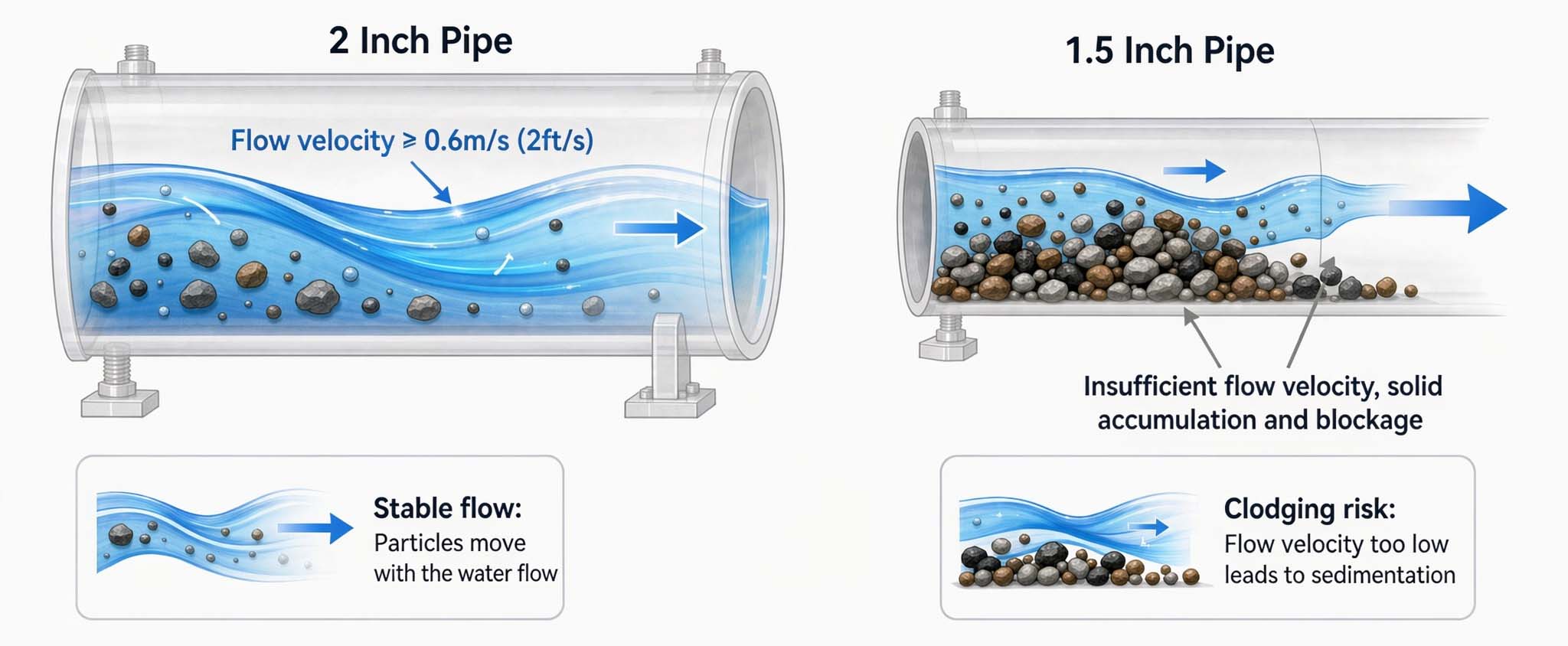
- Discharge diameter. A 1½ inch line is physically too narrow to carry waste and paper reliably. Practice puts a floor of about 2 ft/s discharge velocity to keep solids moving — roughly 21 GPM on a 2-inch line — and forcing that load through 1½ inch invites chronic blockage.
- The basin. A sewage basin must be gas-tight and separately vented. A sump pit is not, and swapping the pump cannot make it compliant. Sewer gas in a living space is not a nuisance; it is a hazard.
| Sump pump | Sewage pump | |
| Moves | Groundwater, seepage | Wastewater with solids |
| Solids passage | ¼–½ in | 2 in residential; 3 in+ municipal |
| Impeller | Shrouded or semi-open | Vortex, channel/non-clog, grinder |
| Discharge | 1¼–1½ in | 2 in minimum for a water closet |
| Motor | 1/3–1/2 HP typical | 1/2 HP and up |
| Typical duty | 40–70 GPM at ~10 ft | 30–60 GPM at 15–25 ft |
| Basin | Open or lightly covered | Gas-tight, removable cover, vented |
| Valves | Often none | Check valve plus a full-open isolation valve |
| Discharges to | Daylight, storm drain | Building drain, sewer, septic tank |
| If misapplied | Wasted capacity | Clogs, stalls, burns out, backs up |
Duty figures are typical residential ranges from published pump specification tables; the 2-inch and gas-tight requirements come from plumbing code.
Note the last row. One column is “wasted capacity.” The other is a biohazard.
What it costs when it goes wrong
When a sump pump fails in sewage service, the flood is not water damage. Raw sewage is Category 3 — “black water” — under the IICRC S500 standard, the highest contamination class. Porous materials that absorb it cannot be cleaned in place; they get demolished and disposed of. Remediation is a professional scope, not a shop-vac scope.
There is an insurance dimension too. Standard homeowners policies commonly exclude sewer backup unless a water-backup endorsement is added. And an adjuster who finds a sump pump where a sewage ejector was required has grounds to question whether the equipment was used properly.
At the septic end, the numbers are plainer still: a routine tank pump-out runs a few hundred dollars, while replacing a failed conventional system runs into the thousands. A pump selection error is the cheap end of that range by orders of magnitude.
The reverse swap: sewage pump as a sump pump
Safe but wasteful, and worth understanding so you can talk a client out of it.
A sewage pump will move clear water, just badly: vortex and grinder impellers are designed around passage, not efficiency, so you pay more power for less flow than a sump pump of the same horsepower. You also pay for solids capability you will never use.
The practical problem is control. Many sewage pumps use manual-reset thermal protection, on the assumption that if the pump trips, someone should look at what jammed it. In a sump pit filling during a storm with nobody home, a pump waiting for a manual reset is not pumping.
Types of sewage pump, briefly
- Solids-handling submersible— the residential default, basin-mounted with a float switch, rated for 2-inch solids.
- Vortex / recessed impeller— for unpredictable waste where clogging is the main risk.
- Channel non-clog— the municipal workhorse, better efficiency with a defined sphere passage.
- Grinder— for long force mains, uphill runs, and small-diameter pressure sewers; more power, and blades to inspect.
- Effluent pump— not a sewage pump. It sits after a septic tank and moves screened liquid, ¾ inch or finer.
- Self-priming— mounted above the liquid, dry motor, serviceable without lifting gear.
Where each one belongs
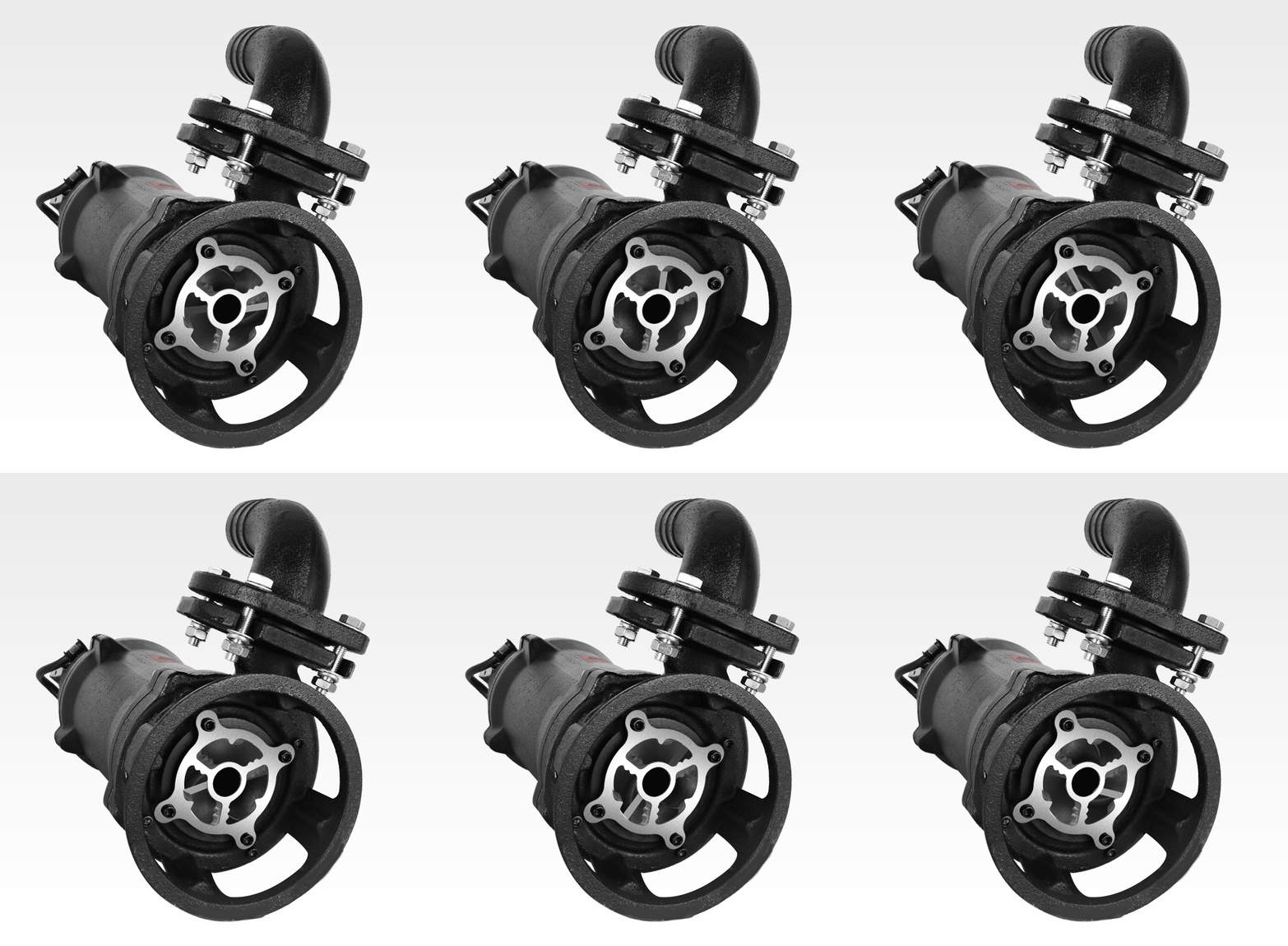
Sump pumps: basements and crawlspaces with groundwater or storm seepage, foundation drainage, stormwater pits.
Sewage pumps: below-grade bathrooms and laundry, septic systems, municipal lift stations, restaurant and commercial kitchen waste, industrial effluent.
The one-line test that settles almost every job: if any fixture drains into the basin, it is a sewage pump. Groundwater alone is a sump pump. There is no grey area, and no jurisdiction where discharging sanitary flow to a storm drain is permitted.
Standards and what the code actually says
You do not need the whole library — four references and two numbers.
Performance testing is covered by ISO 9906:2012 (acceptance grades 1B/1E/1U, 2B/2U, 3B) and, for submersible units tested as a complete close-coupled machine, ANSI/HI 11.6. Wet-well design that stops vortexing and air entrainment is ANSI/HI 9.8. Protection for continuous submersion is IEC 60529, where IP68 declares depth and duration as manufacturer-stated values, not a fixed test.
The numbers that actually decide a residential install come from the plumbing code. Under the International Plumbing Code, a pump receiving the discharge of water closets must handle spherical solids up to and including 2 inches (51 mm); any other pump or ejector, ½ inch (13 mm). Minimum pump capacity scales with discharge pipe diameter, and discharge piping must be sized for a flow velocity of not less than 2 ft/s to keep solids in suspension.
| Discharge pipe diameter | Minimum pump capacity |
| 2 in | 21 GPM |
| 2½ in | 30 GPM |
| 3 in | 46 GPM |
The same section requires the check valve and a full-open isolation valve downstream of it, with access to both. *Source: ICC International Plumbing Code 712.4.2.*
The basin matters as much as the pump. The same code section calls for a pit not less than 18 inches in diameter and 24 inches deep, a gas-tight removable cover set no more than 2 inches below floor level, a solid bottom that permanently supports the pump, and a vent. Miss the vent and every cycle displaces the pit’s air volume through the nearest trap seal.
Two more things worth asking a supplier about, because they appear in real specifications: a minimum L10 bearing life of 50,000 hours, and a 1.15 service factor with Class F or H insulation.
Buying guide: seven checks
- Name the fixtures.A toilet in the group means 2-inch solids, 2-inch minimum discharge, sealed and vented basin. Greywater only means a smaller drain pump will do, cost less and cycle better.
- Size the flow.Add drainage fixture units — water closet 4, shower 2, lavatory 1, laundry tub 2 — or budget 20–45 GPM for a single-family basement.
- Calculate total dynamic head.Static lift plus friction; add roughly 30% to pipe length to cover the check valve, isolation valve and elbows. Twelve feet of static plus about 2.3 ft of friction on 60 ft of 2-inch pipe at 40 GPM lands at 14.3 ft — specify 40 GPM against 15 ft.
- Check the velocity.At 40 GPM, 2-inch Schedule 40 gives roughly 3.8 ft/s, comfortably above the 2 ft/s floor. Watch larger pipe: velocity falls with the square of the bore, so 50 GPM in 4-inch drops below the floor.
- Size the basin for starts per hour.For 6 starts per hour at 40 GPM you need about 100 gallons of drawdown between float on and off levels. This is the figure most often skipped, and short cycling kills motors through starting current, not running hours.
- Pick the material.Cast iron for standard sewage; hardened high-chrome iron where sand and grit are present; 316L or duplex stainless for coastal, brackish or high-chloride service.
- Decide on controls and alarms.Float type, a high-water alarm independent of the pump control, and above single-family residential, duplex with lead/lag alternation.
Budget-wise, a residential unit runs roughly $350–$1,500, about $400–$900 installed on a straightforward replacement — a fraction of one remediation call.
Using and cleaning one
- First start. Clear the pit of debris. Confirm the float swings free and cannot catch the wall or the discharge pipe. Fit the check valve 12–18 inches above the discharge, not screwed straight into the pump outlet. Use a dedicated GFCI-protected circuit sized for locked-rotor current.
- First run. Fill the basin with clean water, watch one full cycle and time it. Write it down — a year from now that baseline tells you something has changed.
- Monthly. Pour water into the basin and confirm the pump starts and stops on its own.
- Annually. Pull the pump, clean the basin walls and intake, clear the float of rag or wipe material, inspect the seal and cable insulation, and log running current against the nameplate. Rising amps at the same flow is the earliest honest signal of wear.
- Daily. Only flush pee, poo and paper.
Frequently asked questions
1.Is there a difference between a sewage pump and a sump pump?
Yes, and it is the most consequential distinction in residential pumping. A sump pump moves clear groundwater out of a pit to keep a basement dry — no solids, no sewer gas, no sealed basin required. A sewage pump lifts wastewater containing solids from fixtures below the sewer line, which is why it has a solids-tolerant impeller, a 2-inch discharge, a gas-tight vented basin and a mandatory check valve.
They are not variations of one product. They are two systems with different failure modes: a failed sump pump leaves you with a wet floor; a failed sewage pump leaves you with contaminated water in a finished space.
2.Will a sewage pump handle toilet paper?
Yes. That is exactly what the 2-inch solids rating is for. Toilet paper is manufactured to come apart in water, and a correctly sized sewage pump passes it without trouble — it is the only solid a residential wastewater system is designed to receive every day.
What it will not handle is the list behind most service calls: wet wipes including ones labelled flushable, paper towels and facial tissue, feminine hygiene products, cotton swabs, dental floss, cat litter and cooking grease. Floss and wipes are worst because they wrap the impeller shaft instead of passing through.
3.What is the best toilet paper to use if you have a septic system?
Choose thin, white, unscented paper that falls apart fast in water — single-ply, or thin two-ply at most. Skip the ultra-soft, quilted and lotion-added rolls: softness and fast disintegration pull in opposite directions, and published work on tissue disintegration found that the polymers added for softness and wet strength actively reduce how well fibers redisperse.
Do not trust the label. “Septic-safe” is marketing, not a certification. Run the jar test instead: drop four or five sheets into a jar of water, shake hard for ten seconds, and look. Paper broken into loose fibers is fine; paper still in recognizable sheets is not. Test your current brand beside a cheap single-ply and the difference usually ends the argument.
Then keep the tank on schedule — the EPA recommends inspection every three years and pumping as needed, typically every three to five years.
4.Do sewage ejector pumps need to be cleaned?
Yes, and it is the maintenance task most owners skip. Solids settle, a film builds on the basin walls, and fibrous material collects around the float and impeller. Left alone, that film is what makes a pump smell, cycle strangely and eventually jam.
Plan on annual service: pull the pump, clean the basin walls and floor, clear the intake, wipe the float and check it moves freely, inspect the seal and cable, and confirm the check valve still holds. Add a monthly check — pour water in and verify the pump starts and stops by itself. None of it needs special tools, and it is the cheapest thing you can do for service life.
5.Can you put toilet paper in a sewer ejector pump?
Yes — toilet paper is the one non-human thing that belongs in it. Flush it normally, without worrying.
The question worth asking is what else goes down the same drain, because that decides whether the pump reaches its full service life. Wet wipes, paper towels, tissues, hygiene products, floss, cat litter and grease all belong in the bin. Grease is the quiet one: it congeals in the pit and on the pipe wall, narrowing the passage over months rather than jamming it outright.
A rule that works on guests as well as family: if it is not pee, poo or toilet paper, it does not go in the bowl.
6.What is the average lifespan of a sewage ejector pump?
Plan on 7 to 15 years, with most residential units in the 7-to-10-year band under normal household use. Light duty — an occasional guest bathroom — stretches toward 8–10 years and beyond; a basement apartment running the pump every day pulls it down to roughly 5–8. Commercial ejectors typically run 8–12 years, and municipal submersible sewage pumps with preventive maintenance and duty/standby rotation commonly report 12–20.
What shortens it is almost always flush behaviour, not manufacturing. Wipes and non-flushables wrapping the impeller or snagging the float cut years off a unit that would otherwise have run a full term.
Practical rule: treat year 10 as the planning point. Past seven years and cycling hard, running rough or tripping, weigh replacement against repair — and know that once sewage has entered the motor windings, repair is rarely worth it.
The bottom line
You cannot use a sump pump as a sewage pump, and the gap is not a matter of opinion or price. It is internal clearance, starting torque, discharge diameter and a gas-tight basin — four things the code states plainly and a sump pump does not have.
Ask one question first: does a fixture drain into this pit? If yes, you need a sewage pump rated for 2-inch solids, on a 2-inch discharge, in a sealed and vented basin, with a check valve and a high-water alarm. Specify it against total dynamic head and starts per hour rather than horsepower.
Do that and the pump stays invisible for a decade.
Next step: send your supplier the fixture list, the static lift, the pipe run and the available drawdown volume, and ask for a certified performance curve at your duty point. If they cannot produce one, keep looking.
References
1.Title: SepticSmart: Homeowner’s Guide to Septic Systems
Abstract: EPA guidance recommends septic inspection every 3 years and pumping every 3–5 years to prevent system failure and costly repairs.
2.Title:ISO 9906:2012 Rotodynamic pumps — Hydraulic performance acceptance tests
Abstract:Standard for centrifugal pump performance testing, including acceptance grades, measurement uncertainty and test setups.