
How Much Does It Cost to Replace a Grinder Pump for Septic Systems?
What a sewer grinder pump is, and what it does
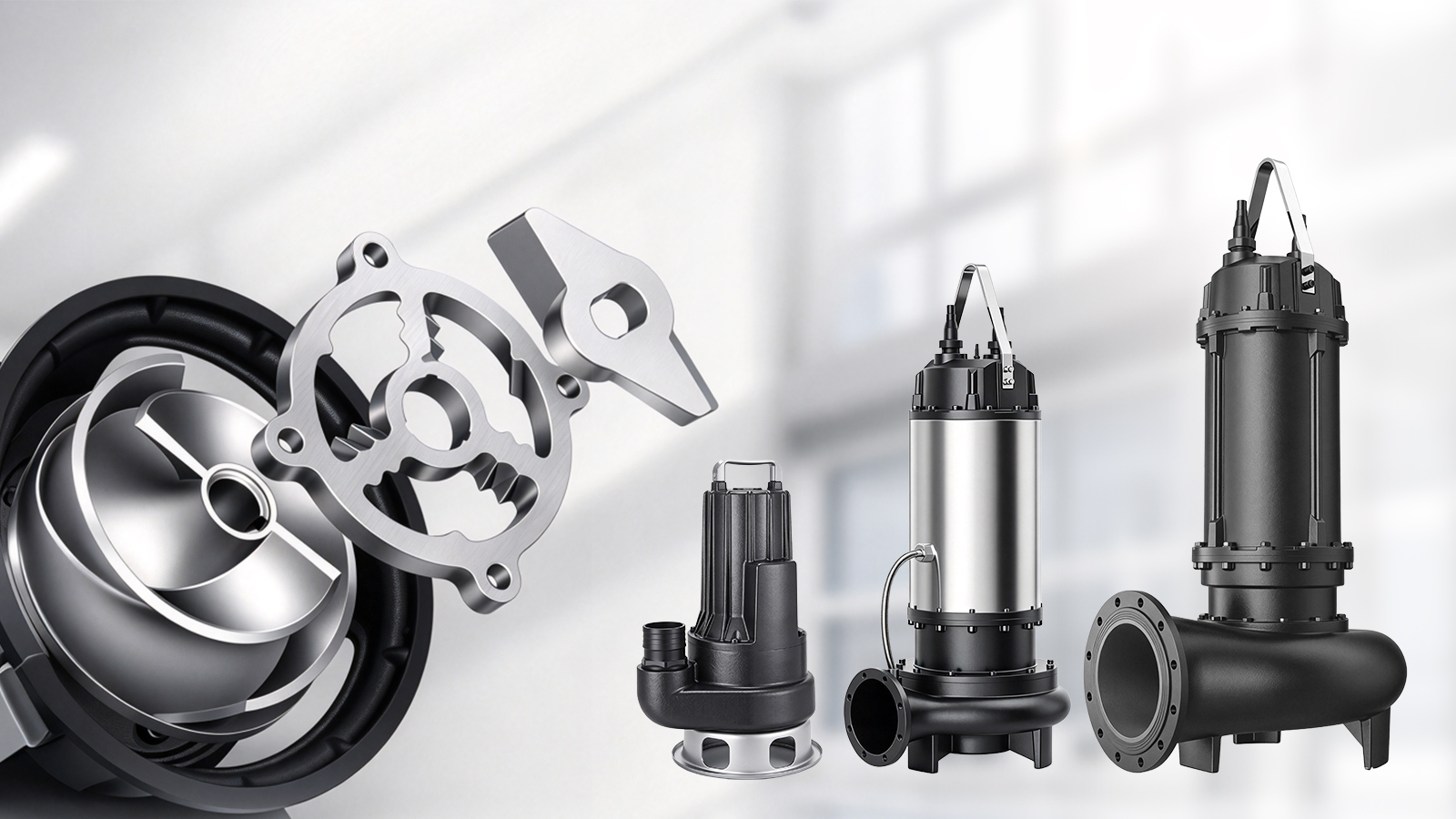
A sewer grinder pump is a submersible pump with a cutting head in front of the impeller. Raw sewage flows into a buried tank; at a set level the pump starts, a rotating cutter works against a stationary shredding ring, solids and paper become slurry, and the impeller pushes it out through a small-bore line under pressure.
The grinding stage is why a sewer grinder pump exists. A pump that passes solids whole needs 2 inch pipe and gives up quickly as head rises. Grind first and 1¼ inch will do, and the pump works against real pressure — which is what lets a low-lying house reach a main, or a septic tank, that sits above it.
Three functions follow: lift, grind, small pipe. Everything else in the spec serves those three.
Where a sewer grinder pump actually sits on a septic property
This is the question that decides the price, and it is the one most quotes gloss over.
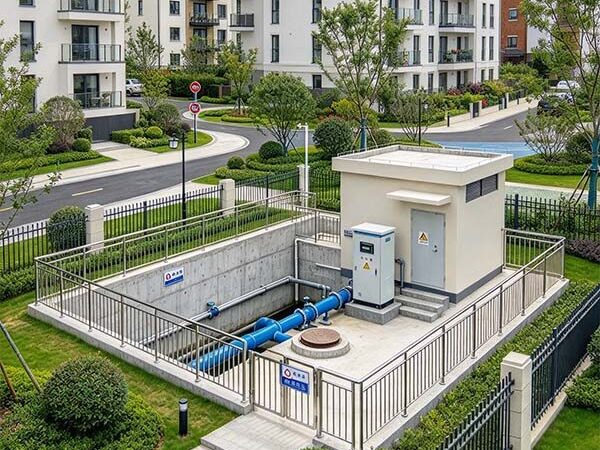
Upstream of the tank — raw sewage. The house drains into the station and the pump pushes raw waste uphill. Nothing has settled yet, so the pump has to grind. This is a sewer grinder pump, and it is the expensive option. Where one sits ahead of a septic tank, several state codes also require an effluent filter on the tank outlet.
Downstream of the tank — clarified effluent. By the time liquid leaves a septic tank the heavy solids have settled out. A mound, a pressure-dosed field or an aerobic unit needs that liquid lifted, but not ground. An effluent pump costs a fraction as much and lasts longer; specifying a grinder here is money for nothing.
Septic-to-sewer conversion. The property comes off septic and connects to a district pressure main. The tank is abandoned or kept as a settling chamber, and a grinder station makes the connection — the fastest-growing reason people meet these pumps.
Put simply: raw sewage in means a sewer grinder pump; settled effluent means an effluent pump. Getting it wrong either way is expensive — too little pump and it clogs, too much and you paid for wear parts you never needed.
Which pump are you actually replacing
| Sewer grinder pump | Sewage ejector pump | Effluent pump | |
| What it moves | Raw sewage, ground to slurry | Raw sewage, solids passed whole | Clarified liquid from tank outlet |
| Pump unit only | $800 – $2,500 | $150 – $900 | $150 – $700 |
| Installed replacement | $1,500 – $3,000 | $850 – $3,000 | $400 – $1,400 |
| Commonly quoted life | 8 – 15 years | 7 – 10 years | 10 – 15 years |
| Typical job | Pressure main, long or high lift | Below-grade bathroom to gravity sewer or tank inlet | Mound, pressure-dosed field, aerobic unit |
| 240 V circuit | Often required | Sometimes | Rarely |
A dosing pump is a fourth type: close to an effluent pump, but run off a timer panel delivering set volumes at set intervals. Mound, drip field or sand filter — that is likely what is in the chamber, and it is cheaper to replace than a sewer grinder pump.
If you do not know which one you have, the as-built drawing filed with your county health or environmental department names the type and model. Get it before you call for quotes.
Where these pumps earn their keep
- Low-lying and flat lots where the tank or main sits above the house — the classic case for a sewer grinder pump.
- Long connections where a gravity line would mean deep trenching.
- Basement bathrooms and below-grade additions with a high lift.
- Septic-to-sewer conversions onto a district pressure main.
- Community low-pressure sewer schemes, where every property pumps.
- Commercial and multi-unit sites, usually with a duplex station.
What the replacement actually costs
| Line item | Typical range | Notes |
| Sewer grinder pump unit | $800 – $2,500 | 1–2 HP; price moves with head rating and materials |
| Labour to pull and set | $150 – $1,500 | 2–4 hours typical; much more with poor access |
| Control panel or alarm | $200 – $600 | Often done at the same time, especially on older systems |
| Float switch or level sensor | $20 – $80 in parts | $75–$450 installed, depending on who does it |
| Electrical work | $200 – $3,000 | The wide band is 240 V upgrades at the top end |
| Access riser or excavation | $100 – $1,500+ | No riser means digging before anything else happens |
| Permit and inspection | $50 – $600 | Some counties treat this as a minor repair |
| Tank pump-out, if needed | $290 – $600 | Most techs will not set a new pump into a full chamber |
| Emergency or after-hours | +$100 – $300 | Alarms have a habit of going off at night |
| **Total, unit swap** | **$1,500 – $3,000** | Basin, panel and pipework reused |
| **Total, full station** | **$2,500 – $6,000** | New basin, panel, discharge line, excavation |
Two independent kinds of source agree on that bottom line. Manufacturer-based lifecycle costing puts replacement at $1,500 to $2,500 on a 16 to 20 year interval, with a repair event of about $800 at the 8 to 10 year mark. Published contractor pricing for a sewer grinder pump swap lands in the same $1,500 to $3,000 band.
What pushes a quote to the top of the range
- No riser.A chamber buried two feet down with no access riser means excavation before anyone touches the pump. Add a riser during the job; it pays for itself next time.
- No 240 V circuit.Many sewer grinder pump units want a dedicated supply, and a panel upgrade is a separate trade with a separate bill.
- The panel went too.On older stations the panel is often the real culprit, and doing both in one visit is cheaper than two.
- A pit behind a retaining wall or under a deck has to be dug by hand, billed by the hour.
- Emergency timing.Nights and holidays carry a premium. If conserving water for a day is survivable, it is cheaper.
- Contractor rates vary by a factor of two or more between rural and coastal metro markets.
Repair or replace: the plain version
Cheap fixes first, in this order — a stuck float ($20–$80 in parts), a failed start capacitor, a check valve that no longer holds, or an obstruction round the cutter. A competent technician tests the float before condemning the sewer grinder pump; any quote that skips that step deserves suspicion.
Replace when the motor has burned out, when the unit is at the end of its service life, when repairs stack up within twelve months, or when the repair quote nears half the cost of a new one. A station under a finished floor is also a case for doing it once, properly.
Buying the replacement: what to pin down
- The curve, not the horsepower.Flow at your actual pressure, two points minimum. Horsepower alone says nothing about reaching the tank or main.
- Match the type to the location.Raw sewage needs a sewer grinder pump; settled effluent does not.
- Discharge and cutter material.1¼ inch is standard for residential grinder service. Ask whether cutter and shredding ring are field-replaceable.
- Core design.Can the core be lifted out whole, or does service require tank entry?
- Confirm voltage, phase, breaker size and whether the existing circuit can carry it.
- Check valve and alarm.The valve stops backflow and short cycling; the alarm goes on its own circuit with a test button.
- UL 778 or CSA on the pump, NSF/ANSI 46 on the grinder, certified floats, and a listed panel rather than an assembly of listed parts.
- Warranty in writing.Two to five years is the usual residential range. Read the terms, not the headline.
- Who owns it.On a utility-run system the station may belong to the district, and unauthorised work can void a service agreement.
Living with your new sewer grinder pump
Install. A new sewer grinder pump sits below local frost depth on a level, compacted base, with anti-flotation provision where groundwater is high. Check valve where the maker specifies it. Vent the tank. Alarm on its own circuit.
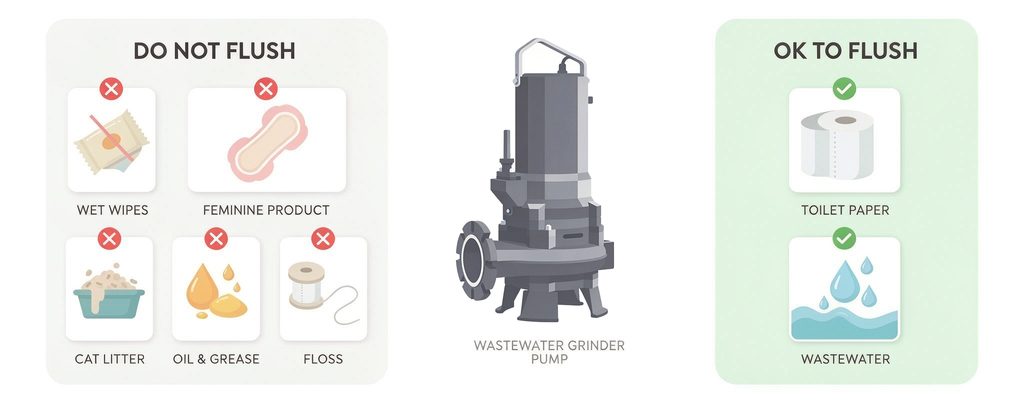
House rules. Water, toilet paper and human waste. Nothing else — no wipes even when the pack says flushable, no paper towel or tissue, no feminine products, dental floss or cat litter, no grease, no paint, solvents or harsh drain cleaners. Grit grinds the cutter down. Wipes wrap round it.
Alarm procedure. Silence the sound, stop using water, wait an hour, check whether the light is still on. Still on, call for service. Cleared on its own, work out why — a nuisance alarm after a big bath is normal, one after a shower is not. In a power outage you have roughly a day of storage, so cut water use rather than test it.
Routine. Press the alarm test a few times a year, listen for a change in sound or run length, keep the lid sealed, and act on the moisture warning light the day it appears. Keep the quote, model number and warranty in one folder.
How to tell a sewer grinder pump is going
Alarm sounding or high water in the chamber; slow drains across the house; gurgling from fixtures; the pump running longer per cycle or never switching off; a hum without rotation; a breaker that trips repeatedly; sewage odour near the tank; a damp patch without rain; a power bill that climbs for no other reason. Any one is worth a look before it becomes a backup.
Frequently asked questions
Can you flush toilet paper with a grinder pump?
- Yes. Toilet paper, water and human waste are what a sewer grinder pump is built for, and paper is already breaking up before it reaches the chamber. It is not built for anything that keeps its strength when wet — wipes even when labelled flushable, paper towel, feminine products, dental floss, cat litter, grease. “Flushable” means it will pass your house pipework, not that it will break down in the tank. Wrapped round a shredding ring, wipes are the most common thing a technician pulls out.
What are the disadvantages of using a grinder pump?
- Four worth knowing. A sewer grinder pump costs the most in this class to buy and install. It often wants a 240 V circuit, which is an electrical bill on top. It has a wearing part — cutter and shredding ring — so its life is shorter than an effluent pump’s despite costing more. And when it stops, it stops completely: no gravity fallback, so failure means an alarm, a rising tank and a real risk of backup. Some makers also use proprietary cores, which limits who can service them.
What happens if a grinder pump fails?
- The alarm sounds, the tank fills, and if nothing is done it overflows. From the moment the pump stops you have roughly a day of household water use, so the sequence is alarm, stop using water, call for service. Keep using water and it comes back through the lowest fixture in the house. Never silence the alarm and carry on.
Do plumbers work on grinder pumps?
- Yes — licensed plumbing and septic contractors do this work, and a straightforward swap takes two to four hours. Two caveats. Some makers run authorised service-centre programmes and require certified technicians for warranty work, so ask. And on a utility-run low-pressure system the district may own the station and insist on its own contractor. It is not a DIY job: the chamber is a confined space with a toxic-gas hazard, and the work involves live electrical parts next to wastewater.
How do you know if your sewage pump is bad?
- The alarm is the first sign. Behind it: longer cycles than usual, running continuously, or not starting at all; a hum with no rotation, which usually means the start capacitor; a breaker that trips repeatedly; slow drains and gurgling; sewage smell near the chamber; or a wet patch in dry weather. Test the float before you condemn the motor — a stuck float makes a healthy pump look dead, and it is a $20 part.
How far will a grinder pump pump sewage?
- Think in pressure, not distance. One published residential unit makes 15 gpm at 0 psig, 11 gpm at 40 psig and 7.8 gpm at 80 psig — and 80 psig is roughly 185 feet of head, since one psi lifts water about 2.31 feet. The pump that moves 15 gpm on a short flat run still moves 7.8 gpm against a serious lift. Horizontal distance then depends on pipe diameter, fittings and friction; pressure sewer guidance calls for mains of 2 inches and larger reaching a cleansing velocity daily. Your number comes off the curve at your elevation and pipe length.
Who owns the grinder pump — me or the utility?
- It varies, and it is worth ten minutes to find out. On a utility-managed low-pressure system the district often owns and maintains the station, and unauthorised work can void a service agreement or a warranty. On a private septic property the sewer grinder pump is yours, along with the bill. Ask the sewer department before you authorise anything.
The bottom line
Replacing a sewer grinder pump on a septic property costs $1,500 to $3,000 if the station is sound, $2,500 to $6,000 if it is not. Before approving anything: confirm which pump you have, confirm who owns it, and make sure the float, capacitor and check valve were tested before anyone quoted a new pump. Then buy on the curve, and keep the paperwork.
Sources
- Orenco Systems — Operational Costs of Two Pressure Sewer Technologies: pump repair at 8–10 years for about $800, replacement at 16–20 years for $1,500–$2,500; field mean time between service calls of 7.2 years across four utility districts.
- Environment One (E/One) — Grinder Pump FAQand pump specification: published average of 10 years between service calls, 240 V dedicated circuit, authorised service-centre programme.
- Colorado Department of Public Health and Environment — Onsite Wastewater Treatment System Regulation: UL 778 or CSA on pumps, NSF/ANSI 46 for grinder pumps, float switch certification, and the effluent filter requirement where a grinder pump sits upstream of a septic tank.
- S. Environmental Protection Agency — Wastewater Technology Fact Sheet: Sewers, Pressure: pressure mains of 2 inches and larger, daily cleansing velocity.
- Published contractor pricing guides for septic and grinder pump replacement (2025–2026): unit, labour, panel, float, electrical, permit, access and emergency ranges, plus regional labour variation.
Cost ranges are indicative and move with region, access and permit rules. Confirm the duty point against the actual curve for the model quoted, and check ownership and warranty before authorising work.
References
1.Title:Operational Costs of Two Pressure Sewer Technologies: Effluent (STEP) Sewers and Grinder Sewers
Abstract: This paper compares lifecycle O&M, repair and replacement costs of grinder sewers and STEP effluent sewers, presenting field failure intervals and pump replacement expense data for decentralized pressure sewer systems.
2.Title: A Comparison of the Operational Energy Demand of Both Low Pressure and Vacuum Collection Systems
Abstract: It evaluates low-pressure sewers with grinder pumps versus vacuum sewer systems, analyzing energy consumption, capital cost advantages on flat/rocky sites and blockage risks from household solids.
3.Title: Manual Alternative Wastewater Collection Systems (EPA)
Abstract: EPA guidance introducing grinder pumps and STEP effluent pumps, covering working principle, alarm setup, check-valve protection, storage limits and common user misuse issues for onsite wastewater.