
Pool Filter System Cost & Runtime: What to Expect Before You Buy
Two questions decide most pool filter system purchases, asked in this order: how many hours a day will it run, and what will that cost. Everything else is argued about afterwards — usually by whoever is not paying the electricity bill.
This guide answers both with numbers, then works backwards to the equipment decision. It is for people who buy and specify rather than own: contractors, resort and municipal facility teams, distributors, OEM buyers.
They belong together because runtime is the input to running cost — you cannot price a pool filter system until you know how long it will run. Over five years the electricity line is usually larger than the equipment line.
What Is a Pool Filter System?
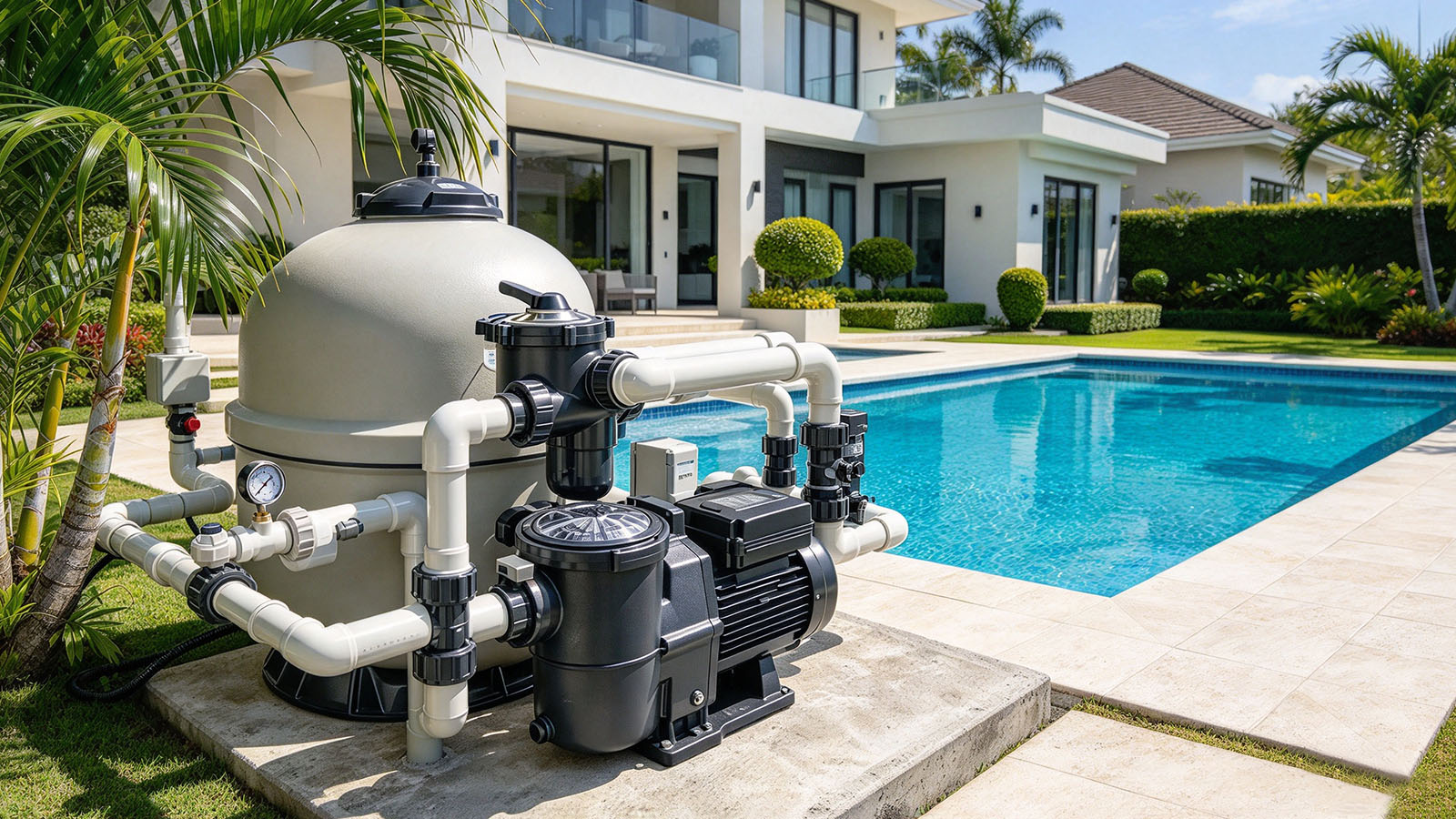
A pool filter system is the circulation loop that keeps pool water clean: a pump that moves the water, a filter that removes particles, and the valves, piping and controls between them. Sold as parts, bought as one decision — which is why a mismatch anywhere in the loop shows up as a complaint about the filter.
A pool filter system does not sanitise — that is chlorine. It does not heat — that is a heat pump. Filtration removes particles so the sanitiser can work, and keeps water moving so chemicals reach every corner.
How a Pool Filter System Works
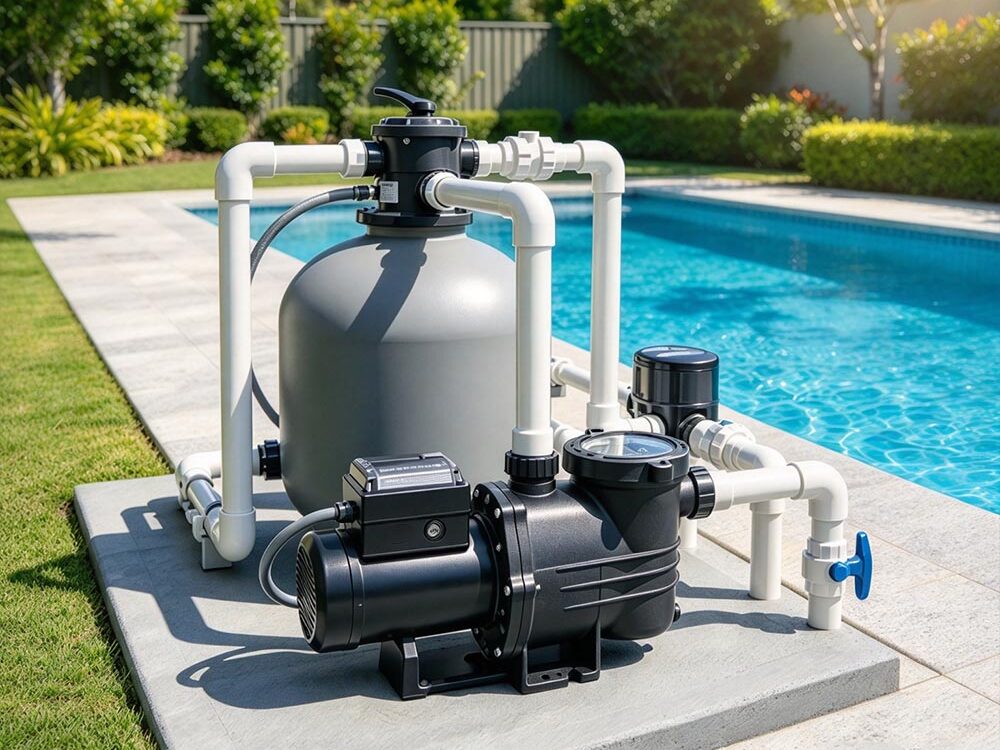
Inside a pool filter system, water leaves through skimmers and the main drain, passes the strainer basket, is pushed into the filter, and returns through jets angled to move the whole body of water — not just the top metre.
Two concepts govern a pool filter system, and both are measurable:
Turnover — the time to pass the whole pool volume through the filter once. Every runtime recommendation derives from it.
Pressure — the gauge on the filter. Rising pressure means the media is loading up; on most installations it is the only instrument fitted.
One counter-intuitive detail: a slightly loaded filter filters finer than a spotless one, because the captured layer — the filter cake — strains out smaller particles. That is why cleaning is triggered by pressure, not the calendar.
What It Actually Does
Clarifies — dust, pollen, dead algae and the silt that leaves water flat despite good readings.
Distributes chemicals — perfect chemistry with poor circulation still grows algae in the corners.
Skims the surface through the same circulation.
Protects downstream equipment — heaters, salt cells, UV and ozone all sit after the filter.
And one that rarely appears on a spec sheet but appears on every invoice: the filter sets the pressure the pump works against, and every extra metre of head is paid for every hour of every day.
The Three Filter Types
All three pool filter system types do the same job with a different medium, and the medium sets both clarity and running cost.
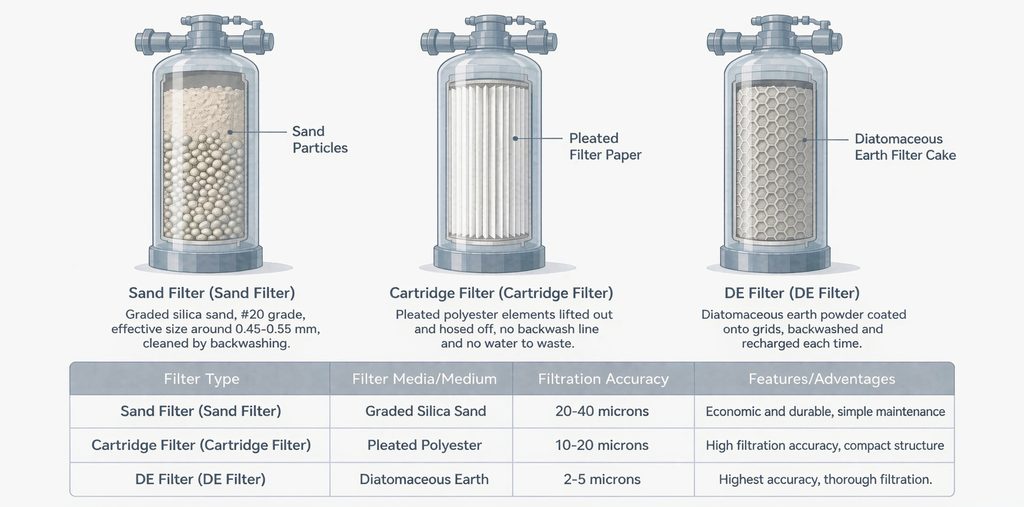
The purchase-price ranking and the running-cost ranking are not the same ranking. That gap is where most budgets go wrong.
Where Pool Filter Systems Are Used
Residential in-ground pools — the volume market for a pool filter system, where running cost is felt most directly.
Above-ground pools — smaller volumes, usually a matched pump-and-filter package.
Hotels, resorts and apartment complexes — long hours, real bather load, auditable circulation records.
Public pools, water parks and leisure centres — turnover is a compliance figure. The CDC Model Aquatic Health Code gives maximum turnover of 6 hours for most pools, 2 hours for interactive pools and lazy rivers, 1 hour for wading pools and 30 minutes for spas (CDC MAHC, 2024 fifth edition).
Spas and plunge pools — cartridge almost universally, for large filter area in a small footprint.
Aquaculture, irrigation and cooling towers — coarse media as pre-filtration ahead of drip lines and exchangers.
Standards That Decide What You Can Buy
Four rules shape what a pool filter system may contain, and one has already removed a whole motor category from new installations.
NSF/ANSI 50 — materials hygiene, corrosion, structural and flow testing, and a requirement that the stated effective filter area be within 5% of measured (NSF International). That clause is the only published number telling you whether a unit is as large as it claims.
US DOE — since July 2021, dedicated-purpose pool pump motors at or above 1 HP must meet variable-speed efficiency requirements (US DOE). A single-speed replacement is no longer an option in most sizes.
ENERGY STAR — certified pool pumps use up to 70% less energy than standard pumps, save up to $350 a year, and are documented as paying back in under two years (US EPA ENERGY STAR). Those are programme figures; two to four years is the honest range for a seasonal pool.
Electrical installation — pool equipment is wired under the national electrical code for pools, where ground-fault protection and receptacle placement are set.
How Many Hours a Day Should It Run?
One full turnover a day, plus roughly a quarter for margin. On a single-speed unit that is 8–10 hours in summer and 4–6 in winter; on a variable-speed unit, 12–24 hours at low speed. Both come from the same arithmetic, which is worth doing once rather than inheriting a timer setting.
Pool volume divided by flow rate in gallons per minute, times sixty, gives hours per turnover. A 15,000-gallon pool on 40 gpm moves 2,400 gallons an hour, so one turnover takes about 6.25 hours. Add a quarter for a filter that is not new and you land near eight hours — which is where the “eight hours a day” rule came from. It was that arithmetic, on that pump, on the day it was installed.
What changes the answer is the motor. The same pool filter system on three different motors gives three different daily hours:
Single-speed — 8–10 hours a day in summer, 4–6 in winter. Run it off-peak where the tariff allows; that alone is 10–20% off for identical filtration.
Two-speed — 2–3 hours on high for skimming, cleaning and any salt cell, then 10–12 hours on low.
Variable-speed — 12 to 24 hours at low speed, with short high-speed blocks for backwashing and vacuuming.
The reason the recommendation inverts is the affinity law, worth stating plainly because it drives every number here: power falls roughly with the cube of speed. Half speed gives about half the flow but roughly an eighth of the power, so twice the hours at half speed moves the same water for about a quarter of the energy. Pacific Northwest National Laboratory measured a typical 1.5 HP pump at about 2,000 watts at 3,450 RPM, dropping to about 593 watts at 2,400 RPM (Pacific Northwest National Laboratory).
US Department of Energy guidance starts lower than industry habit: cut filtration to six hours a day and add half-hour increments only if the water does not look clean. Longer circulation does not by itself prevent algae — chemicals and brushing do. The timer is not a sanitiser.
Season moves it too: one hour per 10°F of air temperature is the common rule for a pool filter system, so a 90°F day wants about nine hours on a single-speed unit — 10–12 hours in summer, 6–8 in winter if chemistry holds.
Signs you are under-running: dull water that clears after a day on high, debris settling in the same corner weekly, chlorine fine on Monday and near zero by Thursday, algae in the same shady spot.
What Does a Pool Filter System Cost to Buy?
Installed, for a like-for-like residential replacement on an accessible pad in the US: cartridge $900–$2,800, sand $1,200–$2,800, DE $1,500–$3,200. Equipment alone is considerably less; labour typically $150–900.
What moves a quotation:
Filter area — element or grid area, or tank diameter on sand. The biggest cost driver, and the one most often undersized to win a bid.
Whether plumbing changes. A like-for-like swap onto existing unions is a couple of hours; switching types means removing the backwash line and multiport valve and re-plumbing.
Pad access — a cramped enclosure or a pad built around the old tank adds hours.
Whether valves, unions and gauges are replaced at the same time — far cheaper than a second call-out a year later.
Check whether you need a filter at all. A pool filter system tank serves ten to fifteen years or more, and many “the filter is failing” call-outs are cheap internal parts — a $15–40 gasket kit instead of a $50–150 multiport valve, a $20–60 lateral set, a $10–40 O-ring.
What Does It Cost to Run?
Two lines: electricity for the pump, consumables for the filter. On most five-year budgets the first is the larger one for a pool filter system — and it is the one nobody puts in the quotation.
Electricity. A 1.5 HP single-speed pump at about 2,000 watts for eight hours a day is roughly 16 kWh a day: about 2,880 kWh over a 180-day season, around $518 at $0.18 per kWh, close to $1,050 year-round. The same filtration on a variable-speed unit lands in a different range, because draw at filtration speed is a fraction of full speed.
Table 1. Runtime and running cost by pump configuration
| Configuration | Daily runtime | Approx. draw | kWh/day | 180-day season @ $0.18/kWh |
| Single-speed, one turnover | 8 h at full speed | ~2,000 W | 16.0 | ~$518 |
| Two-speed, 10 h low + 2 h high | 12 h | ~500 W / ~2,000 W | 9.0 | ~$292 |
| Variable-speed, low-RPM filtration | 14 h | ~400 W average | 5.6 | ~$181 |
| Variable-speed, off-peak schedule | 14 h | ~400 W average | 5.6 | ~$154–$163 |
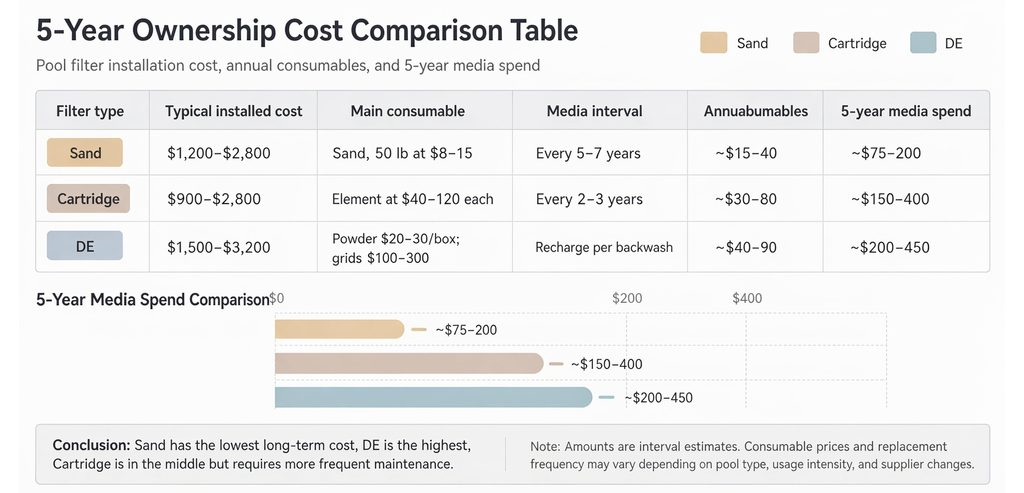
Consumables — the numbers that separate the three types once the purchase invoice is forgotten:
Sand — a 50 lb bag costs $8–15, a tank holds 100–300 lb, a change every 5–7 years. Roughly $15–40 a year.
Cartridge — elements at $40–120 each, replaced every 2–3 years, often two to four at a time. Roughly $30–80 a year.
DE — powder at $20–30 a box recharged after every backwash, plus eventual grids at $100–300. Roughly $40–90 a year.
Note the inversion: cartridge is usually cheapest to buy and mid-field to run; sand cheapest to run and mid-field to buy; DE dearest on both, and buys the finest water. Comparing purchase prices alone picks the wrong one.
Table 2. Five-year cost of ownership by filter type
How to Compare Two Quotations
Brand names are the least useful thing on a quotation. Four checkable numbers tell you more about a pool filter system than any badge, and all four sit on the data plate, the spec sheet or the certification file.
Effective filter area, and whether it is certified — NSF/ANSI 50 requires the stated figure within 5% of measured. A big tank with a small rated area is a smaller filter than it looks.
Design flow rate against the flow the pool needs — not the flow the pump can produce at zero head.
Motor type and compliance — variable speed is the requirement rather than the option in most residential sizes, so a quotation built on a single-speed unit is either old stock or a market the rule does not cover.
Parts availability — gaskets, laterals, grids, cartridges, gauges and unions should be orderable individually. A system serviceable only by whole-unit replacement is expensive to own whatever it cost.
Then one field check settles most comparisons: what each system costs to run for the hours this pool needs. That number decides more than any micron rating on the sheet.
A Worked Example
A 60,000-litre (roughly 15,850-gallon) residential pool, with a pool filter system sized for one turnover a day, over a 180-day season.
On a single-speed unit at about 40 gpm, one turnover is roughly 6.6 hours; with the usual margin, about eight hours a day. At roughly 2,000 watts that is 16 kWh a day, about 2,880 kWh a season, around $518 at $0.18 per kWh.
The same pool on a variable-speed unit running about fourteen hours at filtration speed draws near 400 watts — about 5.6 kWh a day, roughly 1,000 kWh a season, around $181. That is about $340 saved a season, closer to $700 a year if it runs year-round.
Against an upgrade of roughly $1,200–1,500 installed, that is about four years’ payback on a seasonal pool and about two on a year-round one — which is why the two-year figure in programme literature holds for warm climates and stretches for seasonal ones.
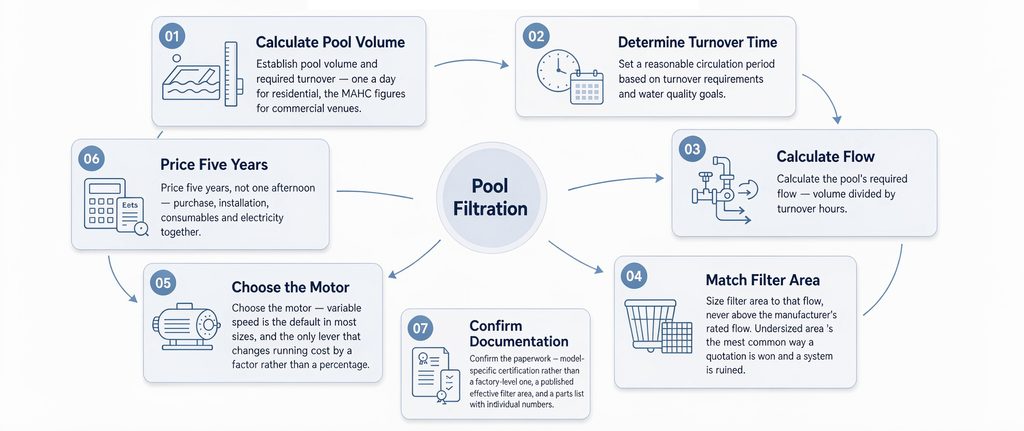
Buying Guide: Six Steps
Frequently Asked Questions
- How many hours a day should a pool filter system run?
- Enough for one full turnover a day, plus a margin for a partly loaded filter. Calculate it from pool volume and flow rate rather than inheriting a timer setting.
- How much does a new pool filter system cost?
- Installed, in the US residential market: roughly $900–$2,800 for cartridge, $1,200–2,800 for sand and $1,500–3,200 for DE, on a like-for-like swap with accessible plumbing. Equipment-only is lower; labour typically $150–900.
- How much electricity does a pool filter system use?
- A 1.5 HP single-speed pump at about 2,000 watts for eight hours a day is roughly 16 kWh a day, about 2,880 kWh over a 180-day season. A variable-speed unit doing the same filtration at low speed lands near 5–6 kWh a day, roughly 1,000 kWh a season.
- Is a pool expensive to run?
- The pump is usually the largest single electrical load in the house, and the one most often left at a default setting for years: several hundred dollars a year seasonally, approaching four figures year-round in a warm climate. Consumables are tens of dollars.
- How do I compare two pool filter systems without relying on brand names?
- Certified effective filter area, design flow against what the pool needs, motor type and efficiency compliance, and whether wear parts are orderable individually. Then price the running cost for the hours your pool needs.
- How long do pool filters last?
- Sand five to seven years, cartridge elements two to three, DE grids for years with annual inspection. The tank lasts ten to fifteen years or more.
What to Expect, in One Paragraph
Expect to run a pool filter system between eight and twenty-four hours a day depending on the motor, and expect the electricity to cost more over five years than the equipment did.
Send a manufacturer four figures, not a model number: pool volume, the turnover you must meet, the electrical supply available, and an honest estimate of total head. A competent team returns the filter area required, the motor type meeting current efficiency rules, and the annual running cost.
References
1.Title: High efficiency pool filtering systems utilising variable frequency drives
Abstract: Experimental tests on VFD pool pumps show 40%–61% energy savings versus single-speed units, maintaining filtration quality and cutting pool electricity consumption and carbon emissions.
2. Title: Whole System Design of an Energy Efficient Residential Pool System
Abstract: Low-speed filtration saves >70% energy; it studies flow limits for salt chlorinators and cleaners, validating low-run high-efficiency pool operation without water quality loss.
Abstract: Reviews the US DOE pool pump efficiency rulemaking process; variable-speed mandates can reduce pool pump energy use by about 75% once stock turnover completes.
4. Title: Field Studies of Two-Speed and PV-Powered Pumps and Advanced Controls for Swimming Pools
Abstract: Field testing evaluates two-speed motors, PV supply and smart controls to cut pool pump power demand; residential pool pumps are major household electric loads.