
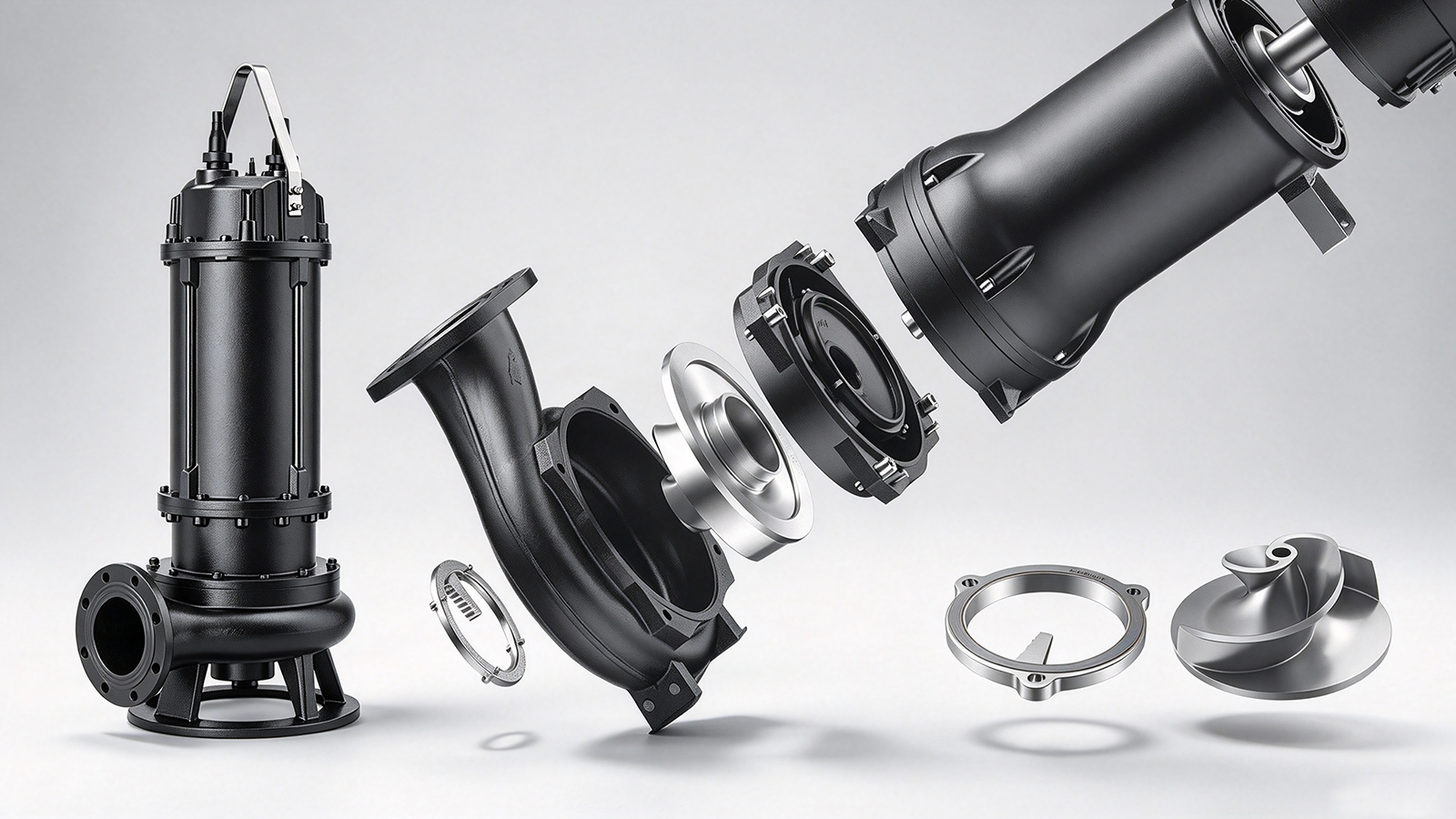
How Much Does a Wastewater Pump Cost?
The honest answer up front
There is no single number, because “wastewater pump” spans a $150 cartridge pump in a septic tank and a $450,000 municipal lift station. What matters more than the price is knowing which end of that range your job sits on.
Here is the whole spread in one place:
| Scale | Typical equipment cost | Typical installed cost |
| Residential effluent / filter pump | $150–$400 | $400–$900 |
| Residential sewage ejector | $350–$1,100 | $1,200–$3,800 |
| Residential grinder pump | $800–$1,800 | $1,500–$3,000+ |
| Commercial lift station (skid) | $8,000–$60,000 | $15,000–$120,000+ |
| Packaged municipal lift station (duplex) | — | $150,000–$450,000 |
Equipment and installed ranges from contractor-reported pricing surveys and published 2026 cost guides; municipal figures cover the factory-built wet well, valve vault, submersible pumps and control panel, before site work.
That municipal line needs a qualifier, and it is a big one: the site-related work — excavation, electrical service, bypass pumping during construction and site restoration — routinely adds 50% to 100% on top of the equipment figure. Anyone budgeting a lift station from the equipment quote alone is short by half.
First, what wastewater actually is
Wastewater is any water that has been used and carries something away with it. Household wastewater runs roughly 155–330 mg/L of suspended solids and 155–286 mg/L of BOD₅ before treatment; after a septic tank and filter, that drops to about 20–55 mg/L and 100–140 mg/L. Municipal and industrial streams vary far more widely, and in some cases run several times stronger than residential — which is exactly why an industrial wastewater pump is quoted against a chemical analysis, not a catalogue.
What makes wastewater hard to pump is not the water. It is what is in it:
- Soft solids— human waste, toilet paper, food scraps
- Fibrous material— wipes, rags, floss, hair. This is the impeller killer
- Grit and sand— abrasive, wears impellers and seals
- Fats, oils and grease— congeals on pipe walls and narrows the passage over months
- Chemical load— chlorides, sulfides, solvents, pH extremes
Every one of those shows up in the price, because each one forces a design decision. A pump for clean water is a commodity. A pump for wastewater is a specification — and the specification is what you are really paying for.
How a wastewater pump works
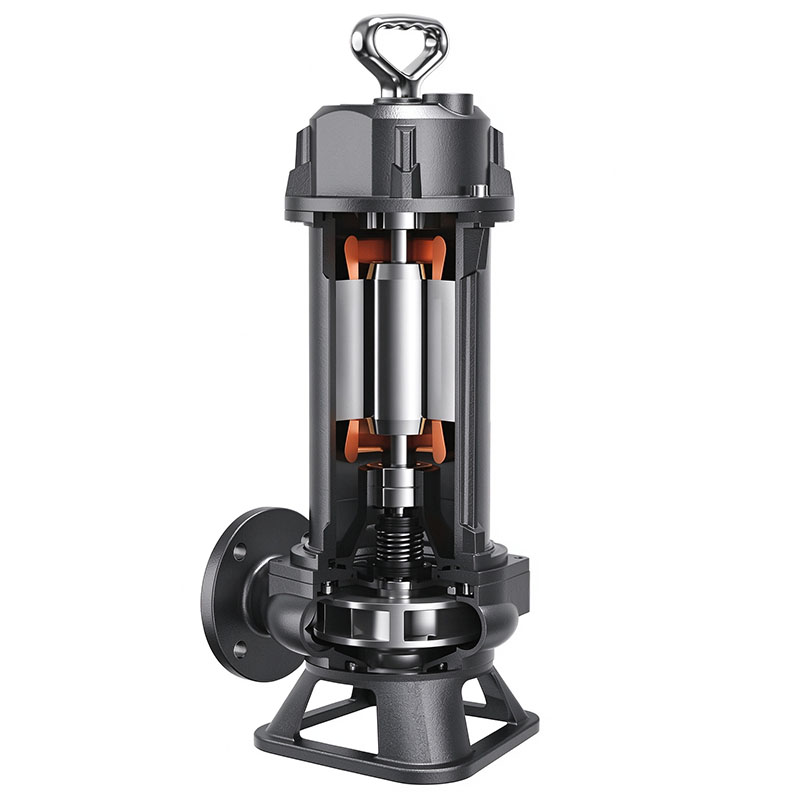
The mechanism is ordinary centrifugal pumping: an impeller spins, throws liquid outward, and converts rotational energy into flow and pressure. Four things surround it.
- Wastewater arrives in a basin, wet well or pump chamber.
- Level rises, and a float switch, pressure transducer or control panel starts the pump.
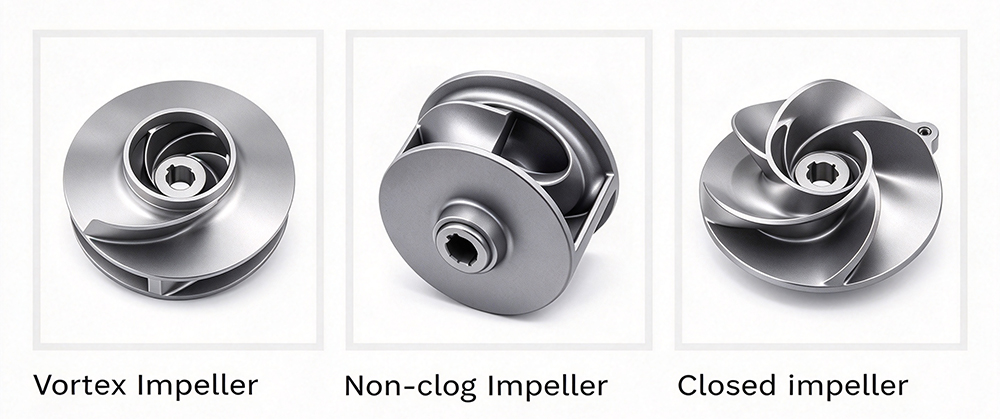
- The impeller does the work.On wastewater duty this is where the money goes: a vortex or non-clog impeller passes solids intact, while a grinder shreds them to slurry first.
- A check valve holds the column so the discharge line cannot drain back and retrigger the pump.
Most wastewater pumps today are submersible — motor and hydraulic end sealed into one unit sitting in the liquid. The liquid cools the motor, which is why running dry destroys them quickly.
The main types, and what they cost
- Effluent pump. For settled wastewater downstream of a septic tank or settling basin, after the solids have dropped out. Passes ¾ inch or less. Cheapest of the wastewater family: roughly $150–$400 for the unit, $400–$900 installed.
- Sewage pump / sewage ejector. Raw waste with soft solids, rated for 2-inch passage on residential work, 3 inch and up municipally. Typically $350–$1,100 for the unit.
- Grinder pump. Cuts solids to slurry so you can run small-bore pressure mains over long distances or uphill. Unit alone commonly $800–$1,800, and $1,500–$3,000 or more installed. You pay for the cutter up front and for blade inspection afterwards.
- Non-clog / channel impeller pump. The municipal wastewater workhorse. Higher efficiency than a vortex, with a defined sphere passage.
- Vortex / recessed impeller pump. Widest free passage, lowest clog risk, lowest efficiency. Chosen where the wastewater stream is unpredictable.
- Cutter / chopper pump. Between a non-clog and a grinder — shears fibrous material without pulverising everything.
Where they get used, and what each job costs
- Below-grade bathrooms and laundry— residential sewage ejector in a sealed, vented basin.
- Septic systems— effluent pump after the tank; sewage pump before it if the tank has to be lifted to.
- Mound and pressure-dosed drain fields— a high-head effluent pump, $300–$700 for the unit.
- Commercial wastewater lift stations— packaged skid with submersible pumps, controls and housing. The station unit itself commonly runs $8,000–$60,000 depending on flow and discharge size, with installation, foundation, electrical, permits and piping taking a total project from roughly $15,000 to beyond $120,000.
- Municipal wastewater collection— duplex or higher, with 100% redundancy so the station still meets peak flow with the largest pump out of service. Packaged duplex stations run $150,000–$450,000 before site work.
- Industrial wastewater— material drives everything. Standard sewage allows cast iron; abrasive slurry calls for high-chrome iron; chlorides push you to 316L or duplex stainless; H₂S-rich wastewater with high sulfide points to CD4MCu duplex.
What actually drives the price
Seven variables, in roughly the order they move the number.
- Horsepower and head.Not the same thing, and conflating them is the most expensive mistake in the trade. Head is what you need; horsepower is what it costs to get it.
- Solids handling.Passing 2-inch spheres requires impeller geometry that sacrifices some hydraulic efficiency. You are buying clog resistance, not flow.
- Materials.Cast iron is the baseline. Each step up — high-chrome iron, 316L, duplex, CD4MCu — buys years in a specific hostile environment and adds real cost.
- Seal and motor protection.Tandem mechanical seals in an oil chamber, moisture probes, thermal switches in the windings, and a compression cable gland. These separate a pump that lasts twelve years from one that lasts four.
- Controls.Float switches are cheap. A control panel with alternation, alarms, and VFDs for peak wet-weather flow is not. On commercial work, electrical and controls commonly run $2,500–$20,000.
- Access and site conditions.The pump is rarely more than a third of the invoice. Chamber access, excavation depth, labour and the tank pump-down that has to happen before anyone can work are what separate a $600 bill from a $1,400 one.
- Certification and lead time.Standard submersible units ship quickly; custom-configured pumps with special materials or hazardous-location listings can run 12–16 weeks or longer.
One more number worth holding onto, because it reframes every price conversation: across the life of a pump, purchase and installation typically account for only about 10–15% of total cost, while energy runs 60–75% and maintenance 15–25%. The cheapest unit on the shelf is rarely the cheapest to own.
Standards worth asking a supplier about
| Standard | What it governs |
| ISO 9906:2012 | Hydraulic performance acceptance testing — grades 1B/1E/1U, 2B/2U, 3B |
| ANSI/HI 11.6 | Submersible pumps tested as a complete close-coupled unit |
| ANSI/HI 9.8 | Pump intake and wet-well design, to prevent vortexing and air entrainment |
| IEC 60529 | IP enclosure ratings — IP68 for continuous submersion, depth and duration declared by the manufacturer |
| NEMA MG1 / IEC 60034-30-1 | Motor design and efficiency classes (IE3, IE4) |
| IEC 60079 / UL 674 | Hazardous (classified) location listings |
| Ten States Standards | Wastewater facility requirements — pump redundancy, minimum pipe diameters, wet-well sizing |
| ACI 350 | Concrete structures exposed to hydrogen sulfide |
Municipal work additionally follows NEC Article 430 for motor circuits and Article 500 for hazardous locations.
Buying guide: eight checks
- Name the liquid.Settled effluent, raw sewage, abrasive slurry, or chemical-laden industrial waste. This one decision selects the pump family and prevents most field failures.
- Calculate total dynamic head, not horsepower.Static lift plus friction loss; add roughly 30% to pipe length to cover valves, elbows and fittings. Twelve feet of static plus about 2.3 ft of friction on 60 ft of 2-inch pipe at 40 GPM lands at 14.3 ft — specify 40 GPM against 15 ft.
- Size for starts per hour, not just flow.For 6 starts per hour at 40 GPM of wastewater you need about 100 gallons of drawdown between float on and off levels. This is the figure most often skipped, and short cycling kills motors through starting current rather than running hours.
- Check velocity.Around 2 ft/s or higher on the discharge keeps solids in suspension. At 40 GPM, 2-inch Schedule 40 gives roughly 3.8 ft/s.
- Choose materials for the actual chemistry.Cast iron for standard sewage, high-chrome iron for grit, 316L or duplex for chlorides, CD4MCu where H₂S is aggressive.
- Specify redundancy above residential.Municipal stations must be duplex or higher, and simplex is prohibited, because the station has to meet peak flow with the largest pump out of service.
- Insist on a certified curve at your duty point.Not a catalogue page, not a horsepower guess. A curve.
- Price the life, not the box.Ask for the efficiency at your operating point, then multiply by the hours you will run.

Using and maintaining one
- Before first start. Clear the basin of debris. Confirm the float swings free and cannot catch the wall or discharge pipe. Fit the check valve 12–18 inches above the discharge, not screwed straight into the pump outlet. Use a dedicated GFCI-protected circuit sized for locked-rotor current.
- First run. Watch one full cycle, time it, and write it down. That baseline is what you compare against a year later.
- Monthly. Pour water into the basin and confirm the pump starts and stops on its own.
- Annually. Clean the intake screen, check the seal and cable insulation, test the floats and alarm, and log running current against the nameplate. On wastewater duty, rising amps at the same flow is the earliest honest signal of wear.
- Daily. Only pee, poo and paper go down the drain. Wipes, paper towels, floss, hygiene products, cat litter and grease go in the bin.
Frequently asked questions
How often does a 1000 gallon septic tank need to be pumped?
It depends almost entirely on how many people live there, and the published tables are more precise than the usual “every three to five years” rule of thumb. For a 1,000-gallon tank in year-round residence: one person, about 12.4 years; two people, 5.9 years; three, 3.7 years; four, 2.6 years; six, 1.5 years; eight, 1.0 year.
So a couple in a 1,000-gallon tank is on roughly a six-year cycle, while a family of four is on about two and a half. That is shorter than most people expect, and it is why the generic three-to-five-year advice lets tanks run long.
Two things pull the interval shorter: a garbage disposal, and any increase in household size or water use. And the table is an estimate — the most reliable method is measuring sludge and scum depth directly with a weighted towel on a stick, then adjusting the schedule from what you actually find.
How much does a 1 hp wastewater pump cost?
For a residential 1 HP submersible sewage or effluent pump, budget roughly $150–$400 for an effluent unit and $250–$600 for a sewage-duty unit, with retail listings for 1 HP submersible sewage pumps commonly landing between about $150 and $300. Installed, a straightforward residential replacement typically runs $400–$900.
Note what you are buying at that price. A 1 HP wastewater pump is a low-head, high-flow machine — designed to move volume a short distance, not to push it up a hill. If your job needs real vertical lift, 1 HP is the wrong question; head is.
What is the best sewage pump for sewage water?
There is no best pump, only the right pump for a duty point — and the honest answer is that the impeller type matters more than the badge.
For raw sewage with unpredictable solids and a history of clogging, a vortex or recessed impeller gives the widest free passage and the lowest clog risk, at some cost in efficiency. For municipal and larger commercial work where efficiency matters and solids are more defined, a channel non-clog impeller is the standard choice. Where the discharge is a long, small-bore or uphill force main, a grinder is the only practical answer — accepting more power draw and a cutting assembly that needs inspection.
Whichever you pick, insist on three things: solids passage stated as a sphere diameter, a certified performance curve at your duty point, and a pump tested as a complete unit to a recognised standard rather than as a bare pump.
How high can a 1 hp pump lift water?
Horsepower alone does not answer this, and that is the most useful thing to know about the question. The pump’s wet end does.
A 1 HP submersible well pump — a multi-stage machine built for pressure — can push water from roughly 200 to 400 feet, but at the top of that range it may only deliver 5–10 GPM, and at 200–250 ft more like 15–25 GPM. A 1 HP surface pump, limited by atmospheric pressure on the suction side, is capped at about 25 ft of suction lift regardless of how much discharge head it can generate.
A 1 HP wastewater pump sits at the other end of that spectrum entirely. Wastewater pumps are built for passage, not pressure: a typical 1 HP submersible sewage pump tops out around 30–40 ft of head, and delivers its rated flow far below that. If you need to lift wastewater 80 feet, you do not buy a bigger motor and hope — you specify for head and check the curve.
What size pump do I need to lift water 20 feet?
Start with the head, add friction, then find the flow.
Twenty feet of static lift plus a realistic friction allowance — say 25 ft total dynamic head on a short run with a check valve and a few elbows — is modest duty. At that head, most residential sewage and effluent pumps in the 1/3 to 1/2 HP class will deliver useful flow; a 1 HP unit would do it comfortably and, if the basin is small, would short-cycle.
The practical method: measure the static lift, add friction (roughly 30% on top of pipe length covers valves and fittings), then read the manufacturer’s curve at that head and pick the pump that gives you the flow you need. If you want 40 GPM at 25 ft, you are looking at roughly the 1/2 HP class. If you only need 15 GPM, 1/3 HP is enough and will cycle better.
Pick by duty point, not by habit. And make sure the basin gives you enough drawdown that the pump is not starting every ninety seconds.
Can a water pump be too powerful?
Yes, and oversizing fails faster and more expensively than undersizing.
A motor draws several times its normal running current every time it starts, and that surge generates heat in the windings. A correctly sized pump might cycle a handful of times an hour; an oversized one fills the basin or pressure tank almost instantly, then restarts as soon as any water is used. Field guidance puts the acceptable ceiling for submersible motors at fewer than 10 to 15 starts per hour. A pump built for a decade of service will not see a third of that under a short-cycling regime.
Three other costs follow. Energy rises, because starting is the least efficient part of the cycle. Wear rises on seals, bearings and the switch. And on well and lift station duty, a pump that pulls faster than the source can supply draws in sand and sediment that erodes the impeller.
Oversizing is not the only sin — an undersized pump runs continuously, overheats and never delivers. The answer is the same in both directions: calculate total dynamic head, pick the pump whose curve puts your duty point near its best efficiency point, and make sure the basin or tank gives it enough volume to rest between starts.
The bottom line
Wastewater pump cost runs from about $150 to $450,000, and the spread is not arbitrary — it tracks head, solids, materials, controls and redundancy, in that rough order. The single biggest jump is not horsepower; it is moving from a residential wastewater pump to a commercial or municipal one, where the pump becomes a small part of a much larger system.
Spend your attention on the three things that actually decide value: total dynamic head rather than horsepower, materials matched to the real chemistry of the stream, and a basin sized for starts per hour. Get those right and the price takes care of itself, because energy and maintenance — not the box — are where the money goes over a ten-year life.
Next step: send your supplier the liquid description, static lift, pipe run, required flow and available drawdown volume, and ask for a certified performance curve at that duty point plus an itemised quote splitting equipment from installation. If they cannot produce the curve, keep looking.
References
1.Title: Examination of Sludge Accumulation Rates for Decentralized Septic Tanks
Abstract: Field monitoring of 29 septic tanks. Household population and water use strongly drive sludge buildup and determine required pump-out frequency.
2.Title: Optimum Simulation and Control of Fixed-Speed Pumping Stations
Abstract: Wet-well control strategy reduces pump start-stop cycles. Less short cycling cuts thermal stress, lowers energy and extends submersible pump service life.