
Why You Need a Swimming Pool Pump?Types, Turnover, Standards & Buying Guide
A backyard pool without a pump is not a pool — it is a 20,000-gallon pond with a nice tile border. Two days of still water in the sun and the shady wall tints green; a week in, you are looking at green water and a chemical bill you never planned for. The fix is not more chlorine. It is a swimming pool pump that keeps the water moving.
Chlorine only works where it can reach. Disinfectant reaches the far corner because something pushes it there, and that something is the pump.
This guide covers what a swimming pool pump is, how it moves water, the six jobs it does, the main pump types, where each fits, the standards that matter, and how to buy, install and run one without wasting electricity.
What Is a Swimming Pool Pump?
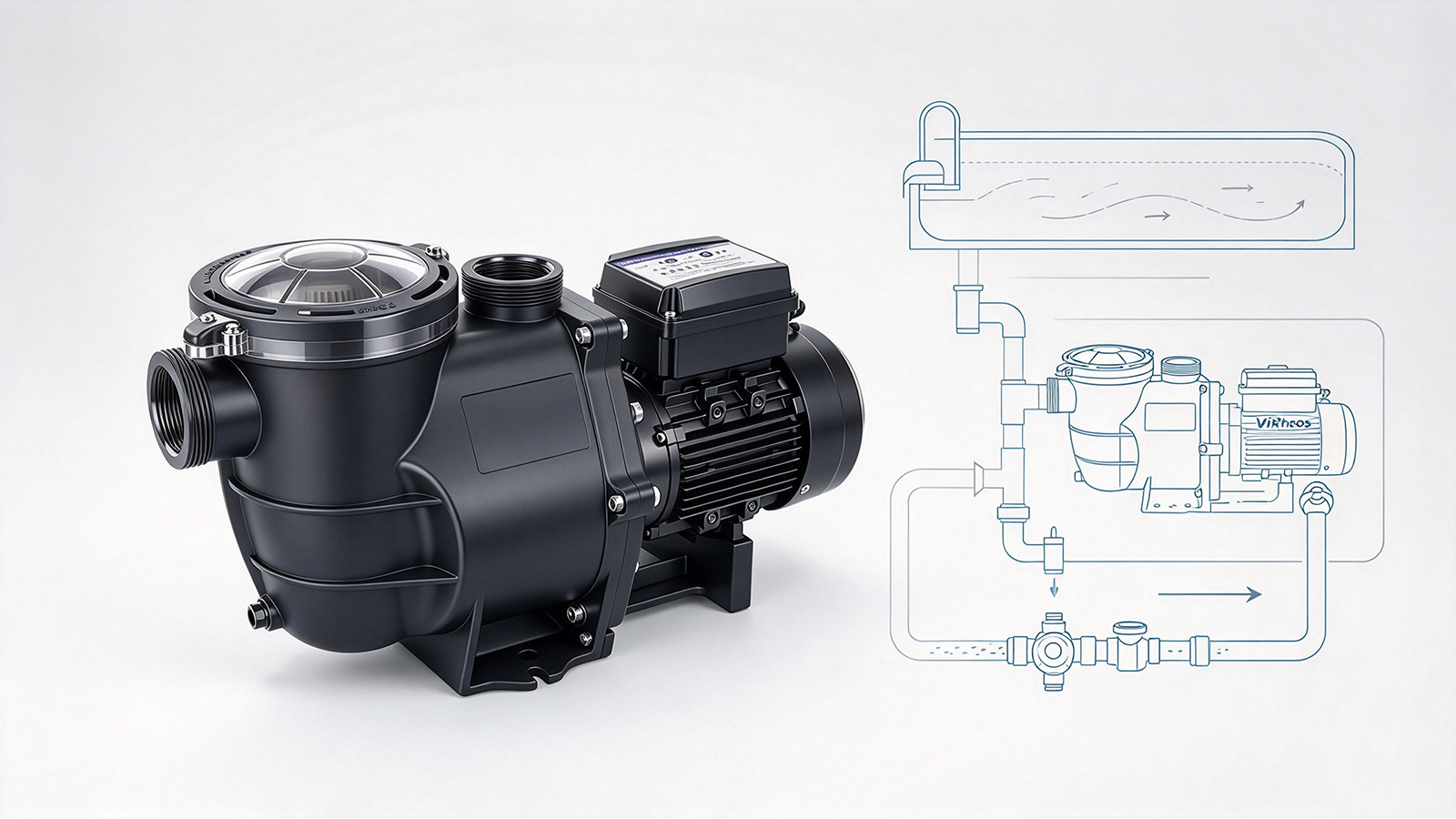
A swimming pool pump is a motor-driven centrifugal pump that pulls water from the pool, forces it through the filter and treatment equipment, and pushes it back through the return jets. Everything else on the pad depends on that flow. Kill it and the rest of the system becomes expensive plumbing decoration.
The parts are worth knowing by name, because they are the parts a service technician talks about:
- Motor— a single-phase induction motor on older units, a permanent-magnet motor on modern variable-speed models.
- Impeller and diffuser— the spinning part that throws water outward and turns motor energy into pressure.
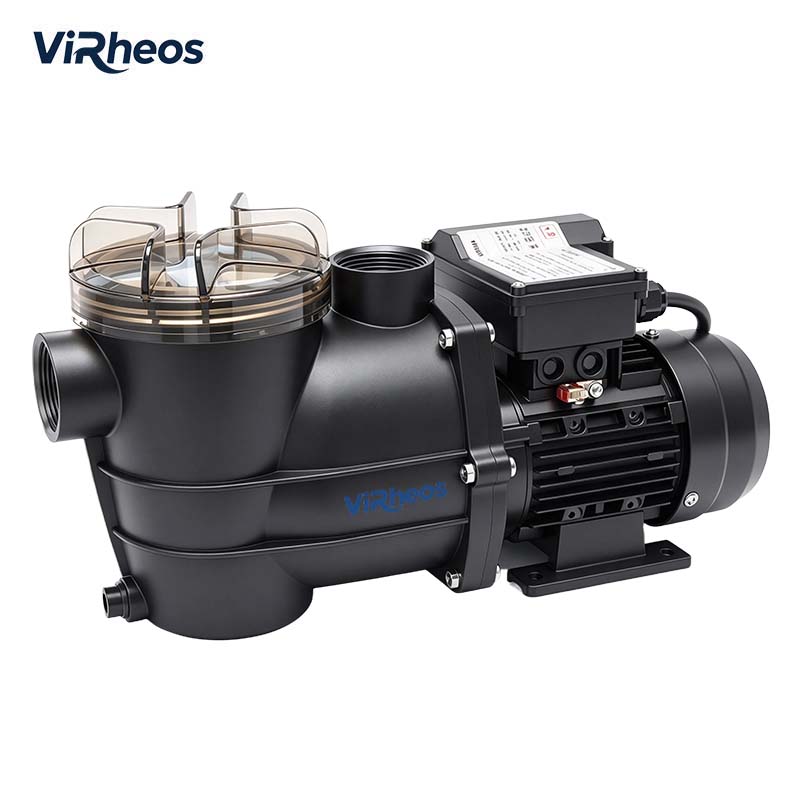
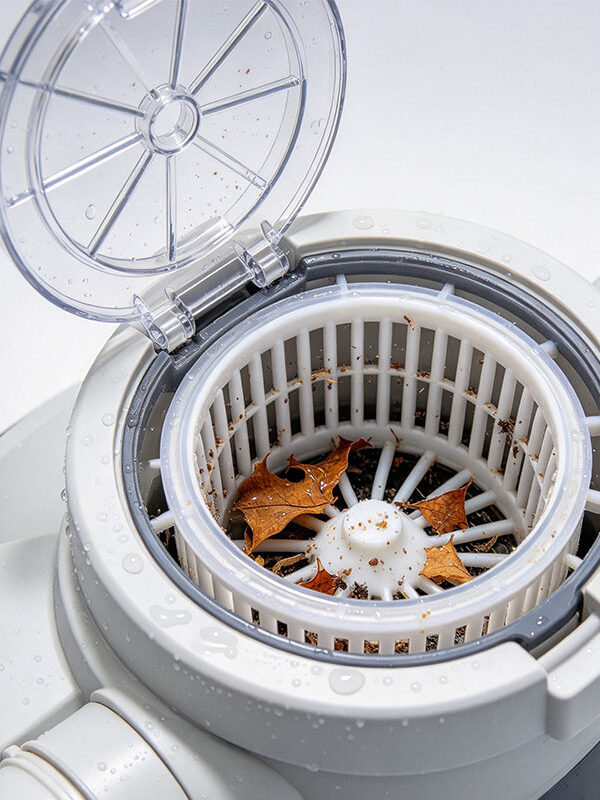
- Strainer basket— the clear-lid pot at the front, also called the hair and lint trap. It protects the impeller from leaves, hair and pool toys.
- Volute (pump body)— collects the water and sends it on to the filter.
- Mechanical shaft seal— small, cheap, and the first thing to fail when the pump runs dry.
- Suction and discharge ports— where the plumbing connects.
In the trade, a swimming pool pump is the heart of the circulation system. Two numbers describe it better than the horsepower badge on the box: flow, in gallons per minute (GPM) or cubic metres per hour, and head, the resistance it pushes against, in feet or metres of water. A pump sold only on horsepower tells you almost nothing about what it delivers once it meets your pipes, filter and heater.
How a Swimming Pool Pump Works
The loop runs in five steps and repeats all day:
- The impeller creates low pressure at the inlet. Water is drawn from the skimmers and the main drain, passes the strainer basket, and arrives at the pump.
- The spinning impeller flings water outward into the volute. Rotation becomes pressure, and that pressure overcomes the filter, the heater and the pipework.
- Water is pushed through sand, cartridge or diatomaceous earth media, trapping particles down to roughly 10–25 microns depending on the media.
- Water crosses the heater, the chlorinator or salt cell, and any UV or ozone unit. Most have a flow switch: below minimum flow, they shut off.
- Clean water goes back through the return jets. Aimed properly, they create a slow circular current that sweeps floating debris toward the skimmers.
Turnover: the number that matters
Turnover is the time needed to pass the whole pool volume through the filter once. It is the most useful number in pool hydraulics. Guidance from the U.S. Centers for Disease Control and Prevention sets turnover at least four times in 24 hours — once every six hours or less — for pools, and 30 minutes or less for spas and splash pads. Residential pools are usually designed around one turnover in 8 hours, sometimes 6 in hot climates.
Why speed costs so much
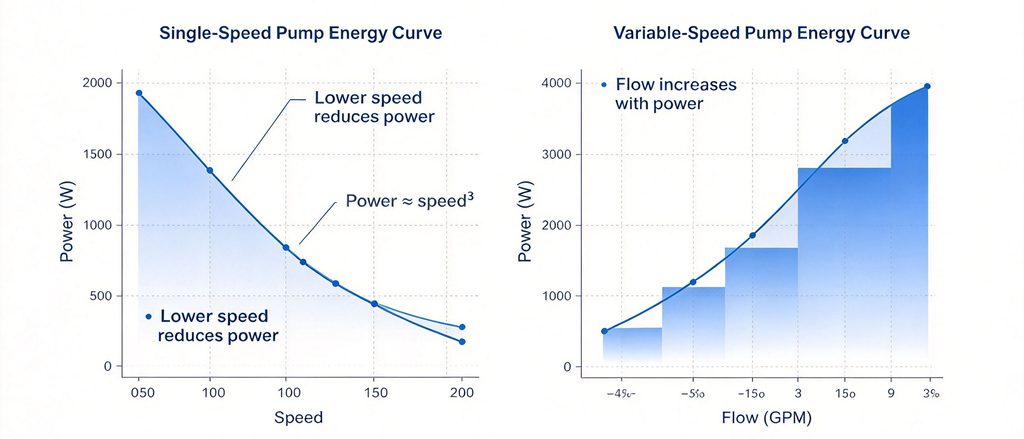
Slowing a swimming pool pump down does not save a little energy, it saves a lot. Power demand rises roughly with the cube of speed, so halving the speed cuts the power needed to about one-eighth.
Measured values published by the U.S. Department of Energy for a 25,000-gallon pool make the point better than any rule of thumb :
- 3,450 rpm — 66 GPM — about 2,000 watts — turnover in 6.3 hours — 6 kWh per day
- 1,800 rpm — 33 GPM — about 250 watts — roughly one-eighth of the power draw
- 1,200 rpm — 22 GPM — about 74 watts — quiet overnight filtration
Run that pool at low speed for longer and daily consumption falls to about 2.2 kWh — around 80% less electricity for the same volume of filtered water. Same water moved, far less paid to move it.
The Department of Energy also notes that a pool pump is often the largest electric motor in a home, burning a few thousand kilowatt-hours a year and ranking second only to air conditioning. ENERGY STAR certified models use up to 70% less energy, save up to about $350 a year, and usually pay back in under two years.
What a Swimming Pool Pump Actually Does
A swimming pool pump does six jobs, and only the first one is obvious.
- Distributes chemicals.A tablet in the feeder does nothing for the deep end unless water moves. Circulation turns dosing into sanitation.
- Feeds the filter.Filters do not suck. They rely on pump pressure. No pressure, no filtration.
- Levels out temperature.Without circulation, a solar-heated pool stratifies: warm on top, cold at the bottom.
- Runs the add-ons.Heaters, salt cells, UV and ozone units and pressure-side cleaners all need minimum flow. Undersize the pump and they cycle off.
- Skims the surface.Return jets aimed the right way push leaves and sunscreen film toward the skimmer — the cheapest cleaning you will ever get.
- Backwashes the filter.Sand and DE filters are cleaned by reversing the flow, and that reverse flow only exists because there is a pump.
Types of Swimming Pool Pumps
Most buyers meet four or five options, and the labels on the box are not always honest. The table below compares the main types of swimming pool pump by how they run, where they fit and what to watch out for.
| Pump type | How it runs | Best fit | Typical power draw | Watch out for |
| Single-speed | One fixed speed, usually 3,450 rpm | Older installs, small above-ground kits, markets without efficiency rules | 1,000–2,500 W | Loud, thirsty, largely displaced by variable-speed |
| Two-speed (dual-speed) | High for vacuuming, low for filtration | Budget retrofit where variable-speed is out of reach | 250–2,000 W | Needs correct wiring and a timer to capture the savings |
| Variable-speed | Permanent-magnet motor, roughly 600–3,450 rpm, programmable | In-ground pools, or any pool with a heater, salt cell or long season | 70–2,000 W | Higher ticket price; needs scheduling to earn it back |
| Self-priming swimming pool pump | Re-primes itself after losing water; can sit above the water line | Pads above pool level, retrofits, most residential installs | 500–2,000 W | Check the published self-priming height, not the claim |
| Non-self-priming (flooded suction) | Must sit below the water line to stay primed | Below-grade pump rooms, new builds | 500–2,000 W | Inlet must stay flooded |
| Booster pump | Dedicated high-pressure feed | Pressure-side cleaners, water features, spa jets | 800–1,500 W | Often runs on the same timer — a hidden load |
| Integrated sand-filter pump | Pump and sand filter in one housing | Above-ground and seasonal pools, easy winterising | 300–900 W | Limited flow; check bed size against volume |
| Commercial end-suction | Continuous duty, often three-phase | Hotels, water parks, municipal and apartment pools | 2–20 kW | Duty rating, redundancy, health-code turnover rules |
Where Each Type Gets Used
Residential in-ground pools. A variable-speed swimming pool pump is the default answer today: filtration at low rpm, then a short high-speed window for the cleaner or the heater. Volume, pipe size and filter area pick the model.
Above-ground and seasonal pools. Integrated sand-filter units dominate here — cheap, light, easy to drain and store. Self-priming matters because the pad often sits above the water line.
Hotels, resorts and municipal pools. Duty cycle changes everything. Commercial pumps run 12–16 hours a day against health-code turnover limits, and a failure closes the facility. Specifiers treat a swimming pool pump certified to NSF/ANSI 50 as a permit condition, not a nice-to-have.
Spas and hot tubs. Thirty-minute turnover, high temperature, jet-driven flow. Spa pumps are sized for jet performance — the opposite of filtration-first pool logic.
Water features, solar heating and infinity edges. These add head and flow on top of the basic loop. A second, dedicated swimming pool pump usually beats upsizing the main one, because the feature rarely runs on the filtration schedule.
Typical case. A 25,000-gallon pool with 1.5-inch plumbing and an old single-speed pump on an eight-hour schedule used about 12.6 kWh a day. The same pool on a variable-speed unit running long hours at 1,200–1,800 rpm filtered the same volume for about 2.2 kWh a day — roughly $400–$900 a year back over a 180-day season.
Industry Standards Worth Knowing
Standards are not paperwork. They are how you check that a swimming pool pump does what the catalogue claims — and in many jurisdictions they are the condition for a permit.
| Standard | Issued by | What it checks | Why a buyer cares |
| NSF/ANSI 50 (NSF/ANSI/CAN 50) | NSF International | Design, material safety, hydrostatic test at 150% of maximum working pressure, independent verification of the published performance curve, verification of claimed self-priming height [5] | The reference equipment standard for pools and spas; written into many state and local codes |
| UL 1081 / EN IEC 60335-2-41 | UL Solutions / IEC | Electrical and mechanical safety of pool pumps, filters and chlorinators | Required for legal sale and installation in most markets |
| 10 CFR 431.465 (Dedicated-Purpose Pool Pumps) | U.S. Department of Energy | Minimum Weighted Energy Factor (WEF, kgal/kWh); compliance required for pumps manufactured on and after 19 July 2021 [3] | Not optional if you import into or sell in the U.S. |
| ENERGY STAR pool pumps | U.S. EPA | Energy performance above the federal minimum, verified by an accredited lab | Qualifies for utility rebates in many regions |
| ISO 9906 / ANSI/HI 1.6 | ISO / Hydraulic Institute | Hydraulic performance acceptance testing of centrifugal pumps | Confirms the flow and head figures on the curve |
| IP rating and insulation class | IEC | Dust and water ingress protection, winding temperature rating | Decides whether the pump survives outdoors, near chlorinated water |
Ask for the certification listing number and check it in the certifier’s directory. A logo printed on a nameplate is easy to add; a listing number is not.
Buying Guide: Nine Checks Before You Sign
- Start with volume and turnover, not horsepower.Required flow = pool volume ÷ (turnover hours × 60). A 20,000-gallon pool on an 8-hour turnover needs 42 GPM.
- Add up the head.Pipe length, diameter, elbows, filter, heater, solar loop and elevation all add resistance. Department of Energy guidance puts the saving from reducing it — bigger pipe, fewer sharp bends, a larger filter — at up to 40%.
- Read the curve.Your swimming pool pump must deliver your required GPM at your feet of head. If a supplier will not send a curve, that is an answer in itself.
- Match the filter.Every filter has a maximum design flow. Pushing 60 GPM through a filter rated for 40 GPM channels the media and wrecks filtration.
- Choose variable speed unless you have a reason not to.Efficiency rules, rebates and the physics above make it the default for in-ground pools.
- Confirm voltage and phase.115/230 V single-phase for most residential work, 230/400 V three-phase for commercial plant rooms. Get it wrong and the pump arrives as a heavy ornament.
- Check the marks, then verify the listing.NSF/ANSI 50, the relevant safety mark, and a compliant WEF rating for the U.S. market.
- Listen to the noise rating.Full speed sits around 70–75 dB; low speed falls to roughly 45 dB. Under a bedroom window, that is the detail you remember.
- Buy on ten-year cost.In a study of 120 pools by Florida Atlantic University, the baseline was 3,000 kWh a year: downsizing the pump brought it to 1,800 kWh, cutting run time to 1,200 kWh, and doing both to 720 kWh — a 75% cut. The pump is cheap; the electricity is not.
Also ask about spares: shaft seals, lid O-rings, baskets and impellers should be stocked items. A swimming pool pump with a three-year warranty and no parts pipeline is a two-year pump.
Installation and Everyday Use
- Where it goes. A level, drained pad above the local flood line, close to the pool, shaded but ventilated. Leave room to open the strainer lid and lift the basket out.
- Plumbing. Keep the suction line short, straight and generously sized — 2-inch pipe is standard residential practice — and prefer two 45° bends over one sharp 90°. Fit unions on both sides.
- Electrical. Dedicated circuit, correctly sized breaker, GFCI protection, proper bonding. Pool equipment and water are a combination where “probably fine” is not a standard. Use a licensed electrician.
- First start. Open every valve and fill the strainer pot with water, because a swimming pool pump that starts dry destroys its shaft seal within minutes. Refit the lid hand-tight, start on low speed, bleed trapped air from the filter, and watch the gauge settle.
- Daily schedule. One full turnover per day is the practical floor. Long hours at low rpm beat short hours at full speed on both energy and water quality, because slow flow gives the media more contact time. Add a short high-speed window for vacuuming or heating.
- Weekly care. Empty the skimmer and pump baskets. Compare the gauge with its clean baseline and backwash when it climbs roughly 8–10 psi. Bubbles in the pump lid usually mean air is being drawn in somewhere. Listen for grumbling bearings.
- Seasonal care. In freezing climates, drain the pump and filter, pull the drain plugs and store the lid and basket indoors. Where freeze protection is fitted, federal defaults are a 40 °F trigger, a one-hour maximum run before re-checking temperature, and no more than half of maximum speed — freeze protection is not a heating programme.
Mistakes That Cost Real Money
- A 2 HP swimming pool pump on a 12,000-gallon pool does not clean better; it wastes power and can damage the filter.
- Running full speed for 12 hours.The most common cause of a shocking pool electricity bill.
- Ignoring the strainer basket.A half-blocked basket starves the pump, raises head and kills seals.
- Undersized suction pipe.A big pump on a 1.5-inch line fights itself all day.
- Buying on price alone.The cheapest pump on the page usually costs more by year three.
Frequently Asked Questions
- How long should a swimming pool pump run each day?
- Long enough for one full turnover — for most residential pools, 6 to 10 hours. Start low, watch the water, and add time in half-hour steps if clarity slips.
- What size swimming pool pump do I need?
- Work out required GPM from volume and turnover, then check the curve at your system’s head. Horsepower is a label; GPM at your head is the answer.
- Can I run the pump at night?
- Yes. On time-of-use tariffs, running a swimming pool pump overnight is usually cheaper. Keep circulation going for a few hours after adding chemicals so they actually mix.
- How long does a swimming pool pump last?
- Typically 8–12 years. The failure signs are familiar: noisy, loses prime, trips the breaker, runs hot, or moves less water than it used to.
- Is a variable-speed pump worth the extra cost?
- Usually yes. Payback commonly lands under two years, and many utilities add rebates on top.
The Short Version
The swimming pool pump is the component every other component depends on. The filter cannot filter without it, the chlorinator cannot distribute without it, the heater cannot deliver without it, and the water cannot stay clear without it. Size it from volume and turnover, check the curve against your real head, buy a swimming pool pump to a recognised standard rather than to a price, and run it slow and long instead of fast and short. Do those four things and the pump stops being the noisiest, most expensive box on the pad and becomes what it should be: invisible.
References
1.Title: A quantitative analysis of swimming pool recirculation system efficiency
Abstract: Bench-scale tracer tests examine pool turnover and hydraulic mixing. Tracer removal follows exponential decay; improving filter capture outperforms adjusting turnover rate for pathogen removal.
2.Title: Whole System Design of an Energy Efficient Residential Pool System
Abstract: This whole-system analysis finds variable-speed pumps save over 80% energy. Low flow risks impair salt chlorinator and pool cleaner, requiring balanced flow scheduling.