
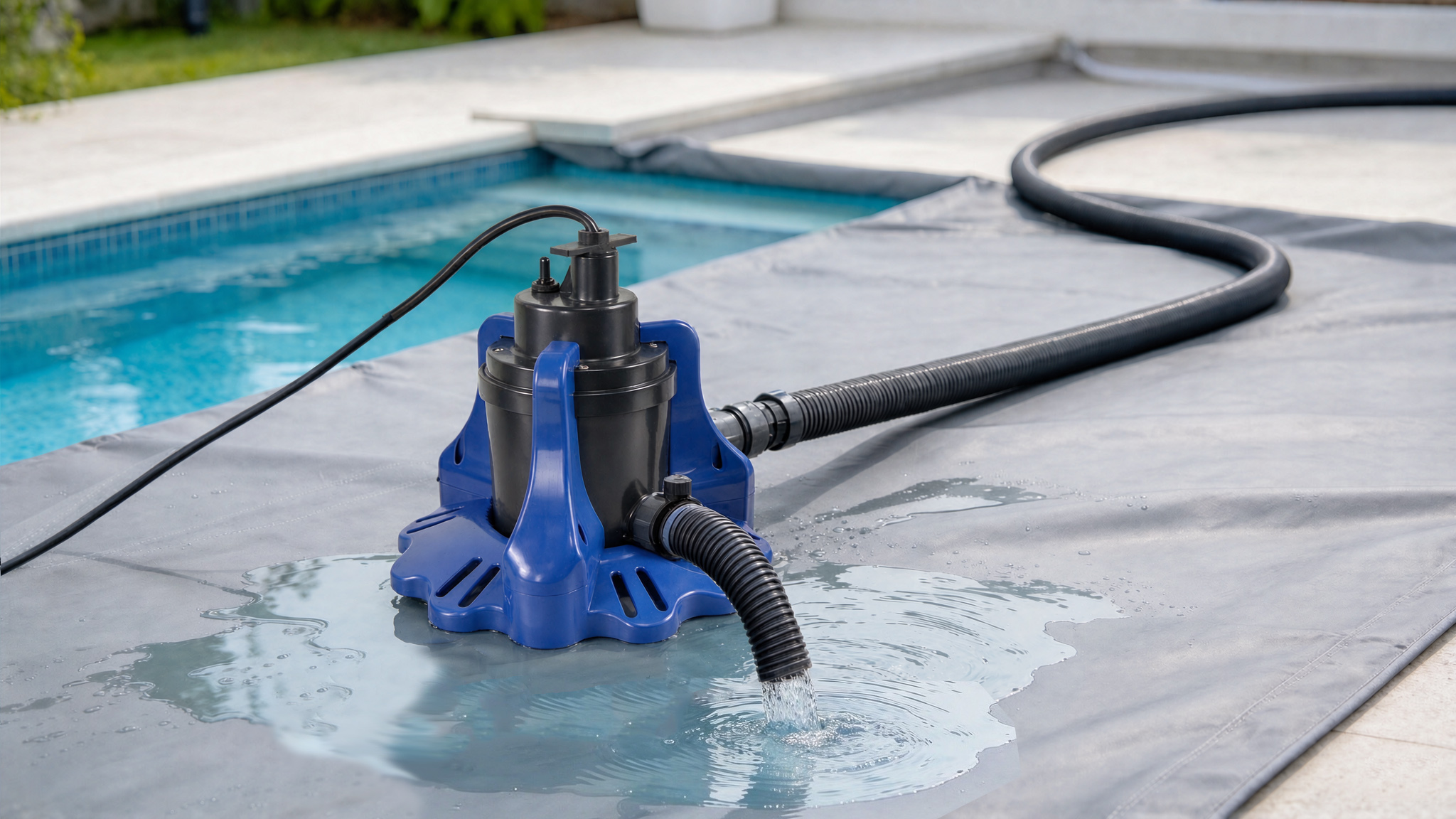
Pool Cover Pump Operation & Maintenance: A Field Guide
Buying a pool cover pump takes an afternoon. Getting four or five winters out of one takes a routine — and that routine is where the money is. A unit left on a wrinkle, under a leaf mat, or frozen into ice will fail in one season whatever it cost.
This guide is the operating companion to the buying decision: how to set a pool cover pump up so it actually drains the cover, the schedule that keeps it alive, what to do when it misbehaves, and straight answers to the questions that come up every winter. It is for contractors, facility teams, distributors and OEM buyers who specify and support this equipment.
What Is a Pool Cover Pump?
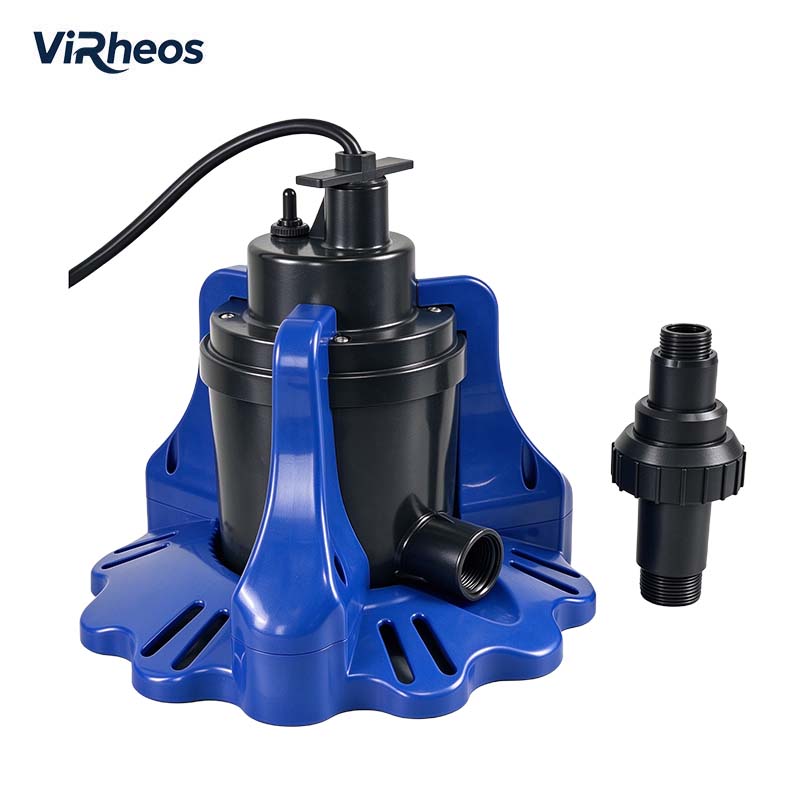
A pool cover pump is a small, low-profile submersible unit that sits on a pool cover and removes standing water — rain, snowmelt, spring thaw — without damaging the cover or running dry. Flat base, screened intake on the underside, a discharge outlet for a standard garden hose, and a cord for an outdoor receptacle.
It is not a circulation pump, and calling a pool cover pump by that name causes half the confusion below. The main pool pump is plumbed into the pool and moves thousands of litres an hour through a filter. A pool cover pump sits loose on a membrane, moves a few hundred gallons after a storm, then goes into storage for the summer. Confusing the two is the single most common source of wrong expectations — including most of the questions answered at the end of this article.
How It Works — and What That Means for Operation
Water enters the screened intake at the base, an impeller pushes it out through the discharge and down the hose. No priming, no plumbing — that part never needs attention.
What does need attention is how it starts and stops, because the water is only an inch or two deep and the pump must switch off before it runs dry:
- Manual — plug in, it runs, unplug it. Fewest parts, highest risk of being left running dry.
- Float switch — a float rises with the water and closes a contact, then drops and stops the unit. Commonly starts near 1–2 inches and stops around ⅜–¾ inch.
- Electronic sensor — probes or solid-state sensing with no moving parts in the water; some trigger as shallow as ⅛–¼ inch.
Three habits follow from that. Floats need free travel, so keep them clear of debris and check them at the start of each season. Electronic sensors need clean probe faces. Manual units need somebody to show up — and if nobody can, the specification is wrong, not the owner.
What It Does
- Protects the cover — water stretches fabric and loads straps and anchors.
- Removes a documented entrapment and drowning hazard: shallow standing water.
- Stops debris breaking down into a nutrient soup that becomes algae and a spring chemistry bill.
- Keeps load off the pool structure — top rails above ground, deck anchors in ground.
It does not winterise the pool, treat the water, or replace a walk-around after a storm. It moves water. That is the whole job.
Types — and the Maintenance Each One Asks For
The type you buy decides the maintenance you sign up for, so it belongs in the operating plan as much as in the specification.
- Manual submersible. Cheapest and simplest. The burden is human — somebody must be there and must remember to unplug it. Fit thermal overload protection.
- Automatic with float switch. The default for most residential and light commercial pool cover pump work. The float is the service item — check it moves freely, clean around it, and confirm the housing can be opened without breaking seals.
- Automatic with electronic sensor. The pool cover pump choice for unattended sites. Fewer moving parts, but probe faces foul and the board is replaced rather than repaired. Ask how it behaves after a power cut.
- Deck-mounted centrifugal. Keeps electrics out of the water but needs priming and frost drainage. Usually bespoke rather than catalogue.
Where a Pool Cover Pump Runs
- Residential in-ground pools with solid winter covers — the core case. Mesh covers drain through and rarely need one.
- Above-ground pools — load goes into top rails and wall structure, not just the cover.
- Hotels, resorts and municipal pools closed for the season — off-season covers carry documented inspection obligations, so unattended automatic operation is the only practical arrangement.
- Holiday homes and managed rentals — nobody is on site to plug a pump in after a 3 am storm.
- Beyond pools — flat roofs, tank and pond covers, tarps over stored material, where shallow-water auto shut-off works the same as on a membrane.
The Rules That Touch Pool Cover Pump Operation
Three rule sets shape how a pool cover pump may be installed and run, and two of them show up in daily use rather than on a spec sheet.
Electrical supply. In the US, receptacles and equipment around pools fall under National Electrical Code Article 680: no receptacle within 6 ft of the pool, at least one GFCI-protected receptacle between 6 and 20 ft, and GFCI protection for equipment receptacles (NFPA 70, Article 680). For the operator it reduces to one rule — into a GFCI outdoor receptacle, never an indoor extension cord.
Product rating. Submersible duty is the whole point: the European pump safety standard requires submersible pumps to meet IPX8 for continuous immersion, with CE marking on top (EN IEC 60335-2-41:2021+A11). In North America, confirm the listed category covers continuous immersion, not intermittent drainage duty.
Cover obligation. ASTM F1346, current edition F1346-23, is the performance specification for safety covers: a 485 lb static load test for pools wider than 8 ft, and a requirement that substantially all standing water be removed within about 30 minutes of rainfall stopping (ASTM F1346-23). That drainage clause is why running a cover pump is a compliance habit, not a matter of taste.
One more governs the rest of the site: during thunderstorms, get everyone out of the water. The 30-30 rule — shelter when the flash-to-bang count drops below 30 seconds, and wait 30 minutes after the last thunder — is standard practice because plumbing and standing water conduct strike current (NOAA).
Buying With Maintenance In Mind
If the unit is to be serviced rather than replaced, four things have to be specified up front.
- Flow that clears the cover quickly enough — and no more. Cover makers commonly cap flow at about 20–30 gpm so the intake cannot grab the fabric, and specify a base screen of around 6 inches.
- Automatic shut-off or dry-run protection. This is the feature that decides whether a unit survives its first season.
- Cord length planned against the receptacle — 25 ft typical, 33 ft on some models — rather than solved with an extension cord.
- Spares as parts: float assemblies, intake screens, impellers and cords should be orderable separately.
Setting Up and Running a Pool Cover Pump
Placement
- Skim the worst of the leaves first. Most “the pump has failed” callouts are a leaf mat over the intake.
- Set the pool cover pump at the true low point, flat and stable. These units are light; one that tips draws air and looks exactly like a mechanical fault.
- Attach the hose securely, run it well away from the pool and house, and check it is not kinked.
- Plug into a GFCI-protected outdoor receptacle — never an indoor extension cord.
- Watch the first two minutes: a humming motor is not proof water is moving. Airlocks appear right here.
Through the season
- Re-check the low point after every rain or melt. Covers shift, and a pump out of the deepest pocket drains partway then short-cycles.
- Clear the intake screen through leaf fall — monthly is a reasonable default, weekly under heavy trees.
- Check the cord and plug each season; months outdoors on an abrasive deck is hard on both.
- After pumping, check the pool water level — an unattended automatic unit can move more pool water than expected.
Cold weather
Freeze damage is the most common way a working pool cover pump becomes a replacement purchase. Work to thresholds rather than guesswork:
- 32–25°F: leave it in place. If manual, run it every 12 hours or so; confirm an automatic unit is cycling.
- 25–20°F: run a manual unit every 6–8 hours, or take it off. Make sure the hose drains fully after each cycle.
- Sustained below 20°F beyond about 48 hours: remove it. Residual water freezes between cycles and ice expansion cracks housings and jams impellers.
- Frozen into ice? Do not chip at it — disconnect, wait for the thaw, remove water by hand meanwhile.
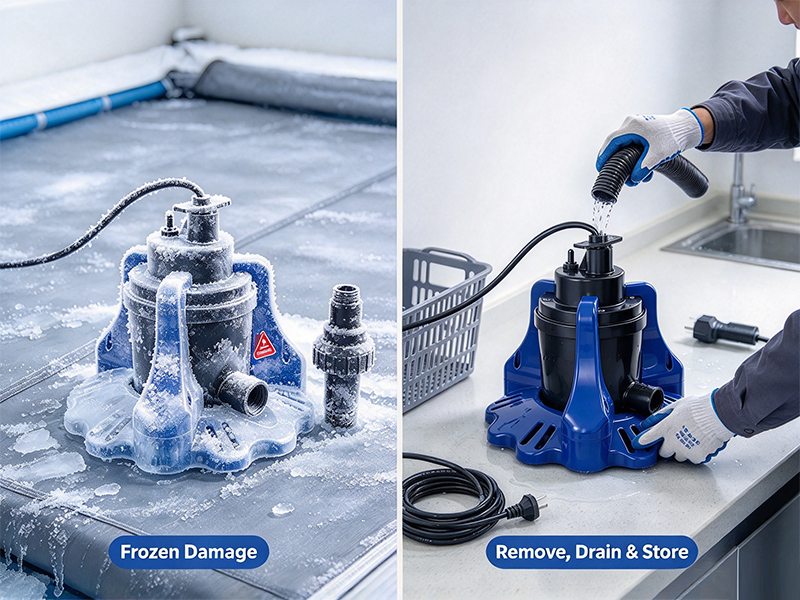
Table 1. Service schedule and fault diagnosis
| When | Task | What it prevents |
| Before the season | Bench-test the unit in a bucket; check float travel or probe faces; inspect cord and plug | Discovering a dead pump on the night of the first storm |
| Each placement | Skim leaves, set at the low point, check the base sits flat, verify the hose is clear | Airlocks, tipping, and intakes blanketed by debris |
| Monthly in leaf fall | Clear the intake screen; rinse the housing | Progressive flow loss that looks like motor failure |
| After every storm | Re-confirm the low point; check discharge is actually moving water | Short-cycling when the cover shifts under load |
| After pumping | Check pool water level | Silent loss of treated and balanced pool water |
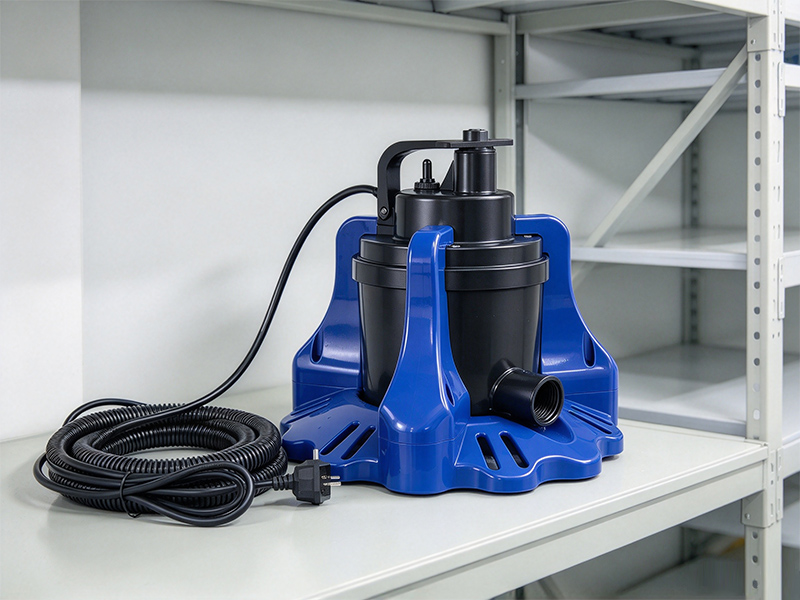
| End of season | Drain pump and hose fully, rinse, dry, coil the cord loosely, store indoors | Freeze cracking and cord damage in storage |
Table 2. Operating parameters worth recording
| Parameter | Typical figure | Why it matters in service |
| Start / stop depth (float) | Start near 1–2 in; stop near ⅜–¾ in | Explains why a thin film of water is normal, not a fault |
| Start depth (electronic sensor) | Some trigger near ⅛–¼ in | Lower residual water; probe faces need cleaning |
| Residential power draw | 50–120 watts | Running cost is cents per hour; energy is not the decision factor |
| Flow range | A few hundred to ~3,000 GPH | Sets drain time; must sit under the cover maker’s cap |
| Cover maker flow cap | Commonly ~20–30 gpm (1,200–1,800 GPH) | Above this the intake can grab or vortex the fabric |
| Freeze removal threshold | Below ~20°F sustained beyond 48 hours | The point where removing the pump beats cycling it |
| Service life | 3–5 seasons typical; up to 5–8 with good storage | Justifies a spare unit on site rather than an emergency order |
Pool Cover Pump Questions Owners Actually Ask
- Should the cover stay on when it rains — and can the main pump keep running?
- Yes to both, and they are separate questions. The cover stays on: pulling it off during rain lets debris and diluted water straight into the pool. The circulation pump can keep running with the cover on — the pump is below the cover, not on it. There is no need to switch the pool pump off during rain; post-storm circulation is what clears the debris the rain washed in. The exception is safety, not equipment: keep people out of the water during thunderstorms and for 30 minutes after the last thunder.
- Can I pump cover water back into the pool?
- That water has been collecting leaves, pollen, bird droppings and everything else the wind delivered, and it is untreated. Pumping it into the pool is the fastest way to a green pool and a shock bill in spring. Route the discharge to a lawn, a planted area or a drain, well away from the pool and house — and note the reverse risk: a short discharge or a cover draining toward the pool just recirculates what you removed.
- Can a pool cover pump be fully submerged?
- Yes — that is how it is designed to work. The rating to look for is continuous immersion rather than splash resistance: the European pump standard requires IPX8 for submersible pumps. Two limits still apply: it is rated for shallow water on a cover, not for deep or permanent submersion in a pool, and the cord, plug and receptacle must stay out of the water.
- How do I remove excess water from the pool itself?
- Not with a pool cover pump — different job. Overfilled pool water is lowered through the waste line on the filter valve, with a submersible pump placed in the pool, or by siphoning with a hose. A cover pump is too small and outside its rating in the pool itself. If you are lowering the level often, check whether the cover drains into the pool or the autofill is misbehaving.
- Should I cover the pool every day, or leave it uncovered overnight?
- Cover it whenever the pool is not in use, including overnight. Uncovered water is where the money goes: EPA WaterSense puts evaporation reduction from a solid cover at more than 90%, with 50–70% of heating costs saved, and estimates an uncovered 500 sq ft pool can lose 12,000–31,000 gallons a year (EPA WaterSense). A night or two uncovered will not ruin anything — it just costs water, heat and sanitiser.
- Can the main circulation pump sit idle for a week?
- In swimming season, no — a week without circulation is usually a week of green water, because sanitiser is not distributed and nothing is filtered. A properly winterised closure is different: chemistry is set for the off-season and the circulation pump stays off by design, while the pool cover pump handles water on top. Those are two different operating states, and confusing them causes a lot of unnecessary alarm.
- How long do pool cover pumps last?
- Three to five seasons is the honest expectation for a well-maintained unit, with some reaching five to eight when stored dry and indoors; budget manual models often manage two to three. On solid covers under near-continuous duty, installers commonly report two to four years. The wear is environmental far more than mechanical — dry running, freeze-thaw cycling, UV, and being dragged across a deck. Treat it as a consumable and keep a spare on site; the failure always arrives during the worst storm of the year.
- Is it safe to run a pump while people are swimming?
- For the circulation pump, yes — that is normal operation, provided the installation is electrically compliant and GFCI-protected as the pool electrical code requires. For a pool cover pump, the question should not arise: the cover is off before anyone swims, so the pump is off the cover, unplugged and put away. Never leave a cover pump running on a cover that people are walking on or removing.
- Is it fine to run the pool pump all day?
- It depends on the pump, not the hours — and a pool cover pump is not part of that calculation at all. A single-speed unit running all day is expensive and unnecessary; a variable-speed unit running most of the day at low speed is often cheaper than a single-speed running six hours, since power falls roughly with the cube of speed. Match run time to the turnover requirement, and clean on pressure rather than on the clock.
- How often should a cover come off, and what do I do with it?
- A winter cover comes off once, at opening. Solar and debris covers come off whenever the pool is in use and go back on after. When it is off: rinse it, dry it completely, fold dirty-side inward and store it dry, shaded and rodent-proof — stored wet it goes mouldy, stored in sun it goes brittle. Inspect seams, straps and springs at the same time, and repair small damage then rather than in a hurry at closing.
The Short Version
A pool cover pump is bought once and maintained for a decade, and the maintenance is almost entirely placement, cleanliness and cold: set it at the low point, keep the screen clear, never let it run dry, take it off before a hard freeze, store it dry indoors, and bench-test it before the season rather than on the first storm night.
Most failures reported in this category are not motor failures. They are a pump on a wrinkle, a screen under a leaf mat, a float stuck on grit, a hose frozen solid, or a unit left running in an inch of slush. Every one costs nothing to rule out, and every one is cheaper than the cover the pump exists to protect.
Specifying these across a fleet or a product line? Standardise four things: record the activation depth and flow cap of the actual model in use, keep a maintenance log per site, stock floats, screens and cords as separate parts, and hold one spare unit per site. That is what turns a seasonal consumable into equipment you can rely on.
References
1.Title: Effectiveness of Pool Covers to Reduce Evaporation from Swimming Pools
Abstract: This study tests evaporation suppression of six pool cover types at NPIRC, quantifying water savings for solid covers, which rely on cover pumps to remove standing rainwater.
2.Title: Position Paper: Layers of Protection Around Aquatic Environments to Prevent Child Drowning
Abstract: It outlines multi-layer drowning prevention for pools, noting standing water on safety covers creates entrapment risk requiring drainage via cover pumps.
3.Title: Quantifying the Influence of the Pool Cover on the Water Evaporation Rate in Indoor Swimming Halls
Abstract: Field measurements show movable pool covers cut indoor pool evaporation up to 70%, and cover drainage affects long-term cover integrity.