
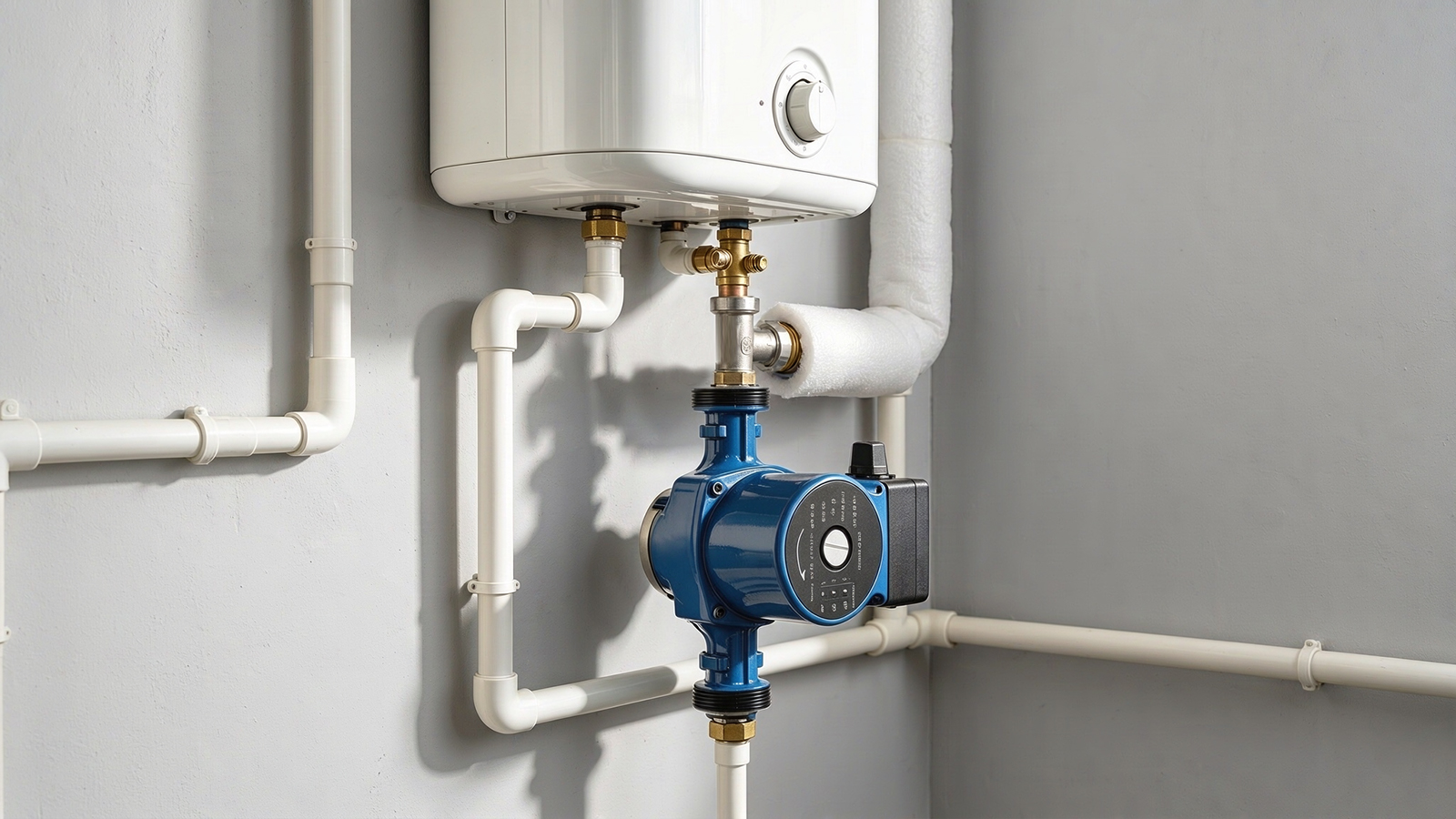
Hot Water Recirculating Pump: Complete Buyer’s Guide for Instant Hot Water
You turn the handle at the bathroom sink. Nothing. Twenty seconds later, lukewarm. By the time it’s actually hot, you’ve watched a minute of clean water go straight down the drain — and that’s before anyone flushed a toilet or started the washing machine.
A hot water recirculating pump exists to end that wait. This guide covers what these pumps do, how they work, which type fits which bathroom, what the regulations actually require, and how to specify a hot water recirculating pump without guessing. Real numbers, named sources, and an honest look at when the payback doesn’t work.
What Is a Hot Water Recirculating Pump?
A hot water recirculating pump is a small circulator that keeps hot water moving through your plumbing so it’s already at the tap when you open it. Instead of letting water sit in the pipe and cool down between uses, the pump gently pushes cooled water back toward the heater and pulls fresh hot water into the line.
It’s worth being clear about what it is not. A hot water recirculating pump does not heat water, does not increase pressure, and does not raise flow. If your shower is weak because of low supply pressure, this is the wrong product — you’d want a booster instead. The recirculation pump solves one specific problem: the wait.
Three terms will keep coming up:
- Loop— the path hot water travels: out from the heater to the fixtures, and back again.
- GPM / L/min— how much water moves through the loop per minute.
- Head (feet or metres)— how much resistance the pump can push against. In a house, resistance is mostly pipe friction and fittings, not height.
Here’s the number that explains why this matters. Researchers at Lawrence Berkeley National Laboratory, working with the US Department of Energy, estimated that the average US home runs 6.35 gallons of water (24 L) down the drain every day just waiting for hot water to arrive. Add the water that was heated, sat in the pipe, and cooled before it was ever used, and the figure rises to 10.9 gallons per day. Set against average household hot water use of about 52.6 gallons per day, roughly 20% of daily hot water is wasted.
That’s about 2,300 gallons a year down the drain. You will see pump brochures quoting 10,000 or even 15,000 gallons saved annually. Those numbers usually count total hot water waste, not just the water you pour away while waiting. Both can be true; they’re measuring different things. Buyers who compare them side by side end up disappointed, so it’s worth knowing which one you’re being sold.
Do You Actually Need One? Read the Symptoms First
Not every slow tap needs a hot water recirculating pump. Run through this first.
| Symptom | What’s actually happening | What to do |
| Hot water takes 45–90 seconds at one far bathroom | Pipe run too long; standing volume too high | Measure the run length — this is a pump job |
| Every fixture is slow, hot and cold alike | Supply pressure or flow problem, not a wait problem | Fix pressure first; a recirc pump won’t help |
| Hot water arrives fast in the morning, slowly at night | You’re waiting on the heater to recover, not the pipe | Check heater capacity and tank size |
| Master bath is fine, guest bath is terrible | Branch run is long or uninsulated | Consider a fixture-level pump on that one branch |
| Tankless heater gives hot-cold-hot “sandwich” | Burner ramp-up gap plus cooled pipe volume | Recirculation plus a buffer or mixing valve |
| You’re in a drought area with tiered water rates | Wasted water costs more per gallon | Strongest payback case for a demand system |
The honest test is the bucket one, and it takes two minutes. Open the hot tap at the worst fixture, run it into a bucket, and stop when it’s hot. Anything over about 0.6 gallons means the standing volume is too large — and that specific figure is not arbitrary. EPA WaterSense requires that no more than 0.6 gallons be delivered to a fixture before hot water arrives, and that no more than 0.5 gallons be stored in piping between the hot water source and any fixture (EPA, New Homes Hot Water Distribution Guide).
The US Department of Energy uses the same threshold in its Efficient New Homes program: field verification collects no more than 0.6 gallons before hot water shows up, with the flow temperature rising at least 10 °F (DOE Efficient New Homes, Version 2 Rev. 3). If you’re failing that test, you have a documented, measurable deficiency — not just a nuisance.
How a Hot Water Recirculating Pump Works
The mechanics of a hot water recirculating pump are simpler than most people expect.
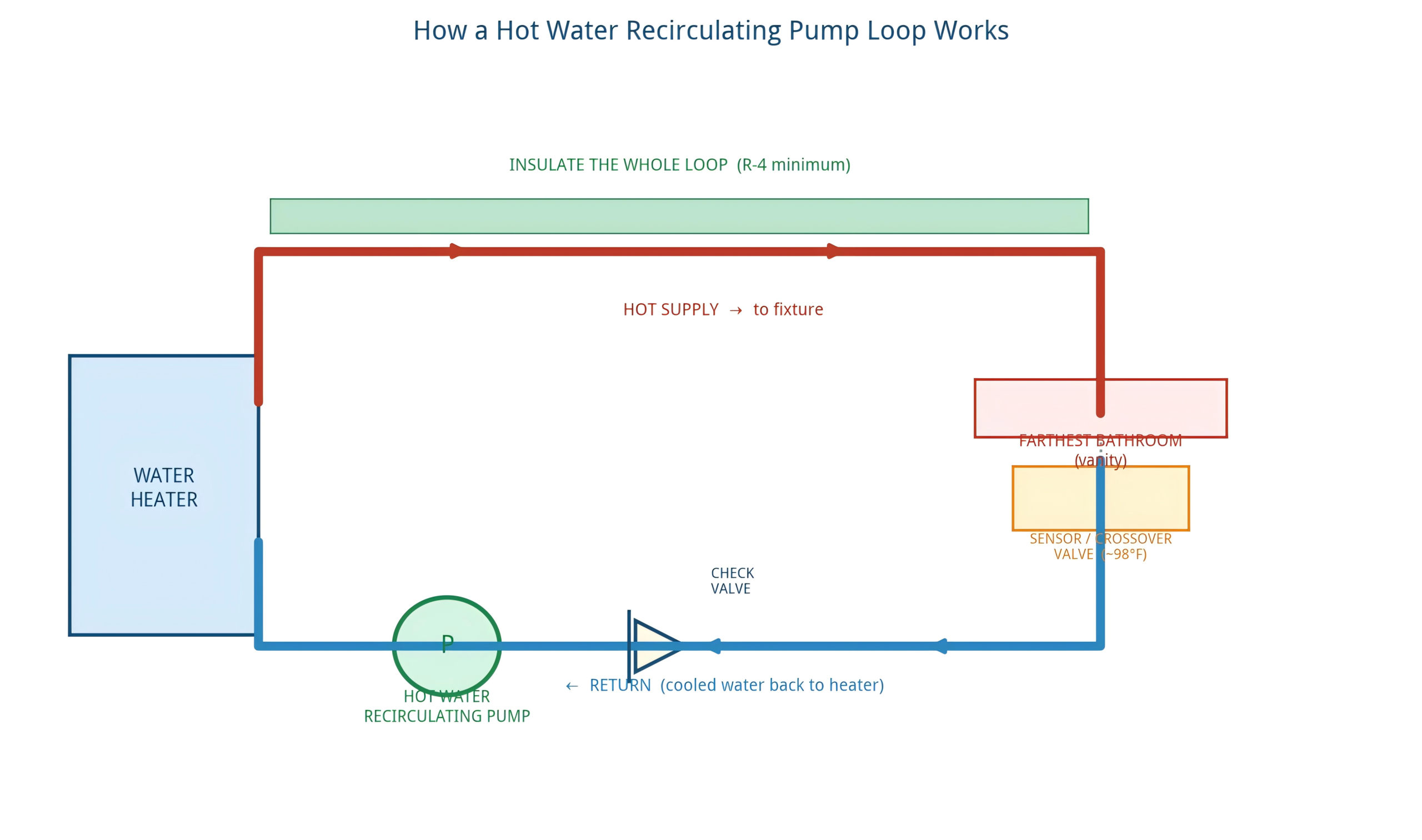
The loop. Hot water leaves the heater through the normal supply pipe. At the farthest fixture, instead of dead-ending, the line continues back to the heater — either through a dedicated return pipe, or (in retrofit systems) through the cold water line using a thermostatic crossover valve.
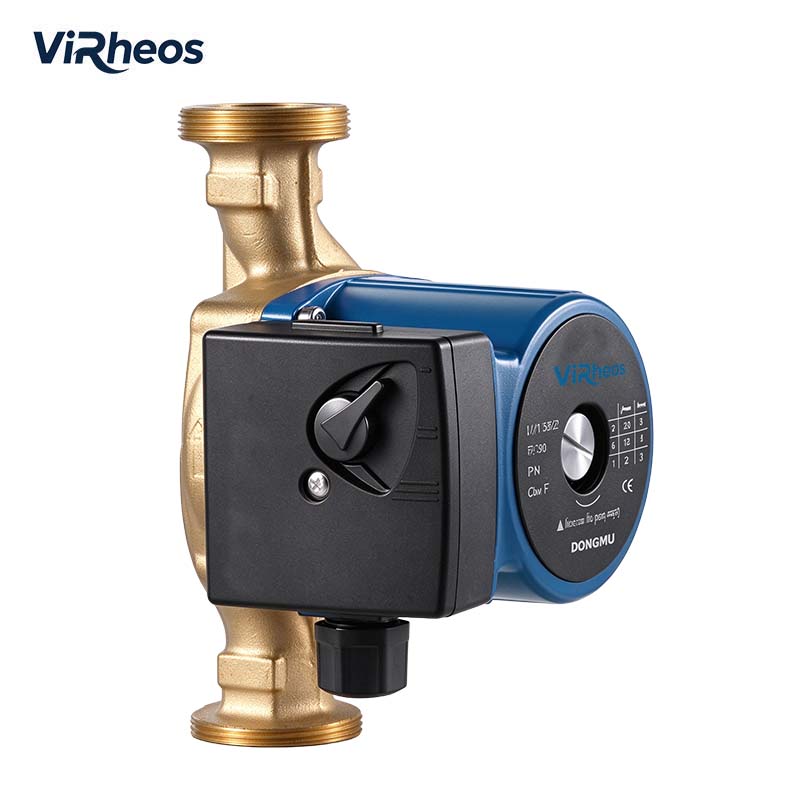
The pump. Almost every residential unit is a small centrifugal circulator: an impeller on a wet-rotor motor, often drawing 5 to 45 watts. Water both lubricates and cools it, which is why these pumps are quiet — there’s no fan.
The check valve. Built into most pumps, it stops water flowing backwards through the loop. Without it, cold water can migrate into the hot line and you’ll feel the loop draining between draws.
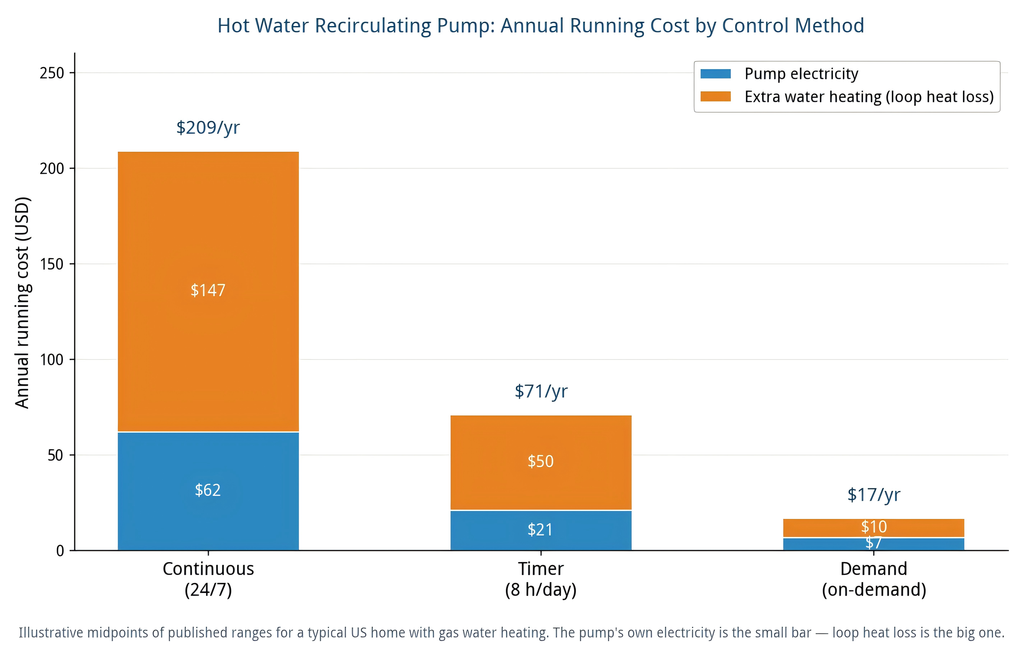
The control. This is where efficiency is won or lost. Three options:
- Continuous / aquastat— runs whenever loop temperature drops. Instant hot water, maximum energy use.
- Timer— runs during set hours. A reasonable middle ground for predictable households.
- Demand (button, motion sensor, or app)— runs only when someone asks for hot water, primes the loop in seconds, shuts off.
The priming. When activated, the pump pushes the cooled water out of the hot line and back to the heater. Once hot water reaches a sensor — usually around 95–98 °F — the pump stops. DOE’s own field protocol waits 40 seconds after activation before testing, which tells you roughly how long a properly sized loop takes.
One detail installers learn the hard way: pipes hold more than you think, and because of mixing inside the pipe you often have to flush roughly double the standing volume before fully heated water reaches the tap. That’s why a 40-foot run with ¾-inch pipe can feel like a 100-foot run. It’s also why pipe sizing rules written in the 1940s, never revisited, leave modern low-flow fixtures waiting longer than they should.
What a Hot Water Recirculating Pump Actually Fixes
- The wait.Seconds instead of a minute or more at every fixture on the loop.
- Water waste.Several thousand gallons a year that would otherwise go down the drain.
- The cold-water sandwich.Particularly on tankless heaters, where the burner’s ramp-up gap combines with cooled pipe volume to deliver hot, cold, hot.
- Comfort consistency.Showers that don’t swing when a washing machine fills.
- Heating energy, selectively.This one cuts both ways, and it’s where the marketing gets slippery — see the cost section below.
A hot water recirculating pump also does something less obvious: it makes a low-flow fixture feel better than it is. Federal standards cap showerheads at 2.5 gpm and private lavatory faucets at 1.5 gpm at 60 psi. Lower flow means the standing water in the pipe takes longer to push out, so the wait got worse as fixtures got more efficient. Recirculation removes that penalty rather than fighting the flow limit.
What it doesn’t fix: low pressure, a failing heater, a partly closed valve, or a fixture with a clogged aerator. Rule those out first.
Types of Hot Water Recirculating Pumps
| Type | Return path | Best for | Retrofit difficulty | Energy profile | Notes |
| Dedicated return loop | Separate return pipe | New build, major renovation | High — needs walls open | Depends on control | Best, most consistent performance |
| Comfort / crossover | Existing cold water line | Retrofit, no return line | Low | Depends on control | Cold tap runs briefly warm at the far fixture |
| Fixture-level (under-sink) | Local crossover at one fixture | One problem bathroom | Very low | Lowest — tiny duty cycle | Serves one fixture only |
| Thermosiphon (no pump) | Gravity convection, vertical rise only | Simple 2-pipe setups with height | Low | Zero electricity | Slow, unreliable, needs specific geometry |
| Integrated (in tankless or unit) | Built in, often with buffer tank | New tankless installs | Medium | Good — matched by design | Rinnai, Navien and similar built-in systems |
For most retrofit projects the real decision is between a crossover system with a pump at the heater and a fixture-level pump under the far sink. The first serves the whole house from one unit. The second is cheaper, easier, and honestly sufficient if only one bathroom is bad.
Dedicated loops still win on performance, and they are the right call whenever walls are already open. A separate return pipe means no warm water in the cold line, a shorter path back to the heater, and a loop that can be balanced properly. If you are pricing a new build, the cost of the extra pipe is small compared to retrofitting it later.
Crossover systems have one quirk worth warning customers about: because they use the cold line as the return path, the cold tap at the far fixture runs lukewarm for a few seconds after a hot draw. Harmless, but it surprises people.
Where They Matter Most: Bathroom Scenarios
Bathrooms are where the wait hurts, because they’re usually the farthest fixtures and the ones used on a schedule.
| Bathroom scenario | Typical complaint | Recommended configuration | Spec priorities |
| Master bath far from heater | 60-second wait every morning | Demand-controlled crossover with button/motion | Priming speed, quiet motor |
| Two-storey home, upstairs bath | Wait plus pressure drop at peak | Full loop or crossover, sized for head | Head rating, check valve |
| Guest bath used occasionally | Long wait, rarely worth heating | Fixture-level pump with motion sensor | Low standby draw, no return line |
| Hotel or guesthouse en-suite | Complaints at peak, water waste at scale | Central loop, demand or scheduled | Duty cycle, service access, spare units |
| Accessible / elderly bathroom | Scald risk from temperature swings | Loop plus thermostatic mixing valve | Stable delivery temperature |
| Tankless-fed bathroom | Cold-water sandwich | Loop with buffer tank or mixing valve | Minimum flow to trigger burner |
One that deserves its own note: in healthcare, hospitality and any building with a legionella management plan, a hot water recirculating pump is part of the control strategy, not a comfort upgrade. Keeping the loop at temperature and avoiding dead legs is standard practice, and some pumps include a disinfection cycle that runs the loop at elevated temperature. That’s a specification conversation, not a retail one.
Standards, Certifications and the Energy Question
What to check on a spec sheet
| Item | What it governs | Why it matters to you |
| EPA WaterSense / DOE hot water delivery | ≤0.5 gal stored, ≤0.6 gal delivered; recirculation must be demand-initiated | Timer-only and temperature-only systems are ineligible in these programs |
| NSF/ANSI/CAN 61 | Health effects of materials contacting drinking water — Section 8 covers pumps and valves | Required by reference in most US state plumbing codes; potable recirc is in scope |
| EU Regulation 641/2009 (ErP) | Glandless circulators: EEI ≤0.27 from Jan 2013, EEI ≤0.23 from Aug 2015 | Benchmark for the most efficient circulators is EEI ≤0.20 |
| Drinking-water suitability marking | EU rules require “This circulator is suitable for drinking water only” on packaging | Quick visual check that a unit is potable-rated, not heating-only |
| Temperature and pressure rating | Liquid temperature range and max working pressure | Potable hot water loops run hot; check the rating, not just the flow curve |
The energy argument, honestly
Here’s the part brochures skip. The pump itself is cheap to run — modern permanent-magnet circulators draw as little as 5 to 8.5 watts, and Grundfos quotes an average running time of just three hours a day for its AUTOADAPT units, which learn household patterns, claiming up to 96% electrical savings and 48% heat savings versus a conventional continuously-run recirculation pump . An older-style 25 W unit running around the clock is a different story: roughly 220 kWh a year, plus the far bigger cost — the heat your loop loses continuously, which your heater has to replace.
So the control method matters more than the motor. Water heating is about 18% of home energy use and typically the second-largest household energy expense. A continuously circulating uninsulated loop is a radiator you pay to run. Insulate the loop, and specify demand control, and the arithmetic works. Leave the loop bare on a timer running eight hours a day and you can easily spend more on gas or electricity than you save on water.
The honest framing: buy a hot water recirculating pump for the wait and the water. Treat the energy saving as a bonus you only collect if you insulate the loop and control the pump properly.
Noise
Modern wet-rotor circulators are genuinely quiet — typically in the 25–45 dB range, with premium units below 30 dB. That is one reason a hot water recirculating pump can live in a cupboard next to a bedroom without complaint. For context, the World Health Organization recommends under 30 dB(A) in bedrooms at night for good sleep quality . A pump mounted on the hot outlet at the heater, inside a cupboard, is unlikely to trouble anyone. The same pump hard-mounted to a stud wall next to a bedroom is a different story: use the isolation the manufacturer supplies, don’t let the pipe carry vibration into the frame, and bleed the air out — air in a circulator is the number one cause of “this pump is noisy” complaints.
Buying Guide: Six Steps That Don’t Need an Engineer
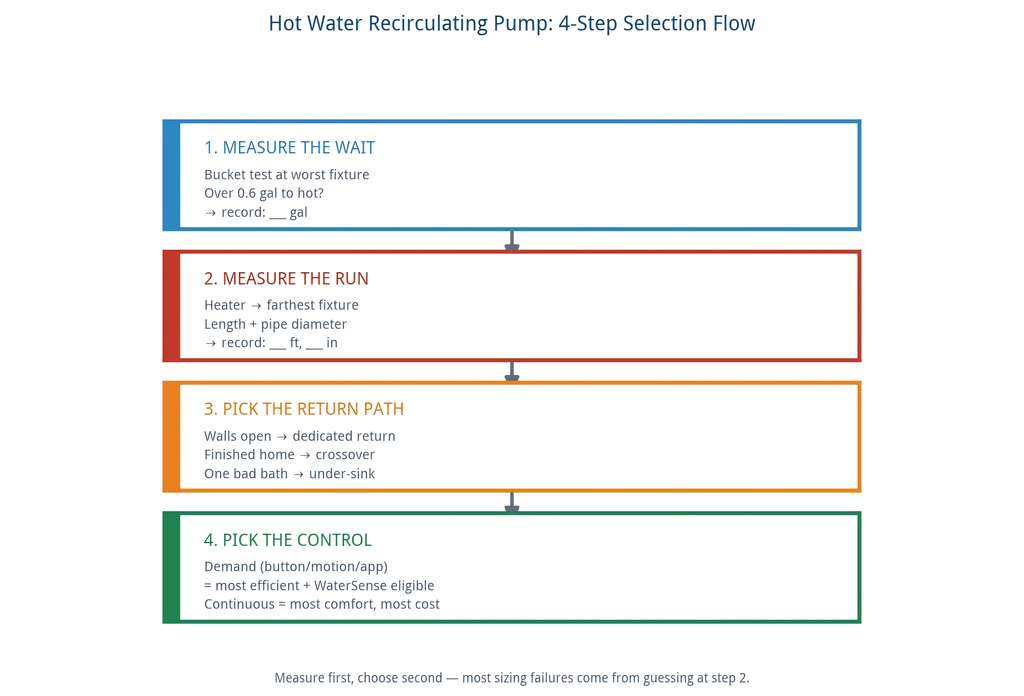
- Measure the wait and the volume.Bucket test at the worst fixture. Over 0.6 gallons to hot? You have a case.
- Measure the run.Distance from heater to the farthest fixture, and note the pipe diameter. ¾-inch pipe holds about 1 gallon per 38 feet; ½-inch about half that. Longer run and bigger pipe means more standing volume and more friction.
- Work out head.Count the loop length, add roughly 50% for fittings and elbows, and check the pump curve can deliver at that head. Most residential units cover 0–6 feet of head easily; multi-storey or very long loops need more. This is the single most common sizing error — a pump that looks fine on flow can stall on head.
- Choose the return path.New build or open walls? Dedicated return line. Finished house? Crossover at the heater, or a fixture-level pump if only one bathroom is bad.
- Choose the control.Demand control (button, motion sensor or app) is the most efficient and is the only kind that qualifies under EPA WaterSense and DOE programs. Continuous circulation is the most convenient and the most expensive to run. Timers sit in between — and note that pure timer or temperature control is explicitly noteligible in those programs.
- Check the paperwork.NSF/ANSI 61 on wetted parts for potable use; EEI value on the nameplate for EU markets; liquid temperature and pressure ratings above your operating conditions; built-in check valve; dry-run protection; and a stated warranty with spares available locally.
- Ask what happens when it fails.For a hot water recirculating pump going into a hotel, a clinic or a rental, ask about spare units in country, how quickly a replacement ships, and whether the control can fall back to a simple timer if a sensor dies.
Three Diagrams Worth Putting on the Page
If you are building this into a product or landing page, three visuals carry most of the explanation:
- Loop schematic
- Control-method cost comparison
- Selection flow
A worked example. Single-storey house, heater in the garage, master bath about 55 feet away through ¾-inch pipe. Standing volume in that branch is roughly 1.4 gallons; after mixing losses, call it close to 3 gallons to flush — comfortably over the 0.6-gallon WaterSense threshold, so the complaint is legitimate. A demand-controlled crossover pump rated around 0–6 ft of head and 4–6 GPM, mounted on the hot outlet with a sensor valve under the far vanity, will prime that loop in well under a minute and then stop. Insulate the run and the loop loses far less heat between draws. Total: one pump, one valve, a motion sensor or button, and pipe insulation.
Installation and Everyday Use
- Where it goes. A hot water recirculating pump mounts on the hot outlet at the heater, or in the return line just before the heater on a dedicated loop. Orientation matters — check the manual, since some units must be mounted with the motor shaft horizontal.
- Before first start. Close the cold supply, drain a couple of gallons to drop pressure, fit the pump with the supplied gaskets, and reopen slowly. Then bleed: open the farthest hot tap and let it run until the stream is steady. Air is what makes new installs noisy and slow.
- On tankless heaters. Check the manufacturer’s minimum activation flow. A pump that moves too little water may never trigger the burner; one that moves too much in short bursts can cause short-cycling. A buffer tank or mixing valve smooths this out.
- Quarterly checks. Listen for noise on startup (air, or a loose mount). Look for weeps at the flanges. Confirm the check valve still holds by feeling whether the hot line cools unusually fast between draws. If the loop has a disinfection or holiday mode, verify it’s configured for the season.
- Don’t do this. Never dead-head a circulator against closed valves for long periods. Never bypass dry-run protection because it keeps tripping — find out why. And don’t specify continuous circulation on an uninsulated loop and then call it an energy-saving measure.
Two Field Cases
- Case A — the sprawling single-storey. Heater in the garage, master bath at the far end, roughly 55 feet of uninsulated ¾-inch copper. Complaint: 70-second wait, twice a day, plus a tankless unit delivering a cold sandwich. Fix: demand-controlled crossover pump with a motion sensor in the bathroom, sensor valve under the vanity, and R-4 insulation on the accessible run. Expected outcome: hot water in seconds, the sandwich gone because the loop is already primed when the burner fires, and several thousand gallons a year not going down the drain.
- Case B — the twelve-room guesthouse. Complaints at the morning peak, and a water bill that didn’t match occupancy. Fix: a central loop with a duty pump, scheduled to the morning and evening demand windows with occupancy-based boosts in remote bathrooms, plus full loop insulation. Here the pump isn’t only about comfort — at this scale the wasted water is a line item, and the loop insulation is what keeps the heating penalty in check.
These are sizing archetypes, not one customer’s installation. Measure on site, and treat the numbers as a starting point.
FAQ
Does a hot water recirculating pump increase water pressure?
- No. A hot water recirculating pump moves water around the loop; it doesn’t add pressure or flow at the fixture. If your shower is weak, look at supply pressure first.
How much water does one actually save?
- Lawrence Berkeley National Laboratory estimated about 6.35 gallons per day of water run down the drain while waiting for hot water in an average US home — roughly 2,300 gallons a year. Manufacturer claims of 10,000+ gallons usually include hot water that cooled in the pipe and was never used, which is a broader measure.
Will it pay for itself on water savings alone?
- Sometimes. In a large house with long runs and high water rates, yes. In a small flat with a short run and cheap water, no — the value is mostly the wait. The pump’s own electricity is trivial; the real ongoing cost is heat lost from the loop, which insulation and demand control address.
Is a hot water recirculating pump hard to install?
- A crossover kit at the heater plus a sensor valve under the farthest vanity is a one-to-three-hour job for a competent plumber or a careful DIYer. A dedicated return line in a finished house is a much bigger job.
Can I use one with a tankless heater?
- Yes, but check the minimum activation flow and consider a buffer tank or mixing valve to avoid the cold-water sandwich and short-cycling.
Is continuous circulation a bad idea?
- Not bad — just expensive. It gives the most consistent comfort and the highest energy use. Insulate the loop if you go that route.
How long do they last?
- Wet-rotor circulators commonly run for years. What kills them early is dry running, air locked in the loop, and hard water scale. Fit the dry-run protection and bleed properly at commissioning.
Bottom Line
A hot water recirculating pump solves a specific, measurable problem: water and time poured down the drain while you wait. Specify a hot water recirculating pump on the strength of that problem alone, and you will not be disappointed. The fix is well understood, the standards are explicit about what “good” looks like — 0.6 gallons to hot, demand-initiated control, insulated loops — and the difference between a good installation and a disappointing one comes down almost entirely to three things: sizing the head correctly, insulating the loop, and choosing demand control over continuous circulation.
References
1.Title: Estimating Energy and Water Losses in Residential Hot Water Distribution Systems
Abstract: This report quantifies water and thermal waste from residential hot-water piping, including standby cooling and waiting water for taps, supplying baseline data for recirculation pump assessments.
2.Title: Hot Water Distribution Efficiency in Low-Flow Fixture Homes
Abstract: It evaluates recirculation strategies, pipe insulation and control types, comparing water savings versus added distribution heat loss for demand and continuous pumps.