
Monoblock Pump Price & Best Brands
A purchasing manager once forwarded two quotations for the same line item — “5 HP 3-phase monoblock pump” — and asked which one to sign. The first was a single row: a model nickname, a unit price, a delivery week. The second ran to four pages: a performance curve, a wetted-parts schedule, a test-report number, a spares list and a warranty path. The second cost more. Six months later a mechanical seal went. The first supplier needed three days just to identify the part; the second had it on a shelf. Nothing about the horsepower had changed. Only the specification had.
Price pages love a round number. B2B buying does not work that way. This guide will not print a price table that would be wrong by the time it is indexed. It shows what moves a quotation, puts the invoice beside the ten-year electricity bill, and answers the brand questions buyers type into search boxes without adding another disposable ranking.
Why There Is No Honest Single Price for a Monoblock Pump
Ask “how much does a 20 HP monoblock pump cost?” and an honest answer starts with a counter-question: which 20 HP? A 15 kW two-pole three-phase machine can be built with one impeller or four, in cast iron or stainless, with a mechanical seal or gland packing, with or without a starter, tested to one standard or to none, shipped on one pallet or in a container. Each is a different product wearing the same motor rating. Print one figure and you have compared nothing.
Regulation widens the gap. The European Commission’s 2024 ecodesign accounting report, using a 2020 EU27 stock baseline, counted 14.5 million regulated clean-water pumps drawing 179 TWh a year — about 7.5% of all EU27 electricity — to deliver 96 TWh of hydraulic work. Its Minimum Efficiency Index of 0.40 was designed to remove the least efficient 40% of models from that market. The Ecodesign for Sustainable Products Regulation entered into force on 18 July 2024, with water-pump measures under the older directive continuing through 31 December 2026 while a broader replacement is prepared . A Monoblock Pump engineered for that market carries test work, documentation and material choices that a price-only tender unit does not.
A printed price is a snapshot of one configuration, one voltage, one test standard, one order quantity and one delivery term. Change any one and the number moves. That is not evasion; it is what happens when a motor rating is used as if it were a part number.

The Price You Keep Paying: Electricity, Not the Invoice
Here is the part price pages skip. The U.S. Energy Information Administration’s 2025 annual averages put industrial electricity at 8.51 cents per kWh, commercial at 13.37 and residential at 17.23; the 2024 figures were 8.13, 12.75 and 16.48, with 13.56 cents across all sectors in 2025. Eurostat reported EU non-household prices including non-recoverable taxes at about EUR 0.1837 per kWh in the second half of 2025, and household prices at EUR 28.72 per 100 kWh in the first half . Tariffs differ two- or threefold between markets, and every Monoblock Pump runs on one of them.
The arithmetic is plain: rated input power, times 2,000 running hours a year, times ten years, times the tariff. A 0.75 kW (1 HP) Monoblock Pump at the 2025 U.S. industrial rate comes to about $1,276 over a decade; a 3.7 kW (5 HP) Monoblock Pump to about $6,297; a 15 kW (20 HP) Monoblock Pump to about $25,530. Those are not prices. They are what the meter records, repeating every month while the invoice is entered once.
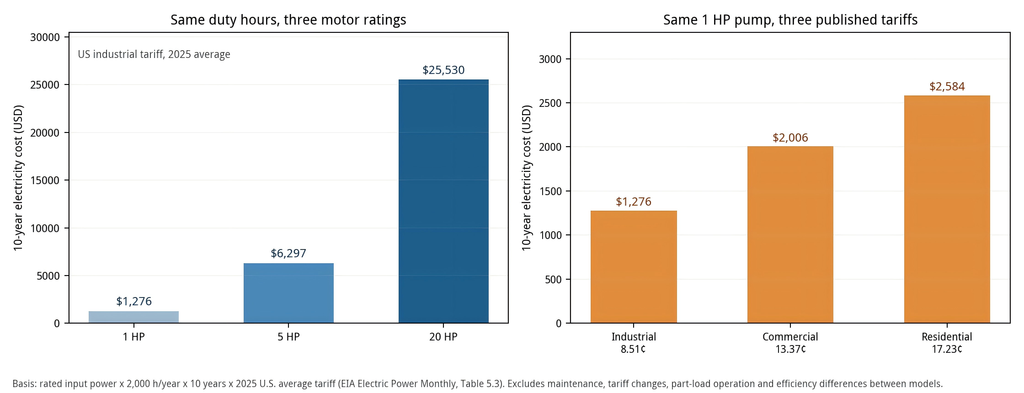
Two things follow. A modest difference in unit price is usually small beside a decade of power, which is why an efficiency claim is worth more as a test report than as an adjective. And the same Monoblock Pump is a different financial product in a warehouse on an industrial tariff and in a house on a residential one. No spreadsheet is needed — just a nameplate rating, honest running hours, and the local tariff.
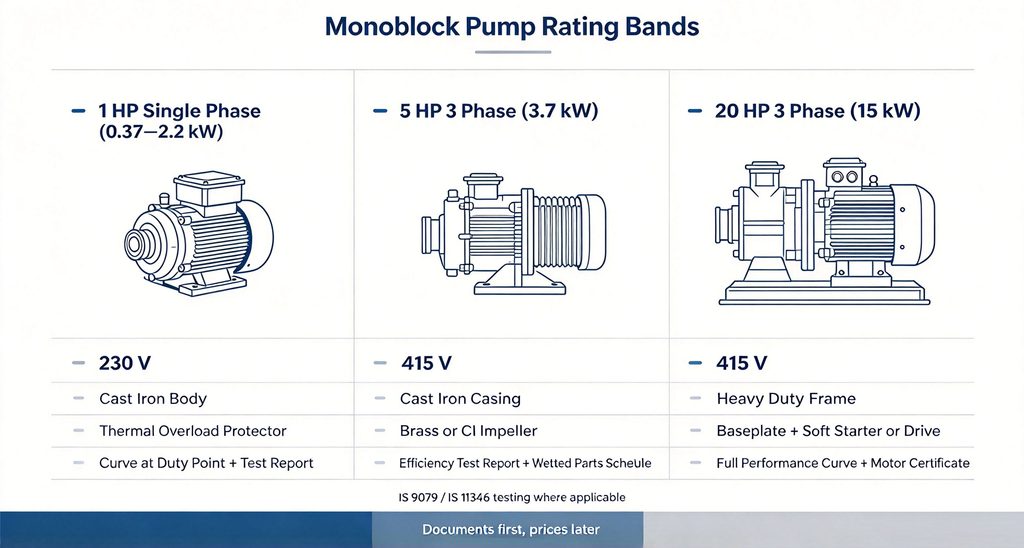
5 HP 3-Phase and 20 HP: Two Very Different Purchases The two most common price questions are not really about horsepower. They map onto published rating bands. India’s Bureau of Energy Efficiency, Schedule No. 7 (Revision 5, effective 1 January 2024), lists three-phase mono-set pumps at 1.1, 1.5, 2.2, 3.7, 5.5, 7.5, 9.3, 11 and 15 kW, continuing to 22 kW, all two-pole, against IS 9079 and IS 11346 testing. Single-phase mono sets cover 0.37 to 2.2 kW. BIS licensing is mandatory and only BIS, NABL, ILAC or APLAC-accredited laboratory reports are accepted. Five horsepower is roughly 3.7 kW; twenty is roughly 15 kW. Both are standard bands, not custom engineering.
| Buyer’s wording | Standard rating band | What is usually quoted | What must appear on the quote |
| 1 HP, single phase | 0.37-2.2 kW single-phase mono set, 2-pole, IS 9079 | 230 V, mechanical seal, thermal overload protector, compact cast body | Curve at the duty point; accredited test report; seal and capacitor part numbers |
| 5 HP, 3 phase | 3.7 kW three-phase mono set, 2-pole, IS 9079 | 415 V, cast-iron casing, brass or CI impeller, IP rating, starter or VFD option | Efficiency test report; wetted-parts schedule; spares list with lead times |
| 20 HP, 3 phase | 15 kW three-phase mono set, 2-pole, IS 9079; bands continue to 22 kW | Larger frame, baseplate, soft starter or drive, cable sizing, stage count | Full performance curve; motor certificate; warranty path; MOQ and delivery terms |
| “Custom” above 22 kW | Outside the listed mono-set labeling bands | Engineered build, material upgrade, non-standard voltage or frequency | Datasheet pinned to a named test standard; factory acceptance test record |
A 5 HP 3-phase Monoblock Pump is the workhorse of a small apartment block, a farm manifold or a builder’s water supply. Three-phase power starts more smoothly at that rating, but it brings a starter, a different cable schedule and different spares. What moves the quotation is stage count, impeller and casing material, enclosure class, whether a drive is included, and order quantity. Two suppliers quoting a 5 HP 3-phase Monoblock Pump can be quoting two machines that share nothing but the motor stamp.
A 20 HP Monoblock Pump is not four times a 5 HP one. At 15 kW the frame, baseplate, starting method, cable run, protection and after-sales arrangement all step up together. The price question becomes a scope question: is the quote for a pump, or for a pump package that can be commissioned on site?
“Best Brand” Is the Wrong Question
Three questions dominate this corner of search: “what is the best pump brand?”, “which company is best for pumps?” and “who are the top pump manufacturers in the USA?” They are answerable, just not with a list of names. A ranking is an opinion with a publication date; a test certificate is a measurement with a serial number. A name strong in residential boosting is not automatically strong in irrigation, fire, pool or wastewater duty — different products, different standards, different spare-part networks.
For the U.S. market the useful question is what a supplier can prove. The Department of Energy’s pump test procedure at 10 CFR Part 431, Subpart Y covers clean-water categories including end-suction close-coupled (ESCC) pumps — the construction a one-shaft Monoblock Pump uses — with thresholds such as 25 gpm and 459 ft at best efficiency point, and it references the HI 40.6 efficiency-testing method, which limits testing to laboratories rather than field measurements. The energy conservation standard in the same subpart sets a pump energy index ceiling for covered equipment, yet self-priming pumps are listed among its exclusions [5]. Even the regulatory answer to “who is top” depends on the exact pump category. A brand name cannot carry that nuance; a datasheet can.
Replace the brand shortlist with four things a supplier can put in writing:
- A performance curve with your duty point marked — head, flow and input power where the pump will actually run.
- A test report from an accredited laboratory, naming the model, the batch and the standard it was tested against.
- A wetted-parts schedule: casing, impeller, shaft, seal faces, plus motor enclosure and insulation class.
- A spares list with lead times for seals, bearings, impellers and capacitors, and a warranty path for the country of installation.
That is not a scoring system and does not need one. It makes two quotations describe the same object. Once they do, the price difference becomes readable: material, certification, service, or simply margin.
A Composite Case: Two Quotations, One Seal Failure
The following is a composite of recurring RFQ patterns in residential and light-agricultural supply, not a single measured project. No price figure or product claim is made for any particular machine.
A contractor requested a 5 HP three-phase Monoblock Pump for a housing cluster. Quote A gave a model name and a unit price. Quote B added a curve with the duty point circled, a material schedule, an accredited test-report number, a spares list and a warranty route. Quote B cost more. The contractor signed A. Eight months in, a seal failed during the monsoon and the site lost water for three days while the part was identified and shipped. The pump itself was fine; the documentation around it was not.
Put that beside the numbers already used. A 3.7 kW unit running 2,000 hours a year at the 2025 U.S. industrial tariff records roughly $6,297 of electricity over ten years. A small premium for a verified curve, a traceable test report and a stocked seal is being compared against a decade of power and an unplanned shutdown. The cheaper quotation was not cheaper. It was less specified. Lists of “top manufacturers” age badly for the same reason: they capture visibility, not whether a seal for a four-year-old model is still held locally.
What to Put in the RFQ So Quotations Are Comparable
Nine lines are enough. Send the same set to every supplier and the Monoblock Pump quotations that come back can finally be compared:
- Static water level, and the vertical distance from the pump to the highest outlet.
- Suction and delivery pipe lengths, diameters and the fittings in between.
- Flow needed in the busiest hour of the day, not the daily total.
- Supply voltage, phase, frequency, and the acceptable voltage range on site.
- Starts per day, expected running hours per year, and whether the water carries sand.
- Required certification and the test standard the performance claim must be pinned to.
- Wetted material grades and motor enclosure or insulation class where the application demands them.
- Incoterms, order quantity, packing, and the spare parts to be shipped with the first order.
- Warranty path, response time and the local holder of wear parts.
With that list attached, a 5 HP 3-phase Monoblock Pump quote and a 20 HP one can be compared line by line. Without it, the only comparable field is the currency.
| The question buyers actually type | Short answer | Number or document to hold on to |
| How much does a 20 hp monoblock pump cost? | No single honest figure. It is a 15 kW two-pole three-phase build, and stages, materials, certification and MOQ move the number. | 15 kW band; about $25,530 of power over 10 years at 8.51 cents/kWh |
| How much does a 5hp 3 phase monoblock pump cost? | Same answer at the 3.7 kW band. Request the curve, the test report and the parts list before comparing figures. | 3.7 kW band; about $6,297 of power over 10 years |
| What is the best pump brand? | A brand cannot be best across duty points. Four verifiable documents beat any ranking. | Curve, accredited test report, materials schedule, spares and warranty |
| Which company is best for pumps? | The one that holds your duty point, certifies it and stocks the wear parts in your market. | Test-report number; spares lead time in writing |
| Who are the top pump manufacturers in the USA? | Split by product category, not by name. General clean-water pumps and self-priming pumps sit differently under federal rules. | 10 CFR 431 Subpart Y category and test-procedure reference |
| Is a higher-efficiency pump worth paying more for? | On long running hours, usually yes: the invoice is one line, the meter writes one every month. | 2,000 h/year x 10 years at the local tariff |
| Why do two quotes for the same HP differ so much? | Voltage, stage count, material grade, test standard, Incoterms, quantity and after-sales scope. | One identical specification sent to both suppliers |
| Does a bigger motor always cost more to run? | Only if it runs. The meter sees input power times hours, not the number on the nameplate. | 0.75 / 3.7 / 15 kW at the same duty hours |
| Should I buy on price or on the test certificate? | On the certificate. A price without a specification is not comparable. | Model, batch and standard on the test report |
Quick FAQ
- How much does a 20 hp monoblock pump cost?
- No reliable single figure. A 20 HP Monoblock Pump is about 15 kW, a standard two-pole three-phase band, and stage count, wetted materials, motor protection, starting method, certification, quantity and delivery terms all move the quote. Ask for a curve first.
- How much does a 5hp 3 phase monoblock pump cost?
- Same answer at the 3.7 kW band, where 415 V supply, enclosure class, impeller material and whether a starter or drive is included change the scope. Send one identical specification to each supplier; only then are the figures comparable.
- What is the best pump brand?
- No brand is best across boosting, irrigation, pool, fire and wastewater at once. What transfers is documentation: a duty-point curve, an accredited test report, a wetted-parts schedule and a spares-and-warranty path for the Monoblock Pump you are buying.
- Which company is best for pumps?
- The one that holds the specified duty point, proves it with a traceable test certificate, and keeps seals, bearings and impellers available in the country of installation. That is a supply question, not a naming question.
- Who are the top pump manufacturers in the USA?
- It depends on the category, as noted earlier: federal rules treat end-suction close-coupled clean-water pumps and self-priming designs differently. Ask which category and which test standard a claim refers to rather than working from a list of names.
- Is a 5-star or higher-efficiency pump worth the premium?
- For a Monoblock Pump running thousands of hours a year, almost always. Efficiency is a small percentage repeated on every kWh for a decade; the premium is paid once. For a unit used a few weeks a year, build quality matters more.
- Why did the same 5 HP quotation change year over year?
- Material grades, certification work, energy thresholds and freight terms move independently of the motor rating. A Monoblock Pump quote is tied to a specification and a date, not to a horsepower. Re-issue the same RFQ and compare like with like.
- Should I choose the cheapest quotation?
- Choose the Monoblock Pump quotation that is fully specified. A low price attached to a model nickname is not a low price — it is an incomplete scope that arrives later as a spare-part delay.
From Price List to Comparable Quote
Send the nine RFQ lines, ask for the curve, the accredited test report, the wetted-parts schedule and the spares list, and state the market where the pump will run so the right certification is quoted from the start. What comes back should be a Monoblock Pump quotation you can compare line by line, install without surprises and service four years later. That is a more useful answer to “price” than any number on a page — and it needs no brand shortlist.
Data sources
European Commission, Directorate-General for Energy, Ecodesign Impact Accounting Overview Report 2024 (prepared by VHK, October 2024), water pumps product sheet, together with the Commission’s water pumps ecodesign product guidance on Regulation (EU) 547/2012 and the Minimum Efficiency Index; and Regulation (EU) 2024/1781 (ESPR), in force 18 July 2024, under which existing water-pump implementing measures continue to 31 December 2026. EU27 stock, electricity and type-share figures use a 2020 baseline.
U.S. Energy Information Administration, Electric Power Monthly, Table 5.3, Average Price of Electricity to Ultimate Customers by End-Use Sector (annual totals for 2024 and 2025, cents per kWh): industrial 8.13 / 8.51; commercial 12.75 / 13.37; residential 16.48 / 17.23; all sectors 12.94 / 13.56.
Eurostat, Electricity price statistics (datasets nrg_pc_204 and nrg_pc_205), 2025 releases: EU non-household price including non-recoverable taxes EUR 0.1837 per kWh in the second half of 2025 (EUR 0.1903 in the first half); household price EUR 28.72 per 100 kWh in the first half of 2025.
Bureau of Energy Efficiency (India), Schedule No. 7: Pump Set, Revision 5, effective 1 January 2024: three-phase mono-set ratings 1.1 to 15 kW and up to 22 kW, single-phase 0.37 to 2.2 kW, two-pole; IS 9079, IS 11346 testing; BIS licensing mandatory and BIS / NABL / ILAC / APLAC-accredited laboratory reports only.
U.S. Department of Energy, 10 CFR Part 431 Subpart Y, Pumps: section 431.464 test procedure (clean-water categories including end-suction close-coupled, 25 gpm and 459 ft BEP thresholds, incorporating the HI 40.6 efficiency-testing method), and section 431.465 energy conservation standards and exclusions, including self-priming pumps. HI 40.6 limits efficiency testing to laboratories and test facilities.
Data notes
Ten-year electricity figures are calculated, not surveyed: rated input power (kW) x 2,000 hours per year x 10 years x the published 2025 U.S. average tariff. They exclude maintenance, tariff changes, part-load operation, power factor and efficiency differences between models. Rated input is a nameplate figure, not measured draw. Horsepower-to-kW mapping (5 HP ~ 3.7 kW; 20 HP ~ 15 kW) follows the bands in Data source 4.
The two-quotation case is a composite of recurring RFQ patterns, not a single measured project. No unit price, brand name or product performance claim is made anywhere in this guide. Material-cost effects are described qualitatively, so a commodity index is not mixed into a pump quotation.
All statistical reports, tariffs and schedule revisions cited here date from 2024 to 2026; the regulations and test standards they reference are the versions currently in force. Sources are listed in the order in which their markers first appear. Figures in both tables derive from those sources and the calculation basis above.
References
Abstract: This paper reviews EU ecodesign for clean-water pump units (pump + motor/drive), quantifies energy-saving potential and discusses test & efficiency calculation barriers for non-regulated pump categories such as swimming pool and wastewater pumps.
2.Title: NAVIGATING THE DEPARTMENT OF ENERGY (DOE) ENERGY CONSERVATION STANDARD AND TEST PROCEDURE FOR PUMPS
Abstract: This article explains US DOE pump rules for end-suction close-coupled clean-water pumps, covers the test procedure referencing HI 40.6, compares with EU Ecodesign and clarifies scope exclusions including self-priming and pool pumps.
3.Title: Lot 11 Pumps: (in commercial buildings, drinking water pumping, food industry, agriculture)
Abstract: EU preparatory study for pump Ecodesign, covering close-coupled clean-water pumps, lifecycle cost breakdown, installed base, annual energy use and the policy target to phase out the least efficient 40% of pumps.