
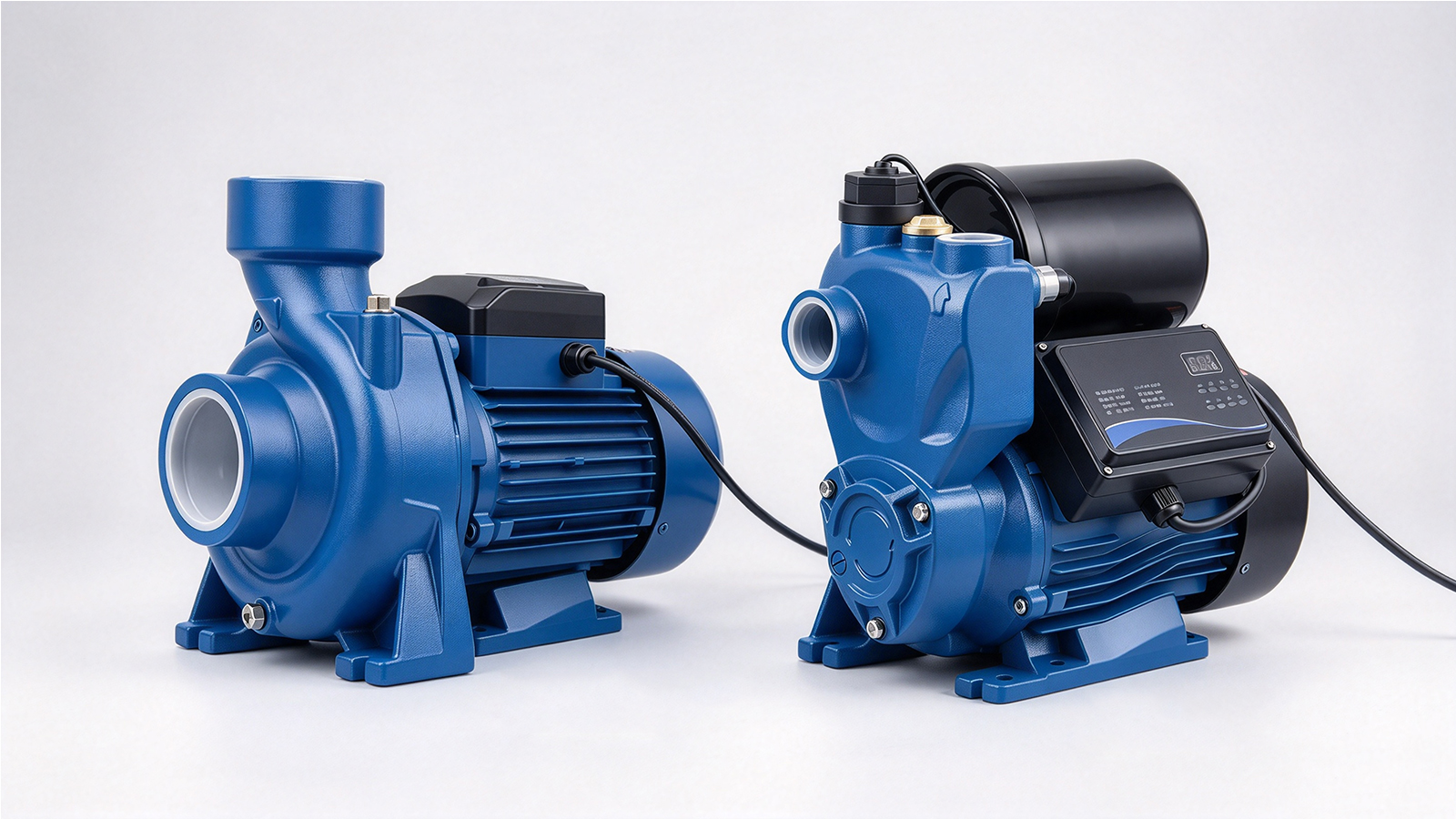
Monoblock Pump Types & Uses: Self-Priming vs Centrifugal
A borewell owner in a dry district described the fault perfectly over the phone: the motor runs, the delivery pipe stays cold, and not a drop comes out. He had already fitted a larger pump after the water table fell. The extra horsepower changed nothing, because the water sat roughly forty feet below the pump and no surface-mounted machine can pull water that far.
That call is why this guide starts with a distinction most product pages skip. A Monoblock Pump describes how a machine is built; self-priming describes what it does on start-up. Treat them as competing categories and you order the wrong unit, then blame the motor. Below: the families behind the name, a plain comparison of the two builds, and usable numbers for the questions buyers type into a search box.
What a Monoblock Pump Actually Is
Strip the casing off and the idea is simple: motor and wet end share one shaft. No baseplate, no coupling, no alignment on site, no belt to tension. The impeller sits on the motor shaft extension, so the assembly fits in a cupboard and one person can carry it. On a busy farm or residential site that compactness is the point — a Monoblock Pump can be swapped in an afternoon, with no coupling guard to re-fit.
The word describes construction, not hydraulics. Most units sold under this name are single-stage centrifugal pumps, but the same one-shaft layout also carries self-priming, jet, peripheral and horizontal multistage designs. So “which is better, a monoblock pump or a centrifugal pump?” has an awkward answer: the Monoblock Pump in front of you almost certainly is a centrifugal pump. You are choosing the hydraulic variant and where it sits. One shared shaft also means one seal and one bearing set — excellent on clean cold water, less forgiving when grit or dry running is routine.

The Four Pump Families — and Why “Monoblock” Is Not One of Them
Ask “what are four types of pumps?” and you get four different answers, because the question mixes two axes. By how energy reaches the water: centrifugal (rotodynamic), positive displacement, jet/ejector, and peripheral or regenerative. By where the machine sits: surface-mounted or submersible. A Monoblock Pump belongs to the first list as a way of building a centrifugal pump, and to the second as a surface unit.
The centrifugal family’s scale is not a matter of opinion. The European Commission’s 2024 ecodesign accounting report, using a 2020 EU27 stock baseline, counted 14.5 million regulated clean-water pumps — all rotodynamic — split into 39% end-suction designs (the family a close-coupled Monoblock Pump belongs to), 16% vertical multistage and 45% submersible multistage. They drew 179 TWh, about 7.5% of EU27 electricity, to deliver 96 TWh of hydraulic work. The same framework sets a Minimum Efficiency Index of 0.40, intended to remove the least efficient 40% of models. So “which type of pump is most commonly used?” resolves cleanly: centrifugal, with submersible multistage dominating wherever the water is deep.
Self-Priming vs Standard Centrifugal: The Difference That Decides the Install
A centrifugal pump is primed when its casing and suction line are full of water; an impeller spinning in air moves almost nothing. A conventional unit therefore needs a foot valve plus a fill-and-vent routine before a cold start. That cheap check valve is usually the first part to fail — sand on the seat, a sticking flapper, a corroded seal — after which the pump quietly loses prime.
A self-priming Monoblock Pump retains a charge of water in an enlarged casing. On start-up the impeller churns it into a liquid ring that seals the casing while suction-line air is separated and pushed out the discharge; once the air is gone it behaves like any other centrifugal pump. It still needs one initial fill and cannot run dry for long, but it re-primes after a power cut. On a fixed duty point running thousands of hours, the simpler standard hydraulic end is usually a few efficiency points ahead. On intermittent duty — a farm starting at dawn, an unattended off-grid restart — the self-priming version wins on labor and avoided call-outs. Both share the same suction ceiling, set by the atmosphere rather than the impeller.
| Monoblock Pump type | Air on start-up | Practical suction lift | Where it earns its keep | Usual service headache |
| Self-priming centrifugal | Retains a water charge; clears the suction line itself | ~7–8 m (23–26 ft) | Shallow borewells, sumps, tank filling, frequent start/stop | Priming chamber wear slowly lengthens prime time |
| Standard centrifugal with foot valve | Casing and suction line must be filled before a cold start | ~7–8 m (23–26 ft) | Flooded suction, overhead tank transfer, continuous circulation | Foot valve sticks or passes grit; prime is lost |
| Jet / ejector | Uses a venturi; deeper wells need an ejector down the hole | ~7–8 m shallow; more with ejector | Open wells and rural supplies with modest depth | Ejector scaling, lower wire-to-water efficiency |
| Peripheral / regenerative | Needs priming; moves small flows at relatively high head | ~7–8 m (23–26 ft) | Clean-water pressure boosting, garden lines, small-bore pipework | Very little tolerance for sand in the water |
| Horizontal multistage | Needs priming or a flooded inlet | ~7–8 m (23–26 ft) | Multi-storey boosting, steady pressure, OEM skids | More stages, more wear parts to stock |
Where Each Type Earns Its Keep
Household boosting is the quiet workhorse: lift stored water from a sump to an overhead tank, or hold shower pressure on the third floor. A standard centrifugal Monoblock Pump with a flooded inlet is hard to beat there — short pipe, clean water, predictable duty point. Add a multistage version when a single impeller starts running near the flat end of its curve. Borewell duty is less forgiving: water levels move with the season, the pump may start dry at dawn, and pulling a foot valve from a long suction line is miserable work. That is the home of the self-priming Monoblock Pump, provided the static level stays within roughly 25 feet. Deeper than that, put the pump down the hole and let a surface Monoblock Pump handle distribution from a ground tank.
Pool circulation and clean-water transfer sit at the other end: long steady runs, little air, a duty point that barely moves. Efficiency is not a footnote on any of these jobs. The IEA 4E Electric Motor Systems Platform reported in November 2025 that motor systems took 53% of global electricity in 2023 (13,462 TWh), rising to 72% of industrial and 86% of agricultural use. A 0.75 kW unit running 2,000 hours a year uses roughly 1,500 kWh; a few efficiency points repeat on that bill for a decade.
Reading the Numbers Without a Spreadsheet
Most confusion comes from one word: “lift”. Pulling water into the pump is suction lift; pushing it away is delivery head. They have completely different limits, and mixing them is how a 1 HP pump gets blamed for a 200 ft well.
Suction lift is capped by air pressure: one atmosphere supports about 33.9 ft (10.34 m) of cold water at sea level, and that is a frictionless theoretical value. Real installations lose head to pipe friction, strainers, warm water and altitude, so the working ceiling is around 25 ft (7.6 m). Adding horsepower does not move it. Delivery head has no such ceiling: every foot of water adds 0.433 psi, so 100 ft needs 43.3 psi, 200 ft needs 86.6 psi and 300 ft needs 129.9 psi, before pipe losses.

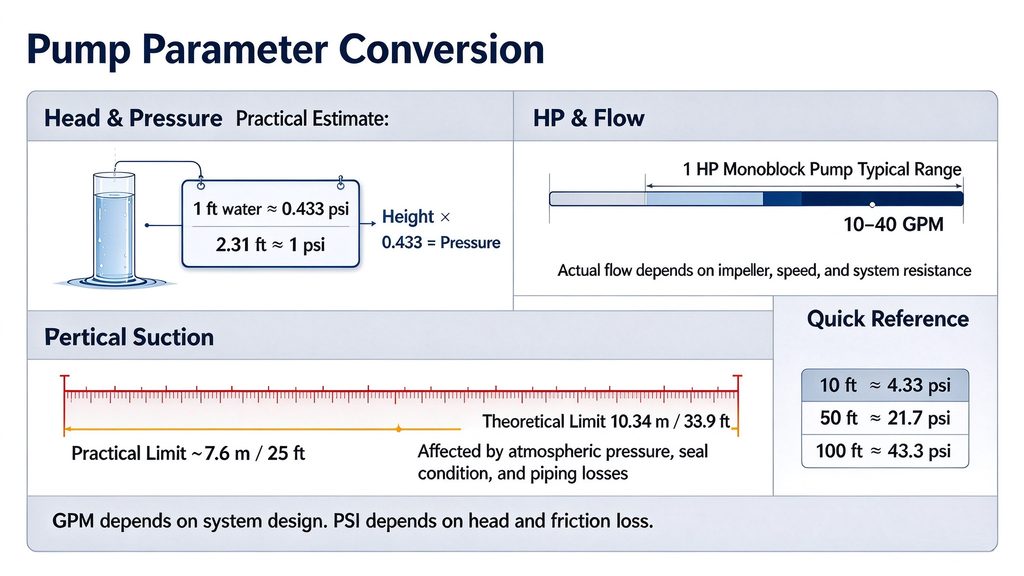
| The question buyers actually type | Short answer | Number to hold on to |
| What is a monoblock pump? | A motor and pump on one shared shaft, with no coupling or baseplate. | One shaft, one seal |
| Monoblock vs self-priming pump? | Construction versus a start-up function; neither replaces the other. | Build vs behaviour |
| How many feet can a 1 HP pump lift? | About 25 ft of suction at most, but 100 ft or more of delivery head. | 25 ft / 100+ ft |
| How far can a 1 HP pump push water? | Published curves put shut-off head near 90–125 ft, with useful flow at 30–60 ft. | 0.433 psi per ft |
| Gallons per hour from a 1 HP pump? | Mid-curve flows of roughly 10–20 GPM are typical for this rating. | 600–1,200 GPH |
| What size pump for a 200 ft well? | Not a size question: a surface pump cannot suck 200 ft. Put the pump down the hole. | 86.6 psi at 200 ft |
| How much HP for a 300 ft borewell? | A down-hole multistage job; the surface unit only distributes the water. | 129.9 psi at 300 ft |
| How many PSI to lift water 100 feet? | 43.3 psi of static head, plus friction for pipe length and fittings. | 43.3 psi |
| How far can a pump pull water vertically? | 33.9 ft in theory at sea level; about 25 ft in a working installation. | 33.9 ft / 25 ft |
| How to know if suction is too high? | Rattling “gravel” noise, repeated loss of prime, falling output on hot days, a hot seal. | Noise first, damage later |
| Is 20 GPM good for a well? | Comfortably above a typical single-home peak; current well guidance puts that peak near 5 GPM [4]. | 5 GPM peak / 20 GPM ample |
| How many GPM is a normal house? | Roughly 5 GPM at peak (two 2.5 GPM fixtures); about 110 gallons per bedroom per day. | 2.5 GPM per fixture |
One more point before the tables become a shopping list: the nameplate rating is input power, not a promise of water. A 1 HP (0.75 kW) Monoblock Pump can be built for high flow at low head or low flow at high head. Read the curve at your own duty point and ignore both ends of it.
Borewells, Shared Wells and Pressure Tanks
“Which pump is best for a borewell?” has no single-model answer. Measure the static water level first: within about 25 ft of a pump placed near the water, a self-priming Monoblock Pump is the cheapest reliable arrangement. Deeper than that, use a submersible multistage unit feeding a ground tank, with a surface Monoblock Pump doing pressurised distribution. The surface machine is still useful — it just is not the one reaching the aquifer.
Two houses can share one well if it keeps up with the worst hour, not just the daily total: roughly double the simultaneous fixture demand, so a yield test and intermediate storage matter more than a bigger pump. Put ownership, metering and the maintenance schedule in writing first. A neighbor’s pumping can lower a shared aquifer and, in a dry season, run your well dry — falling output across several wells is a water-level problem, not a mechanical one. As for an oversized pressure tank: it stores pressure, not a meaningful reserve of water. A low-yield well needs a separate storage tank filled slowly at its sustainable rate, plus a second pump for the morning rush.
A Field Note From a 200 ft Borewell
The following is a composite of three recurring installation patterns in shallow-aquifer districts, not a single measured project. The site parameters are the point; no product claim is being made.
A twelve-unit housing cluster drew from a borewell with a static level near 200 ft. The original self-priming Monoblock Pump at ground level ran, lost prime and ran again; the mechanical seal failed twice in one season. The rework moved lifting duty down the hole to a submersible multistage feeding a ground-level tank, then used a standard 1 HP centrifugal Monoblock Pump to fill the roof header. Suction lift went from an impossible 200 ft to essentially zero. Getting water to a third-floor header still costs about 15 psi for 35 ft of rise plus friction — exactly the delivery head a small surface pump handles all day.
This is not a fringe case. An April 2024 state electricity order in India covered agricultural pump consumers up to 7.5 HP; at March 2024 the state had 4.741 million such consumers, 16% of all its electricity customers, using about 30% of state electricity (39,246 million units a year). The 1–7.5 HP band is where the distinction in this guide pays for itself.
What to Ask a Supplier Instead of “Which Brand Is Best”
Search results are full of “best pump brand” and “top manufacturers” lists. This guide will not add another. Four documents answer the question better than any ranking:
- A performance curve with your duty point marked — head, flow and input power where you will actually run.
- A test certificate from an accredited laboratory, with model, batch and test standard; a star label should match the data.
- A wetted-parts schedule: casing, impeller, shaft, seal faces, motor enclosure and insulation class.
- A spares list with lead times for seal, bearings, impeller and capacitor, plus a stated warranty path.
Price follows the same logic. A 5 HP three-phase Monoblock Pump and a 20 HP unit are not comparable on horsepower alone: stage count, material grade, voltage, certification and order quantity move the number far more. A quotation built from a duty point, a material schedule and a test standard is comparable between suppliers; one built from a model nickname is not.
Quick FAQ
- What is a self-priming monoblock water pump?
- A surface-mounted centrifugal pump with a casing that retains a water charge, so it clears air from the suction line and re-primes itself. It still needs an initial fill at commissioning, and its suction lift is still limited to roughly 25 ft in service.
- What is the difference between a monoblock and a self-priming pump?
- They are different kinds of label. A Monoblock Pump is defined by shared-shaft construction; self-priming is a start-up capability. A monoblock unit can be self-priming, or it can require a foot valve and manual priming.
- Which is better, a monoblock pump or a centrifugal pump?
- A false choice. Nearly every Monoblock Pump sold for clean water is a centrifugal pump. The real comparison is between self-priming and standard centrifugal builds, or between a surface pump and a submersible for a deep well.
- What is the advantage of a monoblock pump set?
- Compact footprint, no coupling alignment, fewer parts to install, and a complete motor-and-pump assembly replaceable in one lift. For small clean-water duties the saving in installation labor usually outweighs the harder service access.
- What are four types of pumps?
- By working principle: centrifugal, positive displacement, jet/ejector, and peripheral or regenerative. By installation: surface-mounted and submersible. Two different ways of sorting the same machines, which is why short lists disagree.
- Which type of pump is most commonly used?
- Centrifugal designs dominate clean-water duty. In the EU27 regulated stock counted for the 2024 ecodesign review, all 14.5 million pumps were rotodynamic, with end-suction and submersible multistage units making up the bulk, as noted earlier.
- What is the maximum suction lift for a pump?
- 33.9 ft (10.34 m) of cold water at sea level in theory, set by atmospheric pressure. With friction, warm water and any altitude, plan on about 25 ft. Beyond that, move the pump down to the water rather than buying a bigger motor.
- How much does a 5 HP or 20 HP monoblock pump cost?
- There is no honest single figure. Three-phase voltage, stage count, wetted materials, test certification and order quantity all change the price. Send the duty point and material schedule with the enquiry and compare quotations against the same specification.
- Which pump is best for a borewell, and can two houses share one?
- Use the static water level to decide the architecture: a surface Monoblock Pump within about 25 ft, otherwise a down-hole multistage pump plus ground storage. Two houses can share a well if a yield test covers the combined morning peak and the costs are agreed in writing.
From Spec Sheet to Quotation
Four numbers are enough to start: static water level, vertical distance from the pump to the highest outlet, suction and delivery pipe lengths with diameters, and the flow you need at the busiest hour. Add supply voltage, starts per day, and whether the water is clean or carries sand. An engineering team can turn those into a duty point, a curve, a material schedule and a quotation with a test certificate attached. That is a Monoblock Pump purchase you can compare, install and service — no brand shortlist needed.
Data sources
European Commission, Directorate-General for Energy, Ecodesign Impact Accounting Overview Report 2024 (prepared by VHK, October 2024), water pumps product sheet; together with the Commission’s water pumps ecodesign product guidance on the Minimum Efficiency Index. EU27 stock, electricity and type-share figures use a 2020 baseline.
Bureau of Energy Efficiency (India), Schedule No. 7: Pump Set, Revision 5, effective 1 January 2024 (IS 9079 for electric mono set pumps, IS 11346 testing, accredited laboratory reports).
IEA 4E Electric Motor Systems Platform (EMSA), Electric Motor Systems: Why Are They Important?, policy brief, November 2025.
New York State Department of Health, Individual Water Supply Wells, Fact Sheet #2: Water Storage, current private-well design guidance under 10 NYCRR Subpart 5-1, Appendix 5-B (5 GPM peak demand; 2.5 GPM fixtures; 110 gallons per bedroom per day).
Government of Maharashtra, Chief Minister Baliraja Free Electricity Scheme-2024 order, April 2024, as reported in The Hindu BusinessLine (4.741 million agricultural pump consumers at March 2024; about 30% of state electricity use; eligibility up to 7.5 HP).
Data notes
Feet-to-PSI conversions (0.433 psi per foot of water), the 33.9 ft / 10.34 m theoretical suction ceiling and the ~25 ft practical working lift are standard physical constants and long-standing field derating for cold water at sea level, not survey statistics. They are consistent with the NPSHA framework used in ANSI/HI rotodynamic pump practice; friction, water temperature and altitude reduce them further.
Indicative 1 HP duty bands are consolidated catalog ranges, not certified performance; the test certificate governs. The 200 ft borewell note is a composite of recurring installation patterns, not a single measured project.
All stock, policy and energy figures quoted in the text were published between 2024 and 2026. Sources are listed above in the order in which their markers first appear. No brand names or commercial product rankings are used anywhere in this guide.
References
1.Title: Investigation on the Transient Characteristics of Self-Priming Pumps with Different Hub Radii
Abstract: This paper compares internal flow, pressure pulsation and radial force of self‑priming pump impellers with varied hub radii, offering guidance for self‑priming pump hydraulic optimisation.
2.Title: Design, Modeling and Analysis of Monoblock Centrifugal Pump Impeller
Abstract: This paper models and analyses monoblock centrifugal pump impellers, examining blade angles and geometric parameters that affect pump hydraulic performance.
3.Title: Agricultural pumping efficiency in India: Role of standards
Abstract: This article analyses low efficiency of Indian agricultural monoblock pump sets, evaluates suction‑head impact and discusses mandatory pump efficiency standards.