
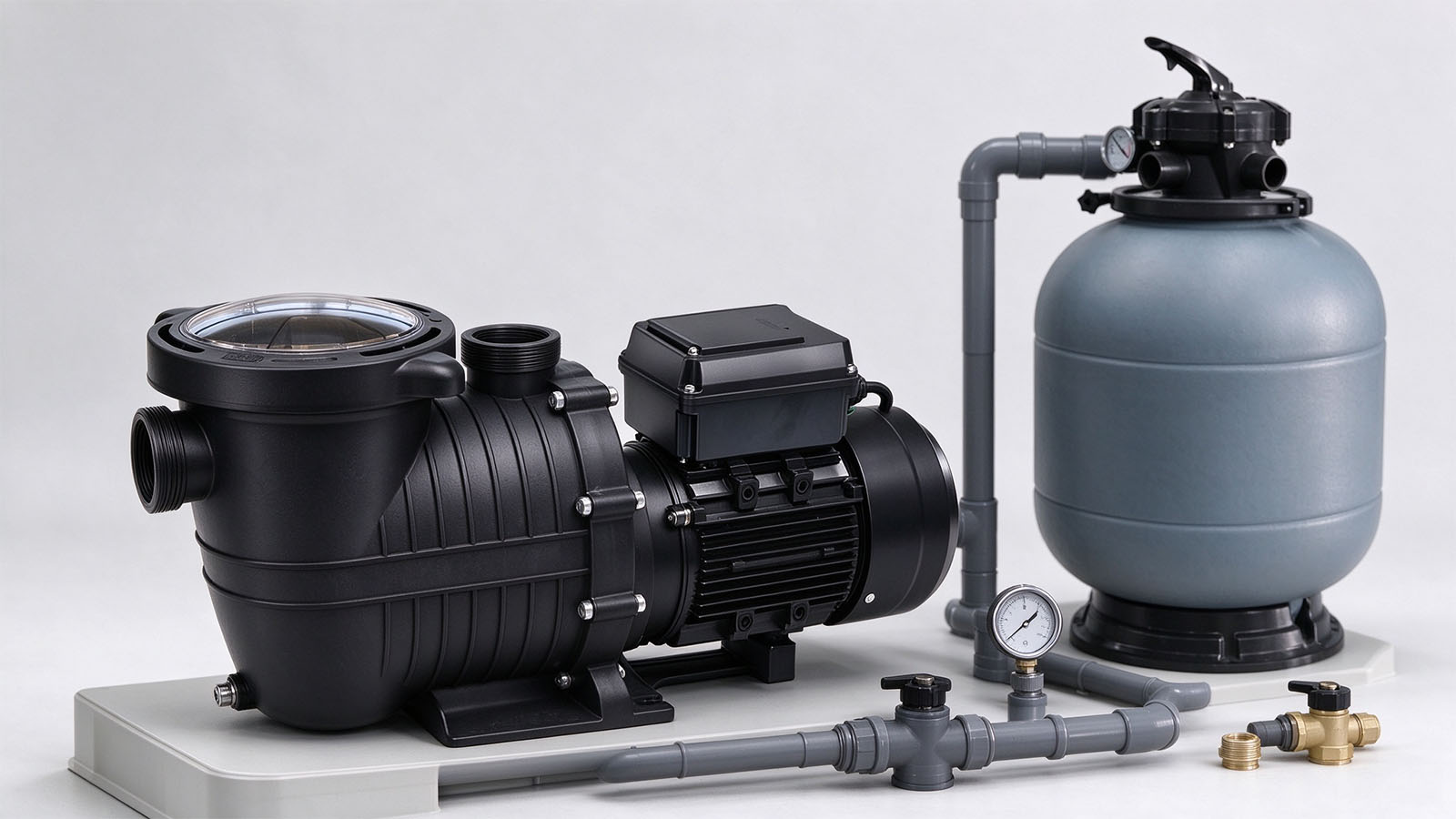
Which Variable Speed Swimming Pool Pump Is the Best?
Ask ten pool professionals this question and you will get ten answers, which is itself the answer: there is no single best variable speed swimming pool pump. There is a best swimming pool pump for your volume, your plumbing, your voltage and the equipment already bolted to your pad.
The useful news is that the shortlist is short, and the differences that decide it are measurable. Flow at your real head, warranty terms, control electronics and local service depth separate a good buy from a two-year regret. This guide covers the concept, the working principle, the types, the standards, a buying checklist and everyday operation — then answers the three questions buyers actually ask: which brand is most reliable, Hayward or Pentair, and what ruins a swimming pool pump.
The Short Answer First
For most in-ground residential pools, the best variable speed swimming pool pump is a 1.5–1.85 HP unit from an established brand, with a published curve you can check, a three-year warranty that does not depend on professional installation, and dual-voltage capability so it lands on either a 115 V or 230 V circuit.
What Is a Swimming Pool Pump?
A swimming pool pump is a motor-driven centrifugal pump: it pulls water from the pool, pushes it through the filter and treatment equipment, and returns it through the jets. Every other device on the pad depends on that flow — the filter cannot filter without pressure, the chlorinator cannot distribute without movement, and the heater will not fire below its minimum flow.
Two numbers define a swimming pool pump better than the horsepower badge: flow in gallons per minute (GPM), and head, the resistance the swimming pool pump works against, in feet of water. A pump sold only on horsepower tells you almost nothing about what it delivers once it meets your pipes.
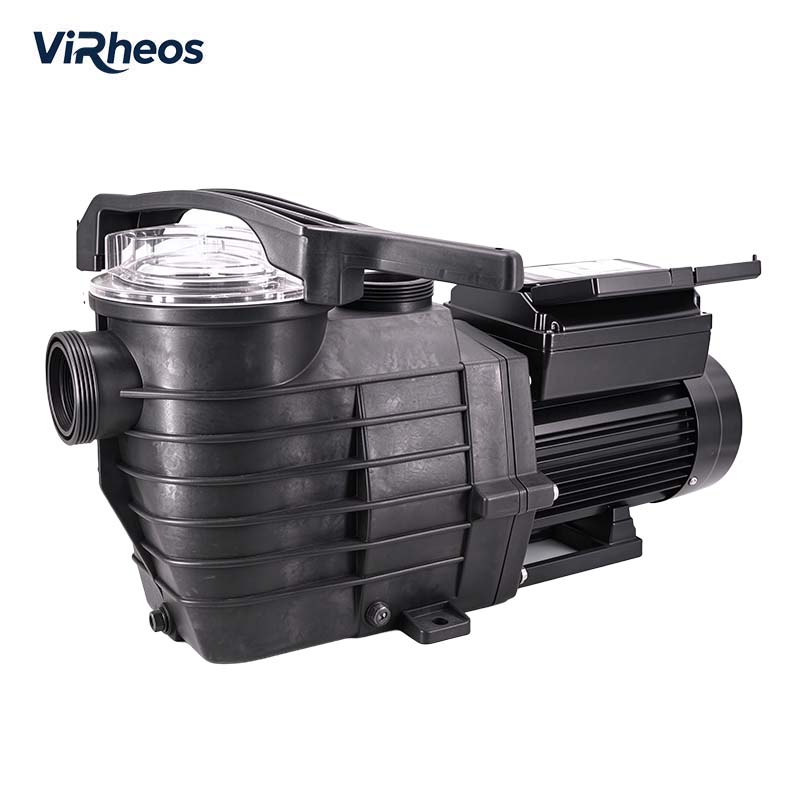
How a Variable Speed Swimming Pool Pump Works
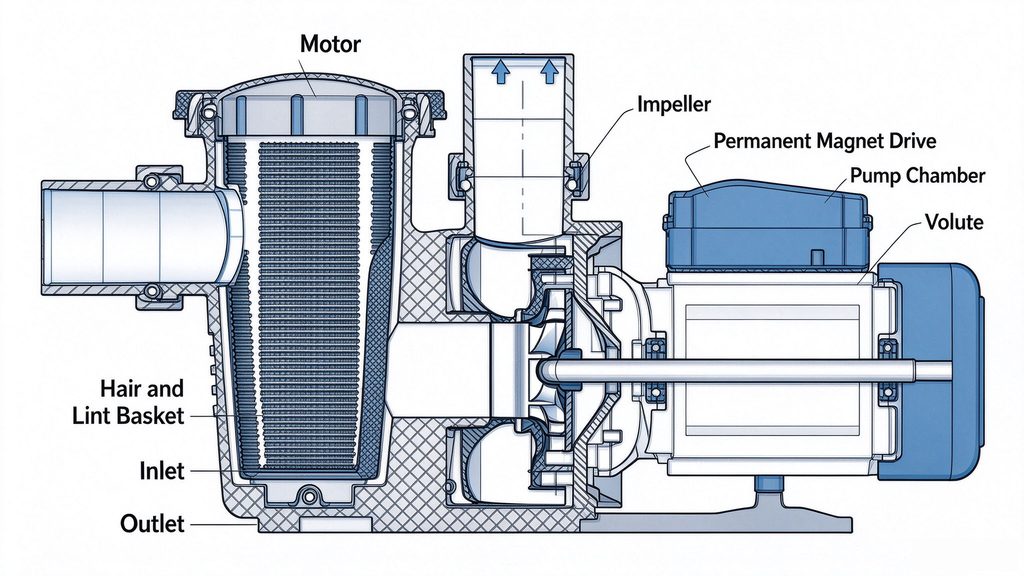
The loop runs in five steps, all day: suction from skimmers and main drain, pressure at the impeller, filtration through sand, cartridge or DE media, treatment across the heater and sanitiser, then return through the jets.
What makes a variable speed swimming pool pump different is the motor. A permanent-magnet motor with an integrated drive lets it run anywhere from roughly 600 to 3,450 rpm instead of one fixed speed. That matters because power demand rises approximately with the cube of speed: halve the speed and it needs about one-eighth of the power.
Measured values published by the U.S. Department of Energy for a 25,000-gallon pool make this concrete :
- 3,450 rpm — 66 GPM — about 2,000 W — full turnover in 6.3 hours — 6 kWh per day
- 1,800 rpm — 33 GPM — about 250 W — roughly one-eighth of the power draw
- 1,200 rpm — 22 GPM — about 74 W — near-silent overnight filtration
Run that pool at low speed for longer and daily consumption falls to about 2.2 kWh — same water filtered, roughly 80% less electricity. ENERGY STAR certified models use up to 70% less energy, save up to about $350 a year, and typically pay back in under two years. In a Department of Energy study of 120 pools, downsizing the pump cut annual use from 3,000 kWh to 1,800; cutting run time took it to 1,200; doing both landed at 720 kWh — a 75% reduction.
One caution that saves arguments later: a slower swimming pool pump does not mean worse water. Long, slow filtration gives the media more contact time, and the Department of Energy found no negative water-quality performance associated with variable speed pumps when they are properly calibrated.
What a Swimming Pool Pump Does All Day
A swimming pool pump does six jobs, and only the first is obvious:
- Distributes chemicals— circulation turns dosing into sanitation.
- Feeds the filter— filters do not suck; they need pump pressure.
- Levels out temperature— without flow, a solar-heated pool stratifies: warm on top, cold at the bottom.
- Runs the add-ons— heaters, salt cells, UV and ozone units and pressure-side cleaners all have minimum flow requirements.
- Skims the surface— return jets aimed correctly push leaves and sunscreen film toward the skimmer.
- Backwashes the filter— sand and DE filters are cleaned by reversing the flow, which only exists because there is a pump.
Variable Speed Pump Types at a Glance
Most buyers are really choosing between four classes of swimming pool pump. The model names differ by brand; the classes do not.
| Class | Typical spec | Best fit | Strengths | Trade-offs |
| Compact retrofit VS | 1.0–1.65 HP, 115/230 V | Replacing a small single-speed unit, tight pads | Lowest entry price, often dual voltage, drops into existing base | Lower maximum flow; struggles with big water features |
| Mid-range VS | 1.5–1.85 HP, 230 V | Most in-ground pools 15,000–30,000 gallons | The value sweet spot; deep field history; quiet at low rpm | Automation accessories sometimes sold separately |
| Premium VS with automation | 2.7–3.0 HP, RS-485 or app control | Large pools, spas, waterfalls, full automation | Programmable schedules, diagnostics, SVRS options, integration with panels | Highest price; drive electronics are the most-reported failure point |
| Commercial-duty VS | 3–25 HP, three-phase | Hotels, water parks, municipal pools | Continuous duty rating, redundancy, health-code turnover capability | Needs a real plant room and three-phase supply |
Turnover is the sizing anchor. Guidance from the U.S. Centers for Disease Control and Prevention puts pool turnover at least four times in 24 hours — once every six hours or less — and 30 minutes or less for spas and splash pads. Required flow is pool volume divided by turnover minutes.
Matching the Pump to the Application
In-ground residential pools. A mid-range variable speed swimming pool pump is the default. It filters at low rpm for most of the day, then steps up briefly for vacuuming, heating or backwashing.
Above-ground and seasonal pools. Compact retrofit units — often an integrated pump-and-sand-filter housing — are cheap, light and easy to drain for winter. Self-priming matters, because the pad usually sits above the water line.
Spas and water features. Sized for jet performance at high flow, not filtration economy. Expect a second dedicated pump rather than one oversized unit.
Hotels, resorts and municipal pools. Duty cycle dominates: 12–16 hours a day, health-code turnover limits, and a failure that closes the venue. Specifiers normally treat NSF/ANSI 50 certification as a permit condition.
Standards and Certifications That Actually Mean Something
| Standard | Issued by | What it verifies | Why a buyer cares |
| NSF/ANSI 50 (NSF/ANSI/CAN 50) | NSF International | Design and material safety, hydrostatic test at 150% of maximum working pressure, independent verification of the published performance curve, verification of claimed self-priming height | The reference equipment standard for pools and spas; written into many state and local codes |
| 10 CFR 431.465 | U.S. Department of Energy | Minimum Weighted Energy Factor (WEF, kgal/kWh); required for pumps manufactured on and after 19 July 2021 | Not optional for the U.S. market |
| ENERGY STAR pool pumps | U.S. EPA | Verified performance above the federal minimum | Qualifies for utility rebates in many regions |
| UL 1081 / EN IEC 60335-2-41 | UL Solutions / IEC | Electrical and mechanical safety of pool pumps, filters and chlorinators | Required for legal sale and installation in most markets |
| ISO 9906 / ANSI/HI 1.6 | ISO / Hydraulic Institute | Hydraulic performance acceptance testing | Confirms the flow and head figures on the curve |
Ask for the certification listing number and check it in the certifier’s directory. A logo on a nameplate is easy to add; a listing number is not.
Buying Guide: Eight Checks
- Size from volume and turnover, not horsepower.A 20,000-gallon pool on an eight-hour turnover needs about 42 GPM.
- Add up the head.Pipe length, diameter, elbows, filter, heater, solar loop and elevation all add resistance. Department of Energy guidance puts the saving from reducing it — bigger pipe, fewer sharp bends, a larger filter — at up to 40%.
- Read the curve at your head,not at zero head, which is where marketing numbers for a swimming pool pump usually live.
- Match the filter.Pushing 60 GPM through a filter rated for 40 GPM channels the media and wrecks filtration.
- Check the voltage before you order.Voltage eliminates more options than any other single specification. Dual-voltage models remove the risk entirely.
- Read the warranty the way it is written.Some long warranties are tied to professional installation; a homeowner install can drop coverage to one year.
- Confirm the noise figure in dB.Full speed sits around 70–75 dB; low-speed operation can fall to roughly 45 dB.
- Buy on ten-year cost.The pump is cheap relative to the electricity it will consume.
Setup and Everyday Operation
Install on a level, drained pad above the flood line, shaded but ventilated, with unions on both sides. Electrical work means a dedicated circuit, correct breaker, GFCI protection and proper bonding — and a licensed electrician.
Before first start, open every valve and fill the strainer pot: a swimming pool pump that starts dry destroys its shaft seal within minutes. Refit the lid hand-tight, start on low speed, bleed air from the filter, and watch the gauge settle.
A common pattern is a long low-speed block overnight plus a short high-speed window in the morning for heating or cleaning. Add a boost cycle whenever the filter needs a proper backwash. Weekly, empty the skimmer and pump baskets and backwash when the gauge climbs about 8–10 psi above its clean baseline.
What Ruins a Swimming Pool Pump?
Almost nothing kills a swimming pool pump suddenly. These pumps are worn down by a handful of repeat offenders, and every one is visible before it becomes expensive.
| Cause | What you see | Typical damage | Fix / prevention |
| Running dry | Loses prime, loud, hot housing | Cracked seal faces, warped diffuser, scored impeller | Keep water level mid-skimmer, fix suction air leaks, refill pot before start |
| Clogged baskets | Weak return flow, high vacuum | Cavitation, overheated motor, seal failure | Weekly basket cleaning, especially after wind or storms |
| Suction air leak | Bubbles in pump lid, poor prime | Cavitation damages impeller and bearings | Lubricate lid O-ring, reseat unions, replace flattened O-rings |
| Bad water chemistry | Scale, corrosion, brittle rubber | Seal elastomers harden, metal corrodes | Keep pH roughly 7.2–7.8, watch calcium hardness, avoid overdosing |
| Blocked filter | Gauge well above baseline | Overpressure strains housing and plumbing | Backwash or clean at about 8–10 psi over clean baseline |
| Poor ventilation | Frequent thermal trips | Winding insulation degrades, motor fails early | Clear vents and fan, add shade without blocking airflow |
| Wrong voltage or loose wiring | Trips, hot terminals, burnt smell | Insulation breakdown, motor burnout | Verify supply voltage, torque terminals, use a licensed electrician |
| Freeze damage | Cracked housing found at spring start | Housing and internal parts destroyed | Drain fully, pull drain plugs, store lid and basket indoors |
On freeze protection: the federal rule ships conservative defaults — a trigger no higher than 40 °F, a maximum one-hour run before re-checking temperature, and no more than half of maximum speed. It is an emergency feature, not a winter heating programme.
The most expensive pattern is ignoring a small leak at the joint between wet end and motor. Water wicks along the shaft into the bearing cavity, rust works quietly, and a seal that costs less than a service call becomes a motor replacement. Wipe the joint dry, restart, and watch for moisture returning within 90 seconds.
Typical service life is 8–12 years for a well-installed swimming pool pump, with the motor often wearing out before the housing. Variable speed units generally outlast single-speed ones because they spend most of their life at low rpm, generating less heat. If a repair bill exceeds about half the price of a replacement swimming pool pump, replacement is almost always the better call.
Hayward or Pentair: Which One?
Both build genuinely good variable speed pumps, and the honest tie-breaker is what is already on your pad.
Choose Pentair if you already run Pentair fittings and a Pentair automation panel. The SuperFlo VS class runs on either 115 V or 230 V, which removes the most common installation surprise, and the larger IntelliFlo class fits existing Pentair bases without re-plumbing. Pentair’s RS-485 automation approach is the more established ecosystem, and more service technicians already work with it. In 2026 retail owner-review compilations, the SuperFlo VS carries the deepest history of any model in the category at roughly 1,800 ratings and a 4.4 average. Reported weak points concentrate in the control electronics and alarms rather than the motor, and some warranty terms are tied to professional installation.
Choose Hayward if you already run a Hayward pad, or you weight owner satisfaction and warranty terms heavily. The TriStar VS class holds the highest owner average in the category, around 4.7 across roughly 310 reviews, with quiet operation the most repeated praise; the Super Pump VS class states three years of coverage. Hayward also publishes a century in business and a claim of being the number one products brand among U.S. pool professionals. The recurring complaint is that control accessories are more often sold separately, which pushes the real installed price up.
The practical rule: for a first upgrade, match the brand you already have. For a fresh build, decide on warranty terms, voltage flexibility and who can service it locally — not on the spec sheet.
So Which Brand Is Most Reliable?
Reliability here is less about the motor and more about three things you can verify before buying:
- Warranty terms that survive a normal installation.Three years with no professional-install clause beats a longer headline warranty that quietly requires one.
- Electronics support.These pumps fail at the drive board more often than at the motor, which is a sealed permanent-magnet unit with no brushes to wear. Ask how a board replacement is handled and how long parts are stocked.
- Local service depth.The most reliable swimming pool pump on paper becomes the least reliable in practice if the nearest technician who knows it is two days away.
The most defensible answer: the established name with the deepest installed base in your region, a three-year warranty, and a distributor who stocks boards, seals and impellers. For B2B buyers sourcing at volume, the same logic applies to the factory — ask for the WEF rating, the NSF/ANSI 50 listing number, a verified performance curve and a written spares commitment.
Four Product Classes Worth Your Money
- Compact retrofit VS (1.0–1.65 HP).Best value as a swimming pool pump for small in-ground and large above-ground pools. Look for dual voltage and a stated three-year warranty. Weak point: limited top-end flow for water features.
- Mid-range VS (1.5–1.85 HP).The default recommendation: quiet at filtration speed, enough head for most plumbing, deepest field history of any class.
- Premium VS with automation (2.7–3.0 HP).Worth it with a spa, a waterfall, a large pool, or if you want app scheduling and diagnostics. Budget for a possible drive board out of warranty.
- Commercial-duty VS (3 HP and up, three-phase).Specified against health-code turnover and continuous duty; certification and redundancy matter more than price.
Frequently Asked Questions
- Which variable speed swimming pool pump is best overall?
- The one that delivers your required GPM at your actual head, on your available voltage, with a warranty that holds without a professional-install clause. For most in-ground pools that is a 1.5–1.85 HP swimming pool pump from an established brand.
- Is a variable speed swimming pool pump worth the extra cost?
- Usually yes. ENERGY STAR puts typical payback under two years, and many utilities add rebates on top.
- How long should a swimming pool pump run each day?
- Long enough for one full turnover — for most residential pools, 6 to 10 hours, or the low-speed equivalent across a longer window.
- How long does a swimming pool pump last?
- Typically 8–12 years, with the motor often failing before the housing.
- What is the most reliable pool pump brand?
- The established brand with the deepest local service network and the cleanest warranty terms. Model-level field history matters more than the badge.
Verdict
There is no universal best variable speed swimming pool pump, but there is a best process: size from turnover, read the curve at your real head, confirm voltage before ordering, check the listing number rather than the logo, and buy the warranty terms you would want to claim. Do that and the pump stops being the most expensive box on the pad and becomes the part you never think about again.
References
1. Whole System Design of an Energy Efficient Residential Pool System
Abstract: This study examines low-speed filtration, salt chlorinator and cleaner limits. Proper low-flow operation saves >70% energy without harming water quality; small PV can nearly cover the filtration load.
2.Field Studies of Two-Speed and PV-Powered Pumps and Advanced Controls for Swimming Pools
Abstract: Field tests compare two-speed motors, PV pumps and smart controls. Low-speed operation cuts power sharply, and intelligent scheduling reduces pool pump demand.
3.Pool Pump Controls for Load Shifting
Abstract: Residential pool pumps are major California home loads. A test rig validates a VS pump control algorithm responding to grid price signals for demand and cost reduction.