
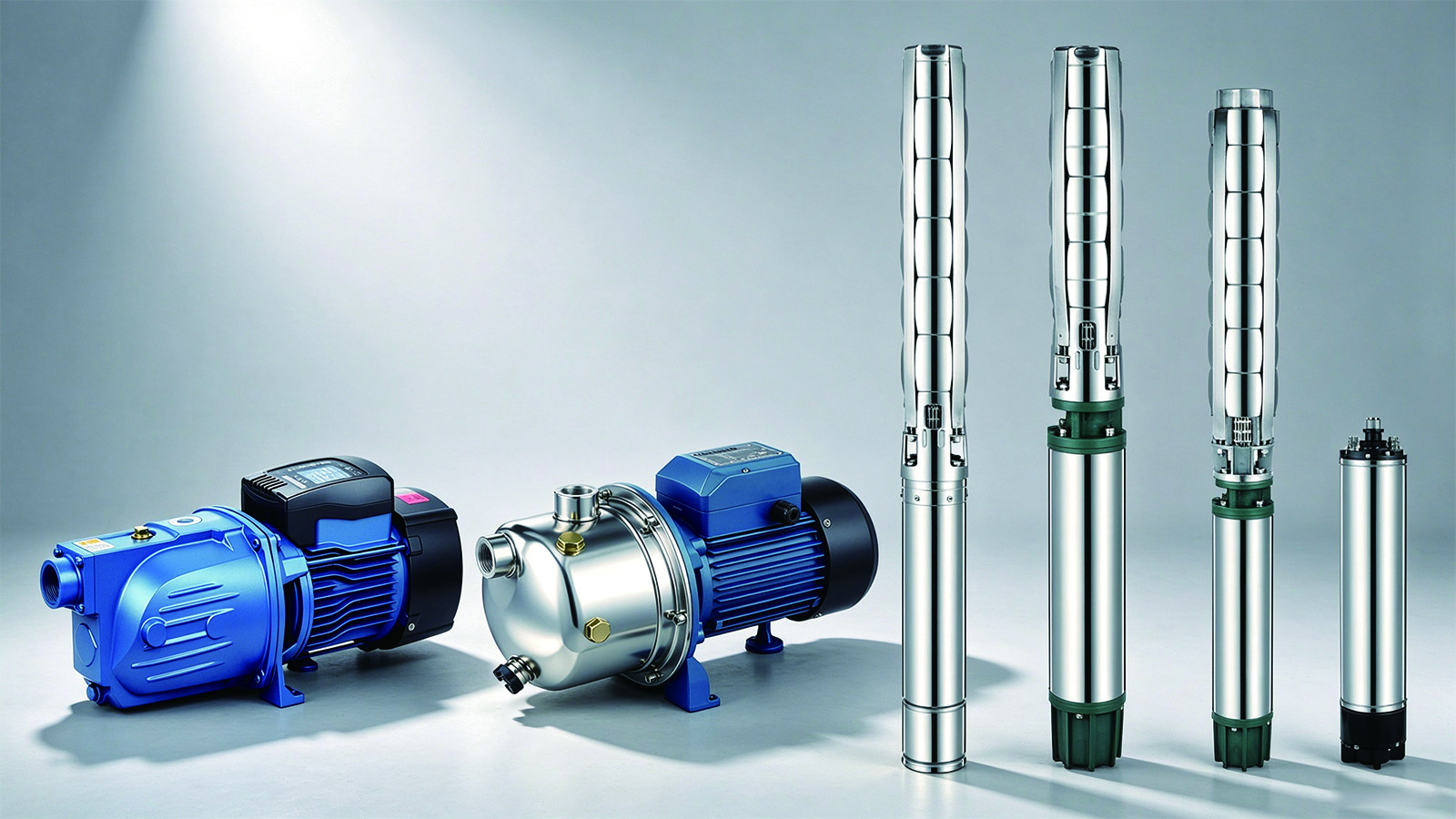
What Is the Difference Between a Submersible Pump and a Jet Pump?
A drilling contractor hands over two numbers: total drilled depth and static water level. Only the second one decides which pump you can buy. A jet pump sits at the surface and pulls water up a suction pipe. A submersible pump hangs below the water line and pushes. Noise, priming, service access, energy use and price all follow from that.
Both quotes list a motor, impeller, tank and cable. The surface system adds a foot valve, a priming port and an airtight suction line; the downhole system adds a drop pipe, sealed motor and control box. On a shallow borehole the surface unit is cheaper to own. In the dry season it can spend months losing prime. This guide is for specifiers, distributors and project buyers.
The short answer, in one table
Static water level is measured from the pump centreline to the recovered water surface, not to the drilled depth. A 60 m borehole with water 5 m down is shallow duty; a 20 m borehole with water at 12 m is not.
Table 1. Nine buying parameters that change with the position of the motor.
| Parameter | Jet pump | Submersible pump | Why it matters to a buyer |
| Position | Above ground, in a pump house | Inside the casing, below pumping level | Sets noise, frost protection, repair method |
| How water moves | Pulls by suction through a venturi ejector | Pushes through stacked impellers | Pushing has no atmospheric ceiling |
| Practical lift | ~7.6 m (25 ft) single-pipe | 30 m to well over 100 m | First spec line to confirm |
| Priming | Required after any air entry | None; already flooded | Lost prime is the top service call |
| Typical motor | 0.5-1.5 hp light duty | 0.5-7.5 hp borewell units | Match to flow and head, not depth alone |
| Casing | Suction pipe suits 3-in wells | Usually 4-in casing minimum | Old narrow bores may rule it out |
| Noise | Motor in occupied space | Inaudible at the wellhead | Matters on residential projects |
| Energy per m3 | Higher: part of flow recirculates | Lower at the same duty point | Shows on the operating budget |
| Service access | Hand tools, no lifting gear | Pull pipe, cable and pump | Drives downtime and spare parts |
This jet pump comparison keeps appearing in tenders: agriculture took 24.0% of 2025 revenue and Asia Pacific 45.2%, in a market worth USD 74.5 bn and forecast at USD 103.3 bn by 2033.
Source: Grand View Research, Water Pump Market Size and Share Report 2026-2033, published 8 April 2026 (2025 market USD 74.5 bn; 2033 forecast USD 103.3 bn; 4.4% CAGR; Asia Pacific 45.2%; agriculture 24.0%).
What a jet pump is and how it works
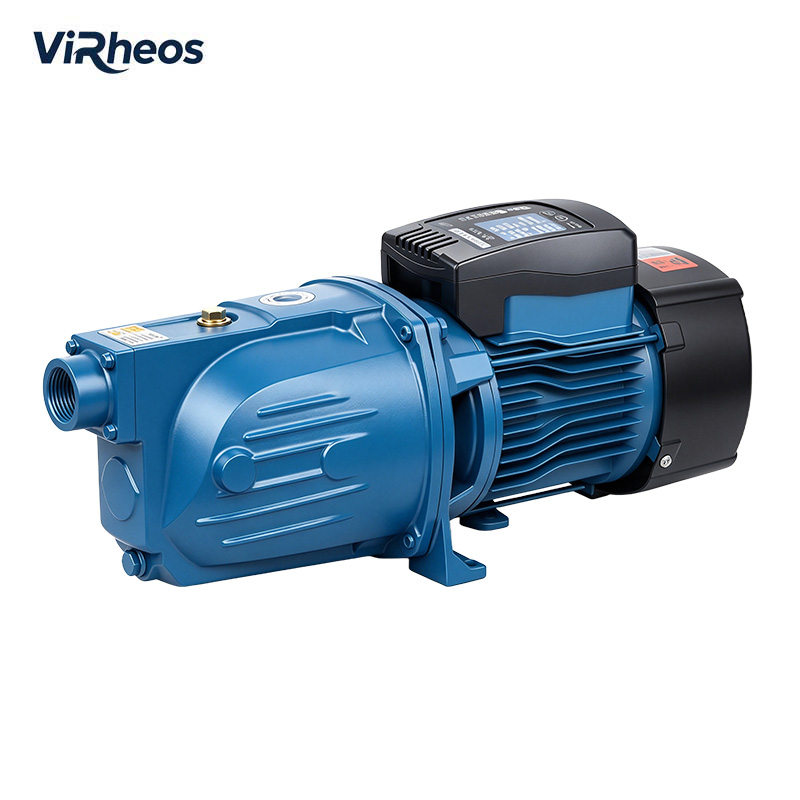
A jet pump is a surface-mounted centrifugal pump with a venturi ejector on the suction side. The impeller drives water through a narrow nozzle; the jet speeds up, pressure drops, and fresh water is drawn up the suction pipe. A diffuser slows the mixed stream and turns velocity back into pressure. Part of the flow recirculates, the rest goes to the pressure tank.
Two consequences matter more than the catalogue headline. The machine circulates more water internally than it delivers, so it uses more input power for the same flow. And it cannot start with air in the casing: air compresses, water does not, so no vacuum forms. Hence the priming plug on the volute and the foot valve, a one-way strainer holding the water column when the pump stops.
A pressure switch typically cuts in at 30 psi and out at 50 psi; a 20 to 80 gallon tank stops the motor starting every time a tap opens. On a datasheet, P1 is the inlet pressure tapping and P2 the discharge tapping – the gap is the pressure the pump adds. If P1 never falls below atmospheric while P2 stays flat, the unit is air-locked, not worn out. A tank that has lost its air charge short-cycles the motor.

What a submersible pump does differently
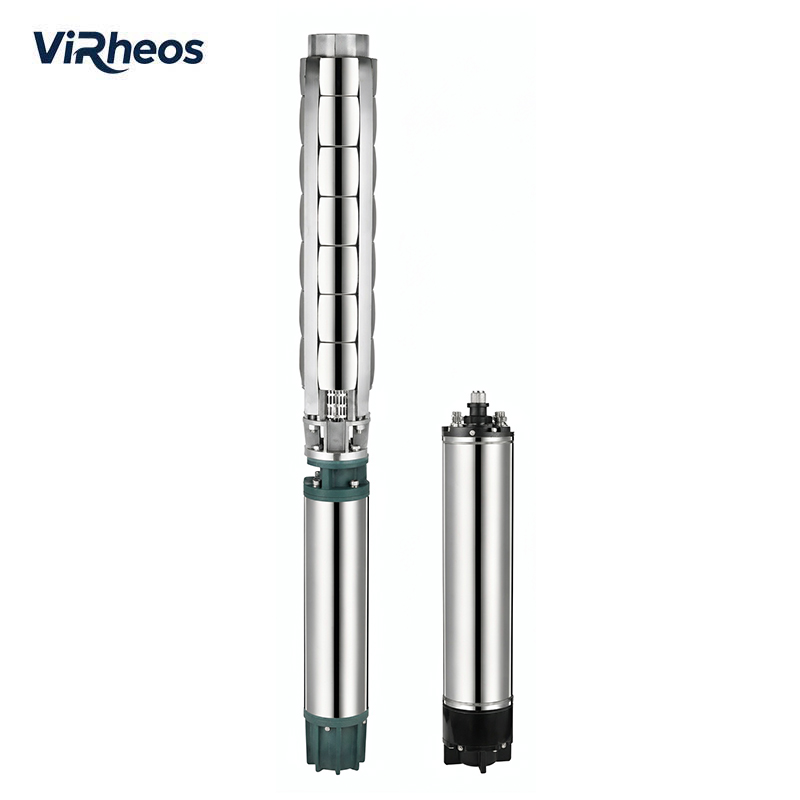
Lower the machine into the casing. A submersible pump is a stainless cylinder about 3.5 in across for a 4-in well, with a sealed motor at the bottom and a stack of impellers above it. Each stage adds pressure. A drop pipe carries water up; a cable runs beside it to a control box.
Because suction is flooded, there is no atmospheric ceiling. Set the unit below the lowest pumping level with margin for seasonal decline, and above the sump where sediment collects. Water past the motor carries heat away, so no ventilation or frost protection is needed. It is quiet for the same reason it is hard to reach. The trade is access: a failed capacitor on a surface unit is an afternoon with hand tools, a failed seal downhole means pulling pipe and pump with a rig.Specify low-level and phase-loss protection; single-phasing burns out downhole motors.
How deep will a jet pump pump water?
About 25 ft (7.6 m) of vertical suction lift for a single-pipe shallow-well jet pump, measured from the pump to the water surface, not to the bottom of the bore.
The reason is atmospheric pressure, not motor size. At sea level air pressing on the well water can support a column of roughly 33.9 ft (10.3 m) under a perfect vacuum. No production pump manages that. Friction, fittings, temperature and altitude bring field guidance down to 22-25 ft; higher elevations lose roughly a foot of lift per 1,000 ft. More horsepower does not move this ceiling.
A deep-well jet pump moves the ejector down into the well: a drive line sends pressurised water down, a suction line brings the combined flow back. Published ranges differ usefully – service literature quotes 90-120 ft for a single-stage ejector, university extension guidance describes installations to 250 ft, industry guidance notes several hundred feet is configurable. All are true; the gap is efficiency. Flow falls away sharply as lift grows, so most projects switch to a submersible well before the theoretical maximum.
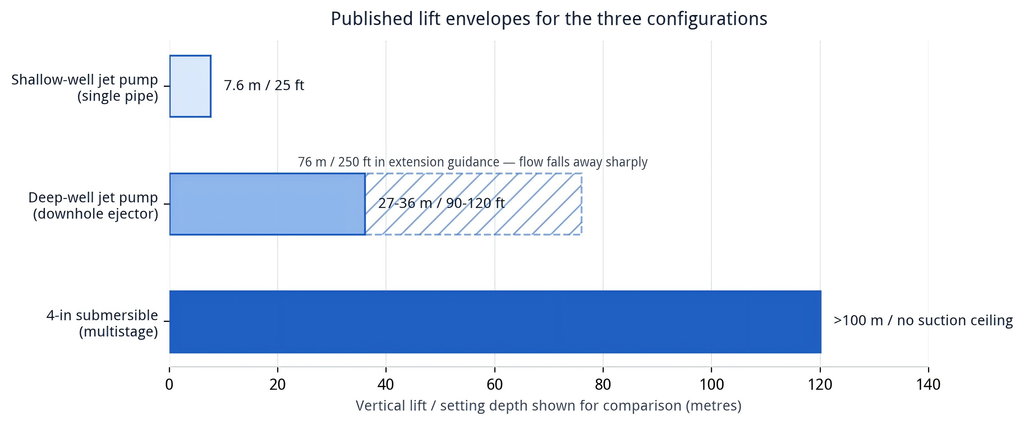
Source (Note 2, engineering basis): National Ground Water Association, Pumping Systems; Nebraska Extension G2152; National Wildfire Coordinating Group, Firefighter Math – Drafting Guidelines (14.7 psi, 33.9 ft theoretical, 22.5 ft attainable); ANSI/AWWA E101. Submersible duty is not suction-limited; industry guidance describes settings of several hundred feet. Depth bands and atmospheric limits are standing physical guidance, not annual statistics; all market, regulatory and hydrological figures here come from 2024-2026 releases.
What are the disadvantages of a jet pump?
Priming comes first. Every power cut, pinhole in a suction union or sticking foot valve lets the water column drain back. A suction-side leak does not drip – under vacuum it pulls air in. Soapy water brushed over the joints shows where. Re-priming takes 30 to 60 minutes, and on a remote irrigation site that is a call-out.
Efficiency is second: part of the discharge is deliberately sent back through the nozzle, so the machine moves more water internally than it delivers. A downhole unit pushes the same flow with less input power; at shallow duty the gap is modest, at 30 m of lift it is expensive.
Third is the depth ceiling. Fourth is noise – the motor lives in a utility room or pump house. Fifth, it needs frost protection and ventilation; a cracked cast-iron casing is a replacement, not a repair. More small parts fail too: nozzle, diffuser, foot valve, seal, switch. Sand and scale wear the nozzle first, cutting suction lift before anything looks broken. None of this makes the jet pump a bad buy; it makes it a shallow-duty buy.
Types of jet pump – and the four pump families buyers compare
Three jet configurations cover most catalogues: shallow-well (ejector in the pump body, one suction pipe), deep-well (ejector downhole, two pipes) and convertible (re-piped either way). Convertible units suit new boreholes where the water table is not yet characterised.
Buyers also ask about ‘the four types of pumps’. There is no official list – it changes with the sorting rule. By energy transfer: centrifugal, positive displacement, jet or ejector, and submersible (an installation category, usually multistage centrifugal). By installation: surface, downhole, vertical lineshaft turbine, inline booster. Most quotes mix the two: a 4-in downhole unit is a centrifugal pump that happens to be submersible, while a surface jet pump is a centrifugal pump with an ejector bolted on.
Applications, with the water data behind them
Shallow wells, cisterns, ponds and lake intakes suit a surface jet pump: water is close, the motor is reachable, capital cost is low. Household boosting, small irrigation plots and rural schemes in that band all use it. Deep-well ejector versions serve narrow or crooked casings that will not accept a 4-in cylinder – they run in wells 3 in or smaller.
Submersible units take over on deep borewells, village supply schemes, booster sets, pool and wastewater duties. Irrigation is the biggest end use and a groundwater story: agriculture takes roughly 70% of global freshwater withdrawals, groundwater supplies about 25% of irrigation water and about half of domestic freshwater withdrawals.
Source: UN-Water / UNESCO, The United Nations World Water Development Report 2024 – Water for Prosperity and Peace, Facts, Figures and Action Examples.
Standards, certificates and the paperwork to request
Standards make two quotes comparable; they are not decoration on a B2B order.
- ISO 9906 governs hydraulic performance tests. Ask for the grade – 1B, 1E, 1U, 2B, 2U or 3B – because ‘tested to ISO 9906’ alone is not verifiable; the grades allow different deviations. A Q/H curve without a grade and serial number is a sales drawing.
- IEC 60529 IP68 covers continuous submersion – read the declared test depth and duration, not just the code. IEC 60034 or NEMA MG1 covers the motor; Class F insulation is common. IEC 60335-2-41:2024 covers safety of household and similar electrical pumps, relevant to surface units sold into domestic channels.
- NSF/ANSI 61 applies to drinking-water contact materials – ask for the listing on wetted parts, not a ‘food grade’ claim. AISI 304 suits clean cold water; 316L is the step up for brackish water.
- For the EU, Regulation (EU) 547/2012 sets minimum efficiency via the Minimum Efficiency Index. MEI >= 0.40 removes the least efficient 40% of models from the surveyed market. ESPR entered into force in July 2024 and a pump review is under way, so specify headroom above the floor.
Source: European Commission, Ecodesign – Water Pumps, Regulation (EU) 547/2012 and MEI >= 0.40; ESPR, July 2024; ISO 9906, IEC 60529, IEC 60034, IEC 60335-2-41:2024, NSF/ANSI 61, current editions.
Buying guide: the eight RFQ line items
Most bad purchases are bad specifications. A jet pump quote should state the ejector configuration and suction pipe size; a downhole quote should state setting depth and cable length. Table 2 condenses what a manufacturer needs to quote accurately.
Table 2. RFQ checklist – the lines that make two quotes comparable.
| RFQ line | What to state | Typical published range | Why it matters |
| Static water level | Measured in the driest week, metres below pump centreline | 3-8 m shallow; 30-120 m deep | Sets the pump family first |
| Casing ID | Nominal and minimum clear internal diameter | 3 in, 4 in, 6 in | Rules a 4-in unit in or out |
| Duty point | Flow at required pressure, plus pipe friction | 1-5 m3/h domestic; 5-30 m3/h irrigation | Avoids oversizing and short cycling |
| Power supply | Voltage, phase, frequency, max starts per hour | 230 V 1-ph / 400 V 3-ph, 50 or 60 Hz | Wrong voltage is a top commissioning fault |
| Wetted materials | Casing, impeller, seal, cable grades | AISI 304 / 316L; NSF/ANSI 61 for potable | Corrosion claims need a grade |
| Performance evidence | Q/H curve, ISO 9906 grade, serial-numbered report | Grades 1B or 2B common | Makes two quotes comparable |
| Efficiency declaration | MEI where applicable, motor IE class | MEI >= 0.40 in the EU | Avoids a re-quote when rules tighten |
| Commercial pack | MOQ, lead time, spares list, packing, warranty | Ejector kit, seal, capacitor, foot valve | Drives landed cost and downtime |
Send the same eight lines to two or three qualified manufacturers. A cheap jet pump quote with thin documentation is rarely the cheapest to own.
What the catalogue tells you before you ask for a price
Most catalogues file a jet pump under surface pumps, alongside peripheral, monoblock and booster units. They share a motor platform, a pressure switch and a pressure tank, so one spares kit covers several article numbers. A submersible unit sits in the downhole family with borewell, sewage and pool pumps – shared sealed motors, cables, control boxes and IP68 tests.
For OEM or ODM orders, settle voltage (115/230 V or 230/400 V), frequency, nameplate language, carton marking and the spares pack up front: ejector kit, foot valve, mechanical seal, capacitor, pressure switch. Validate one sample against its Q/H curve, temperature rise and noise before scaling the order. A jet pump programme that ships with the right spares costs less to own than a cheaper unit needing a second shipment.
Installation and first-week operating notes
Priming is a procedure. Isolate power, confirm the gauge reads zero, open the priming plug and pour clean water in until it overflows and bubbles stop. Refit with thread sealant, restore power and let the unit reach cut-out pressure. If it will not, do not keep it running – a dry run overheats the mechanical seal.
Can a jet pump run without water? Only briefly, and it should not. Impeller and seal need liquid for cooling; a few minutes dry can write off the seal. Fit low-level or loss-of-prime protection on unattended sites.
When a jet pump stops pumping, check in order: air in the suction line, a foot valve that will not hold, a water table below the intake, a blocked ejector nozzle, a waterlogged pressure tank. A waterlogged tank shows water at the Schrader valve instead of air; pre-charge should sit 2-3 psi below cut-in. Keep the suction line short, wide and free of high points, and log cut-in pressure and amp draw on day one.
Two worked borewell examples
These are worked examples built on the published limits above, not third-party field measurements.
Case A – shallow borehole. A 6-in borewell stands at 4.5 m static in September and 7 m in May. A 1 hp single-pipe jet pump with a 1-1/4 in suction line, foot valve, 30/50 psi switch and 80 L tank sits inside the 7.6 m envelope. Two summers in it starts losing prime overnight, with no visible drip. The fault is a pinhole at a suction union pulling air in under vacuum; the fix is sealant, a new foot valve and a re-prime. Parts are cheap; the call-out is not – which is the argument for ordering a spare seal up front.
Case B – deep borewell. A village borehole sits at 32 m static and draws down to 38 m at peak. A two-pipe ejector can be quoted, but flow tapers each dry month. The order moves to a 4-in stainless multistage unit set 6 m below the lowest pumping level, with IP68 motor, control box, low-level protection and a serial-numbered test report. No priming step; commissioning is one lift-in instead of a day of leak-chasing.
This is not niche. The US national domestic well database holds 5,982,715 records with construction data through 2024, and a 2023 study sampled 44 private wells in California’s western Central Valley.
Source: U.S. Geological Survey, Synthesized Domestic Well Database for the Conterminous United States, data release 14 January 2026 (5,982,715 records, 1680-2024); USGS, Quality of Groundwater Used for Domestic Supply in the Western Central Valley, California – 2023, SIR 2026-5069.

Frequently asked questions
- How deep will a jet pump pump water?
- About 25 ft (7.6 m) of practical suction lift for a single-pipe unit, measured to the water surface rather than the drilled depth. A deep-well jet pump with a downhole ejector is commonly quoted at 90-120 ft; extension guidance goes further, but flow drops sharply and most buyers move to a submersible before that.
- What are the disadvantages of a jet pump?
- Priming and lost prime, lower efficiency because part of the discharge is recirculated, the 25 ft ceiling, motor noise indoors, frost protection, and more wearable parts – nozzle, diffuser, foot valve, seal, switch. Manageable on shallow duty, expensive once the water table drops.
- Do jet pumps need priming, and how do I prime one?
- Yes, whenever air has entered the casing or suction line. Isolate power, fill through the priming plug until water overflows and bubbles stop, refit the plug, restore power and watch the gauge reach cut-out. If it fails twice, stop and find the air leak rather than running the motor dry.
- Can a jet pump run without water, and why is mine not pumping?
- It should not run dry at all – the seal and impeller need liquid for cooling. If a primed unit still delivers nothing, check in order: suction-side air leak, foot valve not holding, static level below the intake, blocked ejector nozzle, waterlogged pressure tank, then the pressure switch.
- What is P1 and P2 on a pump, and what is the working principle?
- P1 is the inlet pressure tapping, P2 the discharge tapping; the gap is the pressure the pump adds. The working principle is a centrifugal impeller adding velocity, a diffuser converting it to pressure, and – on this design – a venturi ejector using part of that flow to entrain more water from the well.
- What are the four types of pumps, and what does a borewell jet pump cost?
- By energy transfer: centrifugal, positive displacement, jet/ejector and submersible (the last is an installation category). By installation: surface, downhole, vertical lineshaft turbine, inline booster. On price, we would not put a global figure here – 0.5 to 1.5 hp surface units and ejector kits vary widely by voltage, certification pack and region. Compare landed cost per duty point, spares included.
What to do next
Measure the static water level in the driest week, write the eight RFQ lines, and ask each shortlisted manufacturer for a Q/H curve with a named ISO 9906 grade, the efficiency declaration and a spare-parts list. Compare the documents side by side. The jet pump that arrives with the clearest paperwork is usually the one still running when the water table drops.
References
Abstract: It optimizes multistage borehole submersible pumps via neural network and PSO, improving hydraulic efficiency and internal flow uniformity for rural groundwater supply.
Abstract: This model studies coupled jet pump + submersible centrifugal pump downhole systems, evaluating cavitation boundaries and energy efficiency for well pumping.