
What Is an Effluent Pump? Purpose & How It Works
The one-line answer
An effluent pump moves the liquid that leaves a septic tank after the solids have settled out. It is not a sewage pump, and it is not a sump pump. It sits in the middle.
That middle position confuses people, because the three pumps look almost identical on a pallet and differ by numbers nobody prints on the box. Here they are:
- Sump pump— clear groundwater. If it sees solids, the impeller jams.
- Effluent pump— settled septic liquid with small suspended particles, up to about ¾ inch.
- Sewage pump— raw, unscreened waste including toilet paper, rated for 2-inch solids.
Get the middle one wrong and the failure is fast. Put an effluent pump on raw sewage and the tighter impeller jams, the rotor locks, and the motor sits at locked-rotor current until it cooks. Put a sump pump on effluent and the same thing happens a few weeks later.
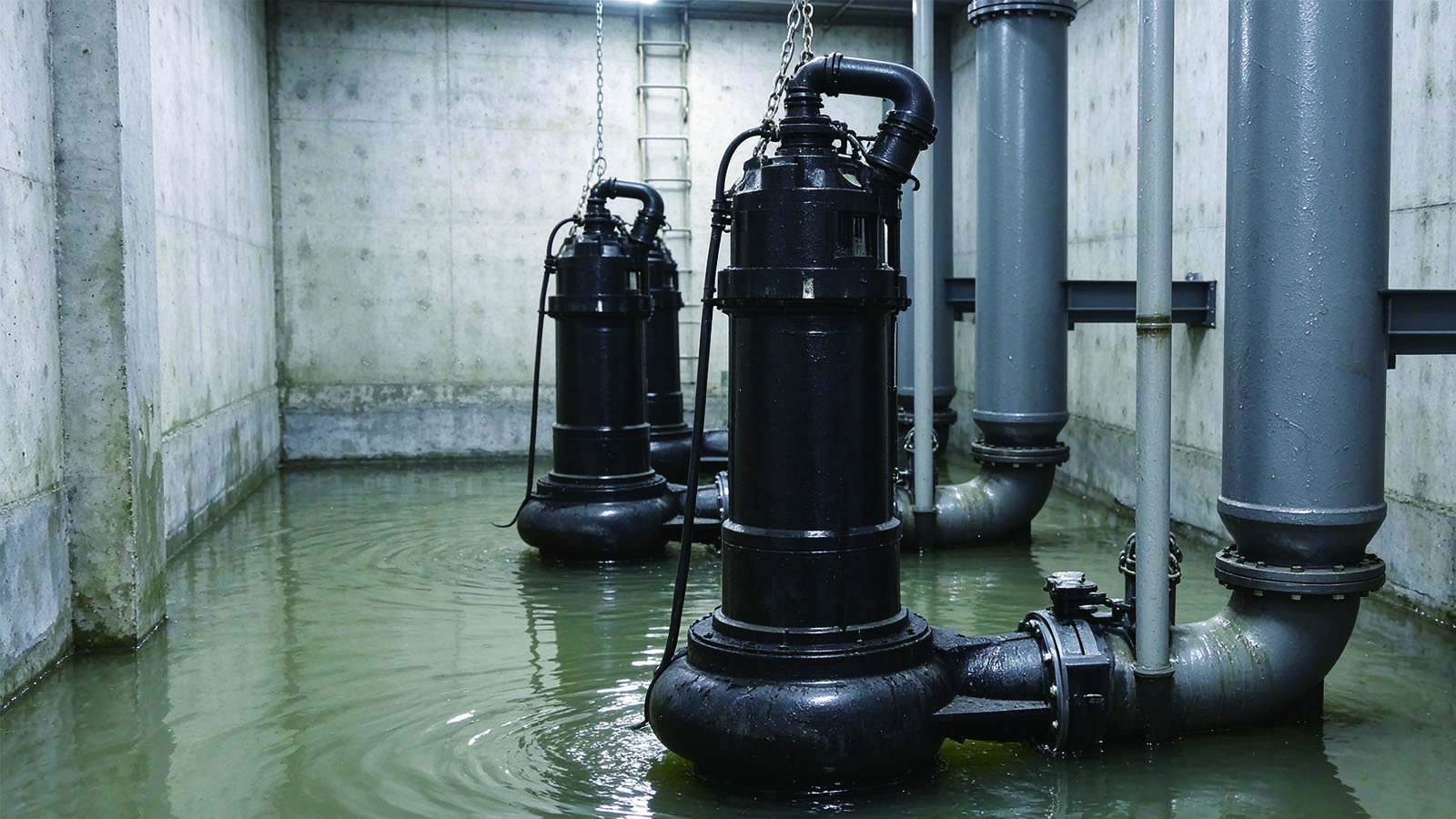
Physically, an effluent pump sits after the septic tank and before the soil. Wastewater leaves the house, settles in the tank, passes an effluent filter at the outlet, and collects in a separate pump chamber — sometimes a compartmented tank, sometimes its own tank downstream. From there the effluent pump lifts it to the drain field. A quick field test: if the chamber has no fixture draining into it and the liquid in it looks like grey, slightly turbid water rather than recognisable waste, you are looking at effluent pump duty.
What “effluent” actually means
Effluent is not a polite word for sewage. It is a different liquid, and the difference is measurable.
Raw household wastewater carries roughly 155–330 mg/L of total suspended solids and 155–286 mg/L of BOD₅. After a properly working septic tank and an effluent filter, that liquid drops to about 20–55 mg/L of suspended solids and 100–140 mg/L of BOD₅, with fats, oils and grease falling from 70–105 mg/L to 10–20 mg/L.
| **Raw wastewater** | **Filtered septic tank effluent** | |
| Total suspended solids | 155–330 mg/L | 20–55 mg/L |
| BOD₅ | 155–286 mg/L | 100–140 mg/L |
| Fats, oils, grease | 70–105 mg/L | 10–20 mg/L |
| Largest solids present | Toilet paper, wipes, food scraps | Fine suspended particles |
| What the pump must pass | 2 in spheres | ¾ in or smaller |
| Impeller this allows | Vortex or non-clog, wide passage | Semi-open or turbine, efficient |
Table 1 — What the pump actually sees. Influent and filtered primary effluent strength for residential wastewater. *Source: Michigan EGLE criteria for on-site wastewater treatment, citing EPA On-site Wastewater Treatment Systems Manual (EPA/625/R-00/008).
Read the last row, because it explains the whole category. Take the big solids out upstream and the pump no longer needs a wide, clog-proof passage. It can use a tighter, more efficient impeller — which is why an effluent pump routinely produces *more* head than a sewage pump of the same horsepower, not less.
How an effluent pump works
The mechanism is ordinary centrifugal pumping. What is distinctive is the cycle around it.
- Effluent flows by gravity from the septic tank outlet, through an effluent filter, into a pump chamber — sometimes called a dose tank or wet well.
- Level rises.In a demand system, a float switch closes and the pump runs. In a timed-dose system, a control panel fires the pump on a schedule and the float only acts as a dry-run guard.
- The pump delivers a measured dose to the drain field — a set volume, then it stops.
- The field rests.That rest period is the point.
Step 4 is the part people miss. Soil absorbs effluent far better in small, regular doses than in one continuous surge. Dosing prevents hydraulic overload of the drain field, spreads the load across the whole infiltrative surface, and is one of the reasons pressure-dosed systems outperform gravity systems on marginal soils. The EPA’s onsite manual describes the dosing-and-resting cycle as promoting maximum contact time between effluent and unsaturated soil.
There are two ways to control that cycle. Demand dosing is the simpler arrangement: a float switch fires the pump whenever the chamber fills to a set level, and it runs until the level drops. It is cheaper and easier to service, but it is blind to how much water the household actually used that day. Timed dosing puts a control panel and a timer in charge, delivering a set volume on a schedule with the float acting only as a dry-run guard. It costs more and it is more complex, but it evens out heavy-use days, keeps doses small and frequent, and — usefully — will raise an alarm when volumes exceed the design figure, which is often the first sign of groundwater leaking into the tank or pump chamber.
Most residential effluent pumps are submersible: motor and hydraulic end sealed into one unit sitting in the liquid. It pushes rather than sucks, so there is no priming and no suction piping. The surrounding liquid cools the motor — which is also why these pumps must never be run dry. Several state design manuals make that explicit: the pump uses water as both lubricant and coolant, and if the intake screen plugs and water cannot reach it, the pump is damaged.
Because the liquid it handles has already been screened, an effluent pump does not need the wide, clog-proof passage a sewage pump requires. State guidance notes that these units usually run a turbine-type impeller rather than a non-clog or grinder design, and that they are correspondingly less expensive and far less prone to clogging.

Types you will be quoted
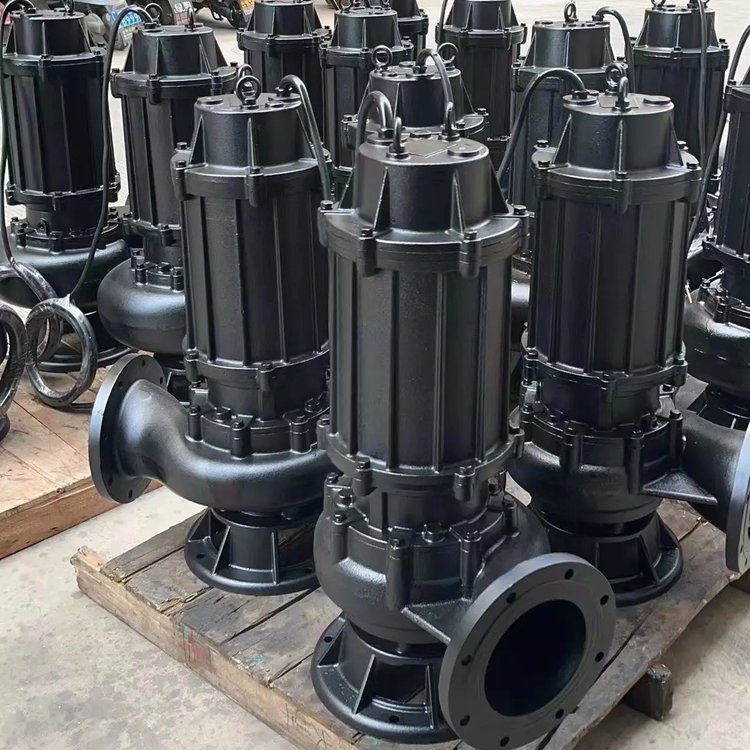
- Standard submersible effluent pump. The default for a septic pump chamber. Typically 1/3 to 1 HP, moving roughly 15–60 GPM at residential heads, with a semi-open impeller and 1½ or 2 inch discharge. If a system has one pump and it sits between a tank and a field, this is almost certainly it.
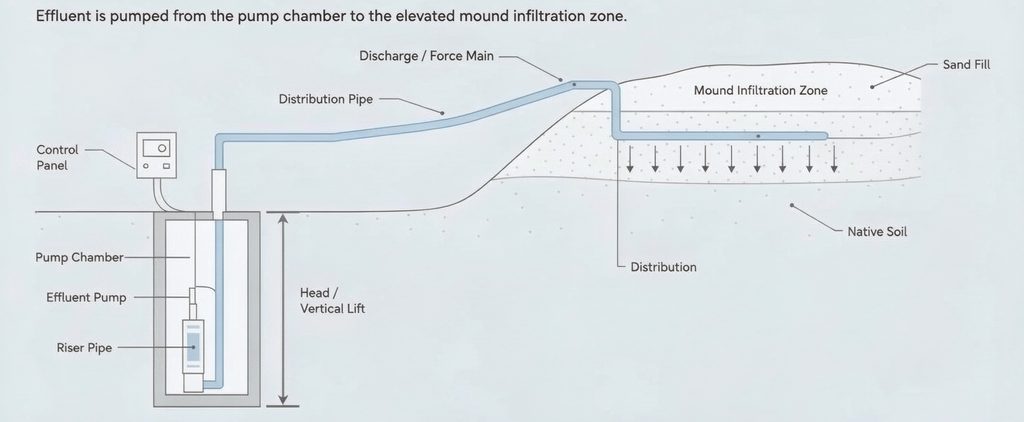
- High-head effluent pump. Same job, built to push against real vertical lift. This is what mound systems and pressure-dosed fields need, where an effluent pump may work against 30–80 ft of head or more. Buying a standard unit and hoping is how mound systems fail in the first year.
- Filtered effluent pump. Fitted with, or preceded by, a screen at the intake. Worth insisting on: the drain field is by far the most expensive component in the system to replace, and everything you stop at the pump is a year of field life you keep.
- Turbine / jet effluent pump. Less common on residential sites. It generates more pressure at low flow, which suits drip distribution emitters that need a specific operating pressure rather than raw volume.
- Effluent pump in a STEP or cluster system. Septic tank effluent pumping — STEP — moves settled liquid from individual tanks into a small-bore collection main instead of a gravity sewer. The principle is identical; what changes is the duty point and the fact that several units share one main.
- Dosing pump assembly. Not a different pump so much as a different control philosophy — pump plus timer, floats and panel, delivering a set volume per event.
And the two it gets confused with: a sewage pump passes raw waste with 2-inch solids into a sealed, vented basin; a grinder pump shreds solids to slurry for small-bore pressure mains. Neither belongs in a standard pump chamber downstream of a healthy tank.
Where they get used
- Pressure-dosed drain fields— the pump delivers measured doses instead of a continuous trickle.
- Mound systems— the absorption area sits above the tank, so gravity is out of the question.
- Uphill or distant drain fields— whenever the field is higher than the tank or several hundred feet away.
- Low-pressure pipe (LPP) distribution— perforated small-diameter pipe dosed under pressure so the whole field loads evenly.
- Drip distribution— shallow tubing with emitters. Note the caveat: drip needs better quality than plain septic tank effluent, so there is usually an advanced treatment unit ahead of the pump.
- Sand and media filters— effluent pumped to a filter bed for further treatment before dispersal.
- Greywater lift stations and commercial settling systems— any place where solids have already dropped out and the remaining load is liquid with fine particles.
Gravity systems skip the pump entirely. If the tank sits above the field and the slope works, you may not have one — and that is fine. An effluent pump earns its place only when gravity cannot do the job: the field is uphill, a long way off, built as a mound, or the code requires even pressure distribution.
| Application | What the pump does | Typical head | Typical HP | Control |
| Pump chamber to conventional field | Doses on demand | 10–30 ft | 1/3–1/2 | Float |
| Mound system | Lifts to an elevated field | 30–80 ft | 1/2–3/4 | Float or timer |
| Pressure-dosed field (LPP) | Timed even distribution | 30–60 ft | 1/2–1 | Timer + floats |
| Drip distribution | Feeds emitters at set pressure | 40–100 ft+ | 1/2–1 | Timer + pressure reg. |
| Sand or media filter | Doses filter bed | 20–50 ft | 1/2–3/4 | Timer |
| Commercial greywater lift | Transfers settled liquid | 20–60 ft | 3/4–2 | Float or panel |
Table 2 — Effluent pump duty by application. Ranges are typical residential and light-commercial practice from published pump specification tables and onsite system design guidance; the installer should size against the actual measured head.
Standards and codes worth knowing
You will not need all of these, but a supplier who recognises them is easier to work with.
ISO 9906:2012 governs hydraulic performance acceptance testing, in grades 1B/1E/1U (tightest), 2B/2U and 3B. ANSI/HI 11.6 covers submersible pumps tested as a complete close-coupled unit rather than as a bare pump. ANSI/HI 9.8 covers pump intake and wet-well design to prevent vortexing and air entrainment. IEC 60529 sets the IP enclosure ratings — IP68 for continuous submersion, with the depth and duration declared by the manufacturer rather than fixed by the standard.
On the septic side, effluent filters are commonly specified to a 1/16 inch (1.6 mm) screen opening, with residential cartridges rated between 500 and 1,500 gallons per day to match tank sizing. Roughly 30 states now require an effluent filter on new septic installations, and several state codes reference NSF/ANSI 46 for component evaluation where an advanced treatment unit is involved.
Buying guide: eight checks
- Confirm what the pump will see.Settled effluent after a filter — effluent pump. Raw waste from fixtures — sewage pump, sealed and vented basin, 2-inch solids. This one decision prevents most of the failures in the field, and it is worth confirming on site rather than assuming from the old unit that was pulled out.
- Calculate total dynamic head.Static lift to the field plus friction loss along the run. Add roughly 30% to pipe length to cover elbows, valves and the filter housing. Specify the pump against that number, not against horsepower.
- Check the dose volume.The dose has to match the field’s absorption capacity and the chamber’s drawdown. A pump that delivers too much per event hydraulic-overloads the field; too little and it short-cycles.
- Match the discharge to the pipe.Effluent pumps commonly run 1½ or 2 inch discharge, and the pipe has to carry the dose volume without excessive friction. Velocity around 2 ft/s or higher keeps fine solids moving.
- Choose materials for the liquid.Effluent is mildly corrosive and carries hydrogen sulfide. Cast iron with a protective coating suits standard duty; 316 stainless or duplex where chloride or aggressive conditions are present; hardened iron if there is grit.
- Insist on the filter.A 1/16 inch cartridge at the tank outlet is cheap insurance for the most expensive part of the system. Budget to clean it every 6 to 12 months.
- Make it serviceable.A pump chamber with a riser to grade turns a two-hour job into a ninety-minute one. One buried under two feet of soil with no riser means excavation before anyone touches the pump. If you are replacing a unit, adding a riser during the same visit pays for itself the next time.
- Fit an alarm.A failed effluent pump announces itself indoors, usually at the least convenient moment. A high-water alarm independent of the pump control turns a flood into a service call.
Cost-wise, a standard effluent or filter pump runs roughly $150–$400 for the unit and $400–$900 installed; a high-head model for mound or pressure-dosed work runs $300–$700 and $700–$1,400 installed. Typical service life is 7–15 years, and the things that shorten it are the same three as anywhere else: wrong specification, a clogged intake screen, and a failed float switch. Note where the money actually goes — the pump itself is rarely more than a third of the invoice. Chamber access, controls, labour and the tank pump-down that has to happen before anyone can work are what separate a $600 bill from a $1,400 one.
Using and maintaining one
Before first start. Confirm the tank outlet filter is installed and clean. Check the pump chamber is clear of debris. Verify the float swings freely and cannot catch the wall or the discharge. Use a dedicated GFCI-protected circuit.
First run. Watch a full cycle. Time it and note the dose volume — that is your baseline for every annual check after this one.
Every 6 to 12 months. Clean the effluent filter: pull the cartridge, rinse it *into the tank* so solids fall back where they belong, inspect for cracks, reseat it. Never rinse onto the ground, and never pressure-wash the mesh — a 1/16 inch screen tears easily. Vent the tank before opening it and never climb in. There is one timing rule worth knowing: if the liquid level in the tank sits at or above the outlet pipe, pump the tank first. Pulling a filter from a flooded tank creates a surge that carries scum and solids straight out to the field, and that damage does not reverse.
Every year. Check the intake screen, confirm the pump chamber pump-down level, test the floats, verify the alarm, and log running current against the nameplate. Rising amps at the same flow is the earliest honest sign of wear.
Never. Do not run the pump dry. It uses the liquid as lubricant and coolant, and a dry run takes out seals and bearings fast.
And upstream. Keep the tank pumped on schedule. A pump chamber receiving sludge instead of effluent is a specification problem disguised as a pump problem.
The bottom line
An effluent pump is the middle pump in the wastewater lineup, and its whole design follows from one fact: by the time liquid reaches it, the solids are gone. That lets it run a tighter, more efficient impeller and produce more head from less horsepower than a sewage pump — provided the tank and the filter upstream are doing their job.
It is also the one pump in the lineup whose performance depends most on someone else’s maintenance. Keep the tank pumped, keep the filter clean, and the effluent pump is the least troublesome piece of equipment on the site. Let either slide, and no amount of pump quality will save the drain field.
Specify it by head and dose volume rather than by horsepower, keep the 1/16 inch filter clean, and fit an alarm. Do those three and it will quietly dose a drain field for a decade or more while nobody thinks about it at all.
Next step: send your supplier the dose volume, the static lift to the field, the pipe run and the effluent quality you expect, and ask for a certified performance curve at that duty point. If they cannot produce one, keep looking.
References
1.Title: Mound Sewage Waste Treatment Systems
Abstract: It introduces effluent pumps for lifting and periodic dosing of mound drainfields, pipe sizing, pressure distribution rules to avoid hydraulic overload.
Abstract: Evaluated N removal in pressure-dosed mounded drainfields with drip and gravel distribution, linked to effluent pump dosing frequency and soil treatment.