
Sewer Grinder Pump Lifespan: Common Failures & Maintenance Guide
What a sewer grinder pump is
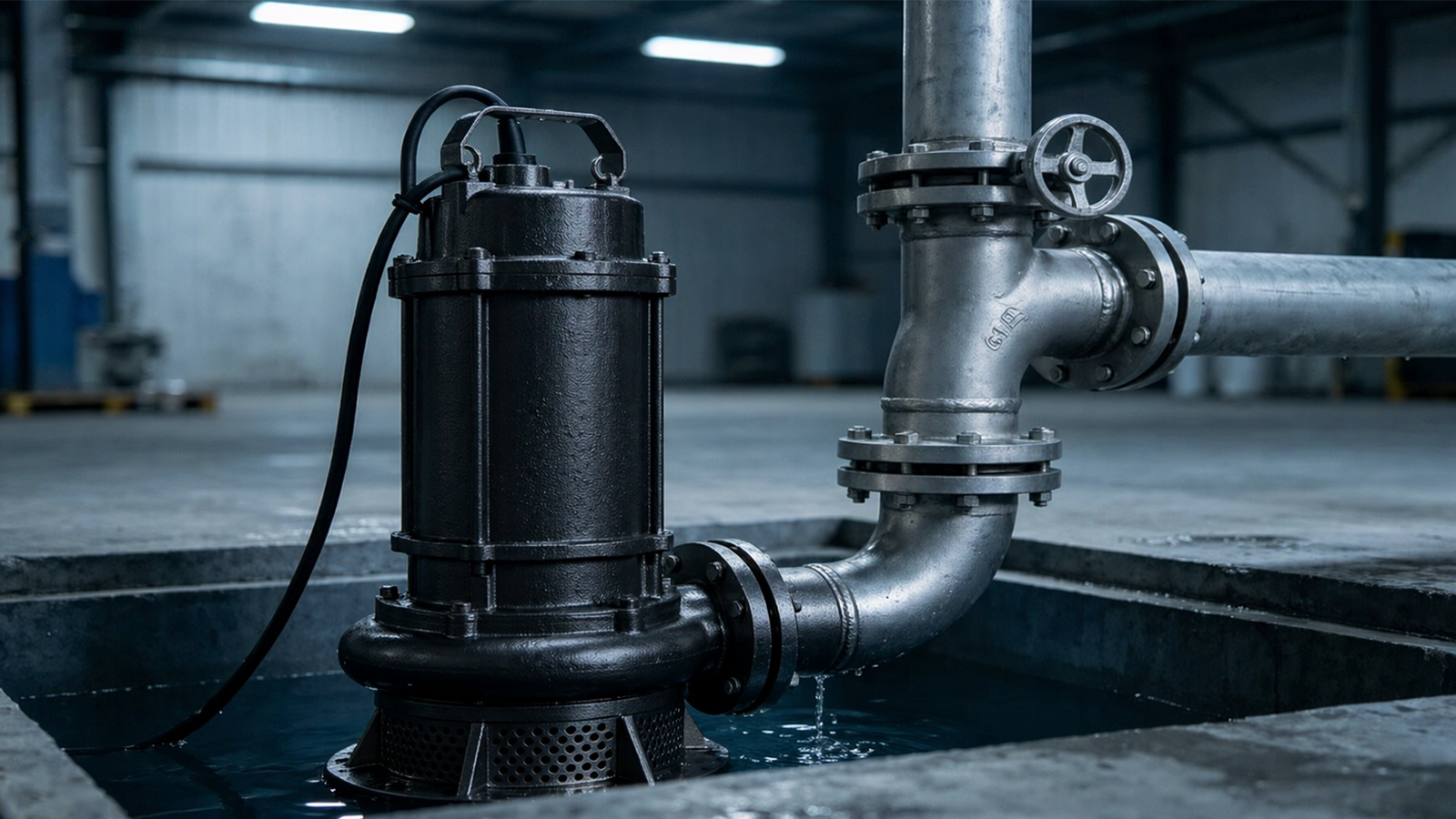
A sewer grinder pump is a submersible pump with a cutting head in front of the impeller. Raw sewage collects in a buried tank. At a set level the pump starts, a rotating cutter works against a stationary shredding ring, solids become slurry, and the slurry goes out through a small-bore line into a pressurised sewer main.
The cutting stage is the whole point. A conventional sewage pump passes solids whole, which forces a 2 inch or larger discharge and limits how far and how high you can push. Ground them first and the discharge drops to 1¼ inch and the pump can work against real pressure — which is what makes sewer connections possible on flat ground and on low-lying lots far from the nearest main.
It is not a macerating toilet bolted behind a bowl, and it is not a sewage ejector pump with a sharper impeller. It is a complete station: tank, pump core, level sensing, check valve, control panel, alarm.

How it works, in plain order
- Wastewater flows in by gravity.
- Level sensing — float or pressure sensor — calls for a start.
- The cutter spins against the shredding ring; soft solids, paper and fibre become slurry.
- The impeller behind it pushes the slurry up the discharge line.
- Level drops, the pump stops, the check valve holds the line from draining back.
Residential duty is lighter than people assume: 10 to 30 minutes of run time per day, over 20 to 40 starts of one or two minutes each. The pump sits idle almost all the time, which is a large part of why these units last.
Sewer grinder pump configurations, and what each is for
| Configuration | What it is | Typical duty | Best for | Trade-off |
| Semi-positive displacement (SPD) grinder | Positive-displacement action against a shredding ring; flow holds as pressure rises | Individual homes on low-pressure networks | Long runs, high lift, small-bore lines | Lower flow; core usually proprietary |
| Centrifugal grinder | Cutting head feeding a centrifugal impeller; flow falls as head rises | Higher flow, shorter runs | Commercial buildings, duplex stations | Output drops steeply as pressure climbs |
| Simplex station | One pump, one control panel, high-water alarm | Single-family homes | Standard residential | No backup if the pump stops |
| Duplex station | Two pumps, alternating each cycle, either can carry the load | Commercial, municipal, multi-unit | Sites where a backup is not optional | Higher capital cost, more controls |
| Hazardous-location unit | Explosion-proof construction for classified areas | Industrial, non-residential | Petrochemical, industrial effluent | Specialist spec and servicing |
One published residential unit shows the SPD behaviour: 1 HP, 1725 rpm, thermally protected, rated 15 gpm at 0 psig, 11 gpm at 40 psig, 7.8 gpm at 80 psig. Same pump, three distances. That curve is the honest answer to “how far will it push”.
Where a sewer grinder pump earns its keep
- Low-lying or flat properties where gravity drainage to the main is impossible — the classic case for a sewer grinder pump.
- Septic-to-sewer conversions, connecting the house to a pressurised district main.
- Long connections where a gravity line would need deep trenching.
- Basements and below-grade additions with a high lift and small-bore discharge.
- Commercial and industrial sites where a duplex station gives redundancy.
- Rural and edge-of-network developments built on pressure sewers throughout.
Standards and certification to ask for
A sewer grinder pump sits where plumbing and electrical codes meet, and most jurisdictions name the marks they want. These recur in US state and county onsite wastewater rules:
- UL 778 (or the equivalent CSA electrical safety standard) on the pump itself, with the mark of a recognised laboratory on the unit.
- NSF/ANSI 46 specifically for grinder pumps — several state regulations require the grinder to be certified to this standard and bear the certifier’s seal, over and above the general pump listing.
- Float switches and level controls certified to UL 60947-4-1 or CSA C22.2 No. 205-17.
- A listed control panel, not an assembly of listed components. Some district specifications say so explicitly.
- Enclosure rating— IP68 on the motor housing — plus thermal or moisture protection in the windings.
Ask for the certificate, not the claim. Municipal specifications usually reject “tested to” in place of “listed to”.
How long does it actually last
This is where marketing and field data part company.
| Metric | Published figure | Where it comes from |
| Mean time between service calls, manufacturer average | 10 years | Grinder pump maker’s FAQ |
| Mean time between service calls, four utility districts | 7.2 years average (4.9 to 10.4) | Pressure sewer cost study |
| Pump repair interval assumed for lifecycle costing | 8 to 10 years | Same study |
| Cost of a pump repair event | About $800, labour and materials | Same study |
| Pump replacement interval | 16 to 20 years | Same study |
| Cost of a pump replacement | $1,500 to $2,500 | Same study |
| Annual operation and maintenance, per pump | About $35 (range $13 to $51) | Same study, four districts |
| Electricity, single-family home | 9 to 20 kWh per month | Manufacturer FAQ |
| Run time, single-family home | 10 to 30 min/day, 20 to 40 starts | Manufacturer FAQ |
This is where marketing and field data part company.
One district told its grinder pump owners bluntly: repairs historically ran $300 to $500, a replacement ran $2,500, and average pump life was 10 years, so repair and replacement are inevitable.
Two things follow. Plan on a service event around year eight to ten and a replacement in years sixteen to twenty — budget, do not improvise. And the spread between districts is wide: the one averaging 10.4 years between calls at about $13 per pump per year is not lucky, it reflects what goes into those tanks.
What actually goes wrong, in the order you will meet it
- Float or level sensor.Grease-fouled, tangled or stuck. The pump never starts, or never stops. Most common single cause, cheapest to fix.
- Start capacitor or relay.Hums and does not start. Usually in the panel, not the pump.
- Cutter obstruction.A hard object or a rag of wipes jams the shredding ring, current climbs, the overload trips. The pump comes out to clear it.
- Check valve failure.Every cycle starts by pushing back what drained out of the force main. Longer run times, more starts, faster wear.
- Mechanical seal.Water reaches the motor. Double-seal units warn first: a moisture light means the lower seal has failed and the secondary still holds. Free warning — use it.
- Control panel faults.Relay board, overload, capacitor. A technician job.
- Motor windings.The genuine end of life, and the least common of the seven.
Notice how many of those are cheap parts in an expensive location — the same pattern on any sewer grinder pump. Pulling the station is the cost, which is why good makers design the core to lift out in one piece — and why a “no preventive maintenance” claim is a claim about design, not permission to ignore the alarm.
What a sewer grinder pump costs
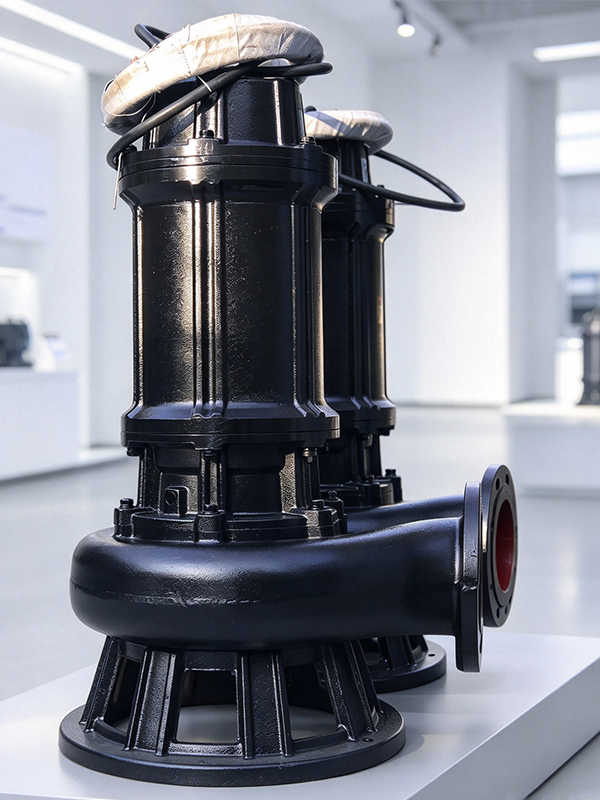
Trade cost guides put a complete single-family sewer grinder pump installation in the $2,500 to $6,000 band, commonly averaging near $4,200. Roughly: pump unit $400 to $2,000 by horsepower and materials; basin $200 to $800; control panel with alarm $300 to $900; piping $200 to $1,000; excavation and labour $800 to $3,000; permits $100 to $600. Labour is typically 30 to 50 per cent of the total, and restricted access is the fastest way to push a job past the band.
Then ownership, from the table above: about $800 at the eight-to-ten-year mark, $1,500 to $2,500 at sixteen to twenty years. Electricity is rounding error — at 11 cents per kWh and around 120 kWh a year, one manufacturer’s own worked example lands near $13 a year.
Buying guide: what to pin down before you sign
- UL 778 or CSA on the pump, NSF/ANSI 46 on the grinder, listed panel, certified floats. Ask for certificates.
- The curve, not the horsepower.Flow at your actual pressure, two points minimum. Horsepower alone says nothing about reaching the main.
- Discharge and materials.1¼ inch is standard for residential grinder service; check cutter and shredding ring material and whether they are field-replaceable.
- Core design.Can the core be pulled without entering the tank, or does service need confined-space entry?
- Audible and visual, separate circuit from the pump, with a test button.
- Simplex or duplex.Duplex for commercial and municipal; simplex plus alarm for one house, unless the site is remote or a backup would be catastrophic.
- Electrical supply.Many units want a dedicated 240 V circuit — one published unit calls for a 30 A breaker, #10 wire, and a minimum of 216 V to start reliably.
- Service network.Who repairs it, how far away, and whether a spare core rides on the van.
- Warranty in writing.Two to five years is the usual residential range; get the terms, not the headline number.
Running a sewer grinder pump day to day
- Install. Tank below local frost depth, on a level compacted base, with anti-flotation provision where groundwater is high. Check valve where the maker specifies it. Vent the tank. Alarm on its own circuit.
- Live with it. Water, toilet paper and human waste. Nothing else: no wipes even when the pack says flushable, no paper towel or tissue, no feminine products, no dental floss, no cat litter, no cooking oil or grease, no paint, solvents or harsh drain cleaners. Grit grinds the cutter down. Wipes wrap around it.
- When the alarm sounds. Silence the sound, stop using water, wait an hour, check whether the light is still on. If it is, call for service. If it cleared on its own, work out why — a nuisance alarm after a big bath is normal, one after an ordinary shower is not. In a power outage you have on the order of a day of storage, so cut water use rather than test that number.
- Routine. Makers of sealed residential units say no preventive maintenance is required, and for the pump itself that holds. What still needs a human: press the alarm test a few times a year, listen for a change in sound or run length, keep the lid sealed, and act on the moisture light the day it appears.
Frequently asked questions
- Can you flush toilet paper with a grinder pump?
- Yes, and it is the design intent. Toilet paper, water and human waste are what a sewer grinder pump is built for — the cutter is sized for soft solids and paper, and the paper is already breaking up before it reaches the tank. It is not built for anything that keeps its strength when wet. Manufacturer guidance is explicit: wipes even when labelled flushable, feminine products, dental floss, paper towel, grease, grit and cat litter go in the bin. “Flushable” means it will pass your house pipework, not that it will break down — and wrapped round a shredding ring it is the most common thing a technician pulls out.
- What happens if a grinder pump fails?
- First the alarm, then the tank fills, then it overflows. In between there is a window: a residential tank holds on the order of a day of household water use from the moment the pump stops, so the sequence is alarm, stop using water, call for service. Keep using water past that and it goes somewhere — usually the lowest fixture in the house. Never silence the alarm and carry on. That risk is why duplex stations exist on commercial sites.
- How far can a grinder pump push sewage?
- Think in pressure, not distance. One published residential unit makes 15 gpm at 0 psig, 11 gpm at 40 psig and 7.8 gpm at 80 psig — and 80 psig is roughly 185 feet of head, since one psi lifts water about 2.31 feet. The pump that moves 15 gpm on a flat short run still moves 7.8 gpm against a serious lift. Horizontal distance then depends on pipe diameter, fittings and how much pressure friction eats; pressure sewer guidance calls for mains of 2 inches and larger that reach a cleansing velocity once a day so solids do not settle. The honest number for your site comes off the curve at your elevation and pipe length.
- What are the common problems with sewage pumps?
- Across sewage pumps generally, the same short list covers most calls: a fouled or stuck float, a failed start capacitor, an obstruction wrapped round the impeller or cutter, a check valve that no longer holds and causes short cycling, a mechanical seal that has let water into the motor, and control panel faults. Actual motor failure is the minority case. Diagnose in that order — a cleaned float and a capacitor cover a large share of calls, and neither needs a new pump.
- Do grinder pumps need to be serviced?
- Sealed residential units from major makers are designed to run without scheduled preventive maintenance, and the makers say so. That is not the same as never being serviced: the same manufacturer publishes ten years between service calls, and field data from utility districts averages about seven. Realistic answer — no scheduled servicing, but an annual look at the alarm, lid and panel, and a budget line for a service event around year eight to ten.
- How much is a grinder pump for a sewer system?
- For a complete single-family installation, trade guides put the range at roughly $2,500 to $6,000, often averaging around $4,200. The pump unit alone runs about $400 to $2,000 depending on horsepower and construction; basin, panel, piping, excavation and permits make up the rest, with labour typically 30 to 50 per cent of the total. Ongoing: about $800 for a repair at the eight-to-ten-year mark, $1,500 to $2,500 for a replacement at sixteen to twenty. Electricity is small — ten to twenty kilowatt-hours a month.
The bottom line
A sewer grinder pump is long-lived equipment with a short list of predictable enemies: wipes, grease, grit, a dead check valve, a neglected alarm. Give it only what it is designed to take, test the alarm, act on the moisture light the day it appears, and budget for a service event near year ten and a replacement near year twenty.
References
1. Title: Operational Costs of Two Pressure Sewer Technologies: Effluent (STEP) Sewers and Grinder Sewers
Abstract: It compares long-term O&M, repair and replacement cost data of grinder pump sewers and STEP sewers from four utility districts, giving grinder pump service interval and lifecycle cost benchmarks.
2.Title: Wastewater Technology Fact Sheet: Sewers, Pressure
Abstract: EPA technical fact sheet introducing pressure sewer systems, including grinder pump (GP) configuration, design rules, cleansing velocity requirements and capital cost features for decentralized wastewater collection.