
Can a Sewage Pump Handle Toilet Paper? Buyer & Maintenance Guide
What a sewage pump actually is
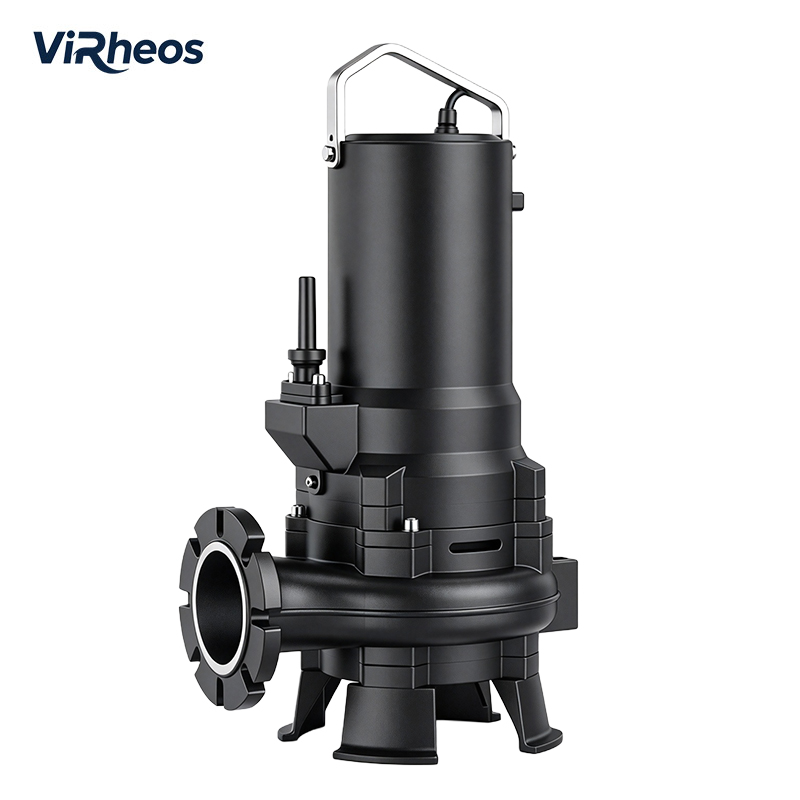
A sewage pump moves wastewater containing human waste and soft solids from a point below the sewer or septic line up to a point where gravity takes over. It sits at the bottom of a sealed basin (a lift station or lifting plant). Fixtures drain in by gravity, a float or pressure sensor starts the pump at a set level, and a check valve on the discharge stops the lifted wastewater draining back when it stops. Put simply, a sewage pump is a small, automatic lifting plant that works only when the basin fills.
Two neighbours get confused with it:
- A sump pump moves clear groundwater away from a foundation. It is not rated for solids and must never be connected to a toilet.
- An effluent pump moves the settled, relatively clear liquid leaving a septic tank. Fine for a dosing tank or sand filter, wrong for raw waste — it will clog on toilet paper.
If a toilet drains into the basin, you need a sewage pump, full stop.
How a sewage pump deals with toilet paper
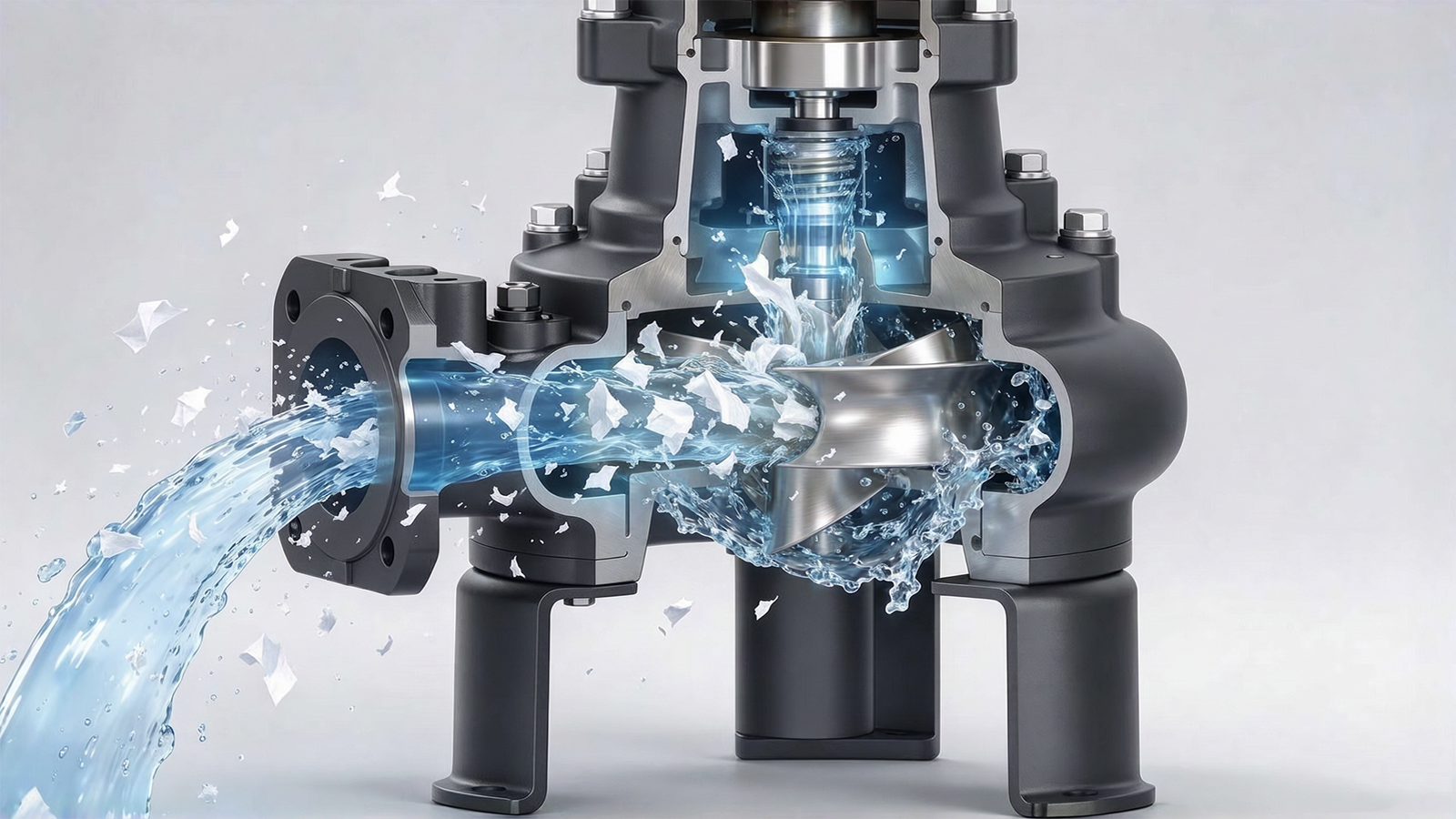
The principle is unglamorous. An impeller spins inside a volute, throws liquid outward, and the pressure it builds pushes the mix up the discharge pipe. Solids pass through the free passage — the unobstructed opening through the impeller and casing — and out with the flow.
By the time toilet paper reaches the basin it has been through the bowl, the trap and several metres of moving water. Good toilet paper is engineered to lose most of its strength the moment it gets wet, so what the impeller sees is wet fibre, not a napkin. The paper is supposed to give up, and the pump is supposed to swallow what is left.
What actually blocks a sewage pump is material that keeps its wet strength:
- Baby wipes, disinfecting wipes, cleaning wipes, and “flushable” wipes used in quantity
- Paper towels, kitchen roll, facial tissue
- Dental floss, cotton buds, hair, condoms, sanitary products
- Cat litter, rags, and the grease mat that builds up on basin walls
There is a formal way to tell the difference, and it involves pumps directly. The fourth edition of the flushability guidance issued by INDA and EDANA in 2018 puts a product through seven tests, and it must pass all seven to be called flushable. Two are pump tests: FG503, the Household Pump Test, and FG507, the Municipal Sewage Pump Test. Both look at what the product does to a pump’s behaviour as it passes through. Products that fail are supposed to carry the “Do Not Flush” symbol on the pack.
Translation for a buyer: if a product says “Do Not Flush”, no sewage pump makes it safe to flush. And a product that passes the household pump test in a lab can still cause trouble in a home where the drain line is long, flat, or partly blocked by grease.
The main types, and what each does with solids
| Type | How it handles solids | Toilet paper | Typical use | Trade-off |
| Solids-handling submersible (channel / non-clog impeller) | Passes soft solids up to its free passage — commonly 2 in (50 mm) on residential models | Excellent — the default choice | Basement bathroom, laundry, whole-house lift | Basin must be sized to the inflow |
| Vortex (recessed impeller) | Impeller sits back in the casing, so solids pass without touching it | Excellent, and gentler with stringy material | Raw sewage with grit, sand or fibre | Lower hydraulic efficiency |
| Cutter / grinder | Macerates solids to a slurry first | Excellent, but grinds rather than passes | Long runs, small-bore pressure mains, high head | More power, more wear parts, more noise |
| Effluent pump | Clear liquid only | No — will clog | Septic tank outlet, dosing tanks, STEP systems | Cheap and efficient, narrow job |
| Macerator unit | Grinds at the fixture, pumps through small-bore pipe | Yes, by design | Adding a bathroom far from the soil stack | Small motor, sensitive to foreign objects |
A grinder is not automatically better than a plain solids-handling sewage pump. Grinding costs energy, adds a wearing part, and only pays off when the discharge line is small or long, or the lift is high. For a basement bathroom with a 2 in discharge and a short run, a solids-handling pump does the same job more quietly, with less to go wrong.

Where these pumps earn their keep
- Below-grade bathrooms and laundries.Anything under the main sewer line needs lifting — the most common sewage pump job in housing.
- Septic effluent pumping.Where a drainfield sits above the tank, or a system doses a filter, the settled liquid goes uphill.
- Grinder pressure sewers.Rural developments and difficult terrain use small-bore pressurised mains instead of gravity sewers.
- Municipal and commercial lift stations.Larger versions of the same idea, usually in duplex pairs so one pump carries the load while the other is serviced.
- Commercial kitchens and workshops.With a grease interceptor upstream and a cleaning schedule, a solids-handling sewage pump copes well.
Standards worth asking your supplier about
You do not need to read the standards. You do need the supplier to name them.
- EN 12050-1covers lifting plants for wastewater containing faecal matter — the packaged basin and sewage pump installed below flood level, with non-return valve requirements in EN 12050-4. A supplier quoting this is in the right product family.
- ISO 9906is the hydraulic performance acceptance test, in grades 1, 2 and 3 with progressively wider tolerances. Ask which grade the published curve was tested to; a curve with no grade behind it is a drawing, not a guarantee.
- Motor efficiency classes(the IE3 / IE4 series under IEC 60034-30-1) tell you how much of the bill does useful work.
- Enclosure and protection.IP68 on the motor housing, thermal or moisture protection in the windings, a recognised cord and control certification for your market.
- Plumbing approvals.Where code requires it, look for the marks your inspector recognises on the basin and fittings.
Buying guide: the checklist that predicts trouble
| Spec | Why it matters | Typical residential value | What to ask for |
| Flow at the duty point | Baths, showers and a washer all arrive at once | Roughly 80–130 GPM at 5 ft of head for ½ hp models | The published curve with the duty point marked |
| Total head | Vertical lift plus friction decides the real flow | Commonly 10–25 ft for a basement | A written head calculation, not a guess |
| Solids passage | Decides what can get through | 2 in (50 mm) spherical on most residential units | Stated free passage, in mm or inches |
| Basin volume and drawdown | A bigger basin means fewer starts and a longer motor life | Around 100–150 L (26–40 gal) for one bathroom | Start/stop levels and usable volume between them |
| Motor and power supply | Single-phase availability and voltage drop on long runs | ½ hp typical, 1 hp for higher head | Voltage, phase, locked-rotor current |
| Duty cycle | Short-cycling kills motors faster than heavy use | 20–30 starts per hour is a common design limit | Maximum starts per hour |
| Discharge and check valve | Backflow protection and serviceability | 1¼–2 in discharge, union plus check valve | Valve type, and whether it can be serviced |
| Alarm | A failed sewage pump is silent until something overflows | Separate high-water float | Alarm float or panel included |
| Materials and spares | Cast iron, stainless or engineered polymer | Cast iron or stainless for long service | Parts availability and lead time |
Red flags that cost money later: a pump sold only by horsepower with no curve; no stated solids passage; no alarm on a finished-basement job; no check valve; no answer on spares or lead time.
What it costs to run
Take a ½ hp sewage pump, about 0.37 kW at the shaft. Run it half an hour a day and you get roughly 0.19 kWh per day, about 5.6 kWh a month, which at 15 cents per kWh is under a dollar a month — call it ten dollars a year. Check your own with a plug-in power meter.
The money that hurts is not electricity. It is the call-out when a pump fails under a finished floor, the clean-up, and the hours the bathroom is out of service. Compare suppliers on purchase price, power draw, service interval and parts availability, in that order.
Using it and keeping it alive
- Install. Set the basin level on a compacted base, seal the lid gas-tight, vent it, fit a check valve plus a union so the pump comes out without cutting pipe, and give it a dedicated, protected circuit.
- Start-up. Fill the basin, cycle the pump, watch the joints for leaks, and confirm it stops below the inlet so the basin is not left brimming.
- House rules. The three Ps: pee, poo and toilet paper. Bath, shower and washing-machine water are fine. Cooking oil and grease are not — they float, cool, and turn into a mat that smothers float switches.
- Care, twice a year. Kill the power at the breaker first; never reach into a live basin. Check the float swings freely, hose grease and fibre off the walls and the sewage pump housing, exercise the check valve, press the alarm test button. If the pump sounds harsh, runs longer than it used to, or cycles every few minutes, call a professional rather than waiting for the overflow.
- Warning signs: gurgling drains, a toilet that will not clear, sewage smell near the basin, or a damp patch over the drainfield. All of them mean stop adding water and investigate now.
Frequently asked questions
Do sewage ejector pumps need to be cleaned?
- Yes. A sewage ejector pump is a sewage pump in a basin, sitting in raw wastewater, and the walls, float and housing collect a film of grease, paper fibre and lint. Twice a year is a reasonable rhythm for a family home; a heavily used or commercial basin wants quarterly attention. Cleaning means switching off the power, opening the lid, hosing down the walls and the float, and confirming the switch moves freely. Skip it for years and the first symptom is usually a float that will not drop, so the pump never stops.
What is the best toilet paper to use if you have a septic system?
- Plain, unbleached or white, one- or two-ply paper that disperses quickly. Test a roll at home: two sheets in a jar of water, lid on, ten shakes. Good septic paper breaks into loose fibre. Paper still in recognisable sheets is high in wet-strength resin and belongs in the bin. Skip thick quilted and lotion-loaded products.
What do Amish use instead of toilet paper?
- Mostly the same toilet paper everyone else buys. The question comes from real rural history: before commercial rolls were cheap, an outhouse often kept a box of dried corncobs, or a nail with pages torn from an old newspaper, an almanac, or a mail-order catalogue. The Old Farmer’s Almanac was famously printed with a hole in one corner so it could hang on that nail. Charming story, and a reminder that anything that does not break up in water is a problem in a drain — corncobs included.
How many loads of laundry a day on septic?
- One or two, spaced out. Laundry is the biggest single slug of water most systems see, and a septic tank needs time to settle between slugs. An older top-loader can use roughly 40 to 45 gallons per load; a modern high-efficiency machine runs about 10 to 25 gallons, so four loads can mean 160 gallons or 60 depending on the machine. Do not stack them back to back on a Saturday — spread them through the week and run full loads.For scale, the average person uses about 82 gallons of water a day at home, so a family of four puts roughly 330 gallons a day through the system before laundry is counted.
Is Dawn dish soap ok for septic?
- Yes, in the quantities that come off a sponge. Modern hand-dishwashing liquids in the US are built on biodegradable surfactants and are phosphate-free, and the small amount going down the sink dilutes into a tank carrying far more organic load than that. Two cautions: antibacterial formulations are harder on the tank’s bacterial culture if used heavily, and the real villain in a kitchen is not the soap — it is the cooking grease washed off the pan. Wipe greasy pans with a paper towel into the bin first.
Can I take a shower if my septic tank is full?
- No. Stop putting water into the system. A tank at capacity has nowhere to send the next 20 gallons, and the pressure goes somewhere — usually back up through the lowest fixture, which is often the shower itself. Hold off on showers, laundry and the dishwasher, and arrange pumping. If drains are already slow, you hear gurgling, or there is a spongy wet patch over the drainfield, treat it as urgent: an overloaded drainfield can flood, sending sewage to the ground surface or back into fixtures.
Can I flush “flushable” wipes if I have a sewage pump?
- Only if your sewer operator or septic professional says yes, and even then sparingly, one at a time. A wipe that has passed the industry’s seven-part assessment breaks down far better than a baby wipe, but it is still thicker and stronger wet than toilet paper, and it shares the pump with everything else in the house. In a long or flat drain line, or a basin that has not been cleaned lately, wipes are the most common thing pulled out of a blocked impeller.
The bottom line
Toilet paper is exactly what a sewage pump is built to move. Failures come from three places: a pump chosen on horsepower instead of a curve, non-dispersible products sent down the bowl, and a basin nobody has opened in years. Get the solids passage and duty point right, insist on a tested curve and the right certification for your market, keep wipes and grease out, clean the basin twice a year — and the pump becomes the most boring piece of equipment in the building.
Sources
- S. Environmental Protection Agency, WaterSense — Statistics and Facts(average per-person home water use of 82 gallons per day).
- S. Environmental Protection Agency, Office of Water — How Your Septic System Works(sludge and scum separation in the tank; drainfield overload and backups).
- INDA (Association of the Nonwoven Fabrics Industry) — Flushabilityguidance, Fourth Edition (GD4, 2018), including the Household Pump Test (FG503) and Municipal Sewage Pump Test (FG507), and the “Do Not Flush” labelling requirement.
- Whirlpool Corporation — How much water does a washing machine use?(roughly 40–45 gallons per load for older machines, about 10–25 gallons for high-efficiency machines).
- EN 12050-1:2015 (DIN / UNE transpositions) — Wastewater lifting plants for buildings and sites — Part 1: Lifting plants for wastewater containing faecal matter.
Typical residential figures in the tables come from published residential pump specification sheets; always check the duty point against the actual curve for the model you are buying.
References
1. Title: Effect of toilet tissue Paper on residential sewerage-line clogging
Intro: It studies disintegration performance of toilet paper under varied water conditions, analyzes wet-strength additives, and links paper properties to sewer clog risk.
2.Title: Guidelines for Assessing the Flushability of Disposable Nonwoven Products (GD4, 4th Ed.)
Intro: Industry flushability framework with FG503 household pump & FG507 municipal sewage pump tests to judge whether products pass through sewage pumps safely.
3.Title:Wipes in sewer blockage study – Final Report
Intro: Field investigation of pump station blockages, confirming non-flushable wipes are the dominant clog material rather than toilet paper in sewage pumps.