
Where to Install a Hot Water Recirculating Pump: Location, Cost & Lifespan
A hot water recirculating pump is a small object. Where you put it, which way it faces, and what sits on either side of it decide whether the system delivers hot water in ten seconds or in ten minutes. That is the part most buyers get wrong, because the pump looks like a plumbing accessory and behaves like a system component.
This guide covers the three questions that come up before anyone buys anything: where a hot water recirculating pump physically goes, what it costs to have one installed in 2025, and how long it should last once it is running.
The one rule that governs placement
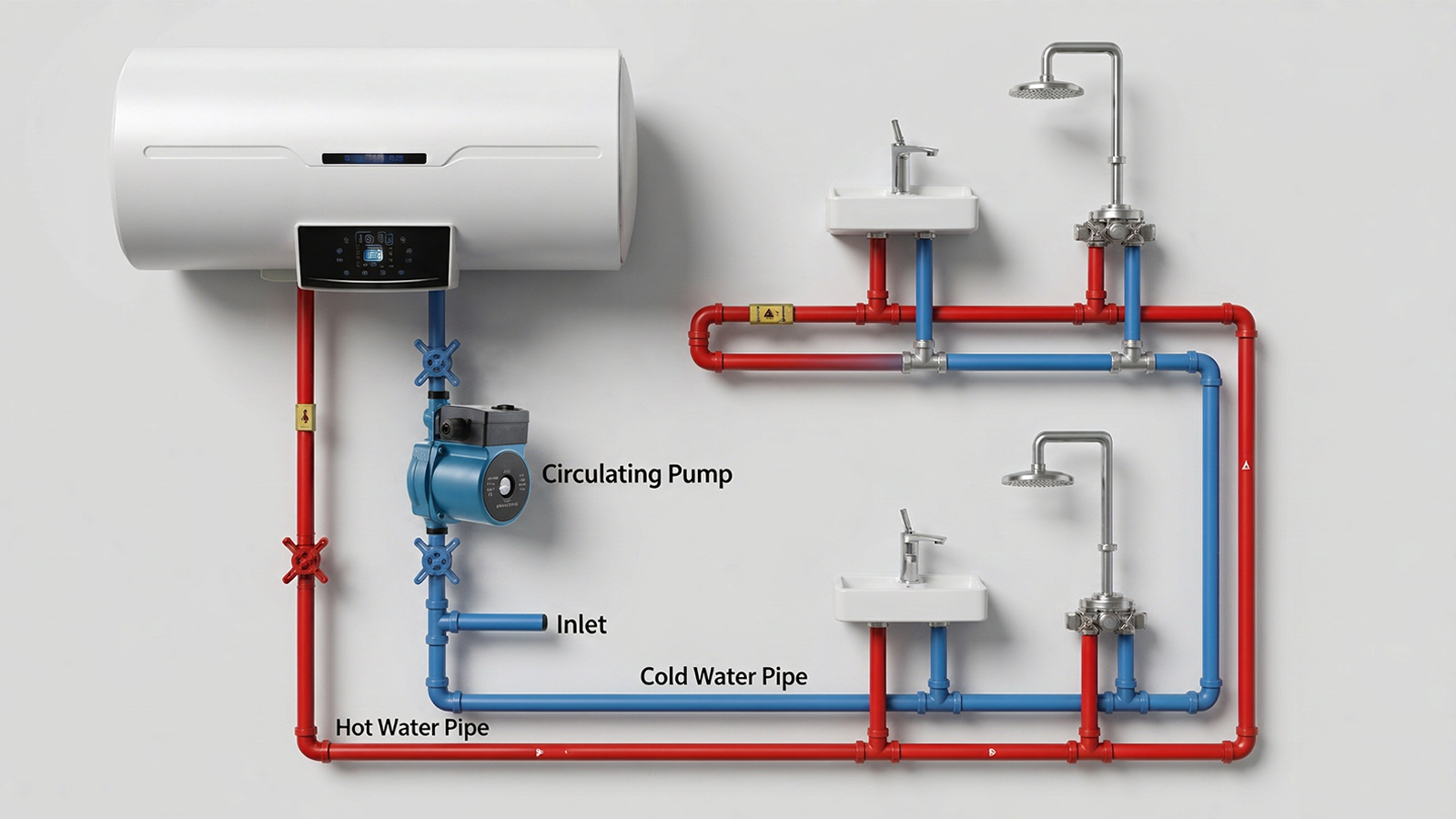
A hot water recirculating pump belongs on the return side of the loop, inside the recirculation line, pushing water back toward the water heater. Manufacturer installation instructions for residential circulators are consistent on three points: install it in the recirculation line below the water level of the heater, do not install it in the supply line, and do not install it pumping away from the heater.
The reason is simple. The pump’s job is to move cooled water home. Put it on the supply side and it fights the draw at the fixture instead of feeding it; mount it above the water line and it loses prime and runs dry. Wet-rotor circulators are lubricated by the water they move — a few minutes of dry running is enough to score the bearings.
In practice that means a spot on the return riser within a few feet of the heater, with the flow arrow on the housing pointing at the heater, isolation valves on both sides so the pump can come out later without draining the system.
Two layouts, and they put the pump in different places
Whether you have a dedicated return line changes everything about placement, including where the controls go.
- Layout A — dedicated return line. A third pipe runs from the farthest fixture back to the heater. The pump and its controls sit on that return line near the water heater, and the temperature sensor goes as close to the end of the supply portion of the loop as possible, in a spot you can actually reach. California’s HERS-verified installation certificate spells this out as one of two accepted placements.
- Layout B — cold water line used as the return. No third pipe exists, so a thermal crossover valve bridges hot and cold under the farthest sink. Here the pump, the demand controls and the sensor all go at the end of the supply portion of the hot water line, usually in the cabinet under that sink. The same California certificate accepts this placement, and it also notes that insulation is not required on the cold water line when it is used as the return.
Both layouts work for a hot water recirculating pump. Layout A is cleaner and keeps the cold line cold; layout B is what makes retrofits affordable, because nobody has to open a wall. If you are choosing between them, the deciding factor is rarely performance — it is whether the house has a spare pipe going back to the heater.
What else has to be in the assembly
Placing the pump is one decision; the parts around it are the rest of the job. The California compliance document for HERS-verified hot water distribution reads like a checklist of exactly the items installers skip, and every one of them has a failure mode attached.
| Component | Where it goes | Why it is there | What happens if it is missing |
| Check valve | Between the pump and the water heater, arrows aligned with the pump | Stops reverse flow when a tap opens | Short cycling, lukewarm water at the cold tap |
| Isolation valves | Both sides of the pump | Lets the pump come out without draining the house | A $20 seal job becomes a full service call |
| Automatic air release valve | Inlet side of the pump | Vents the air that enters with every fresh draw of cold water | Air lock: humming pump, no flow |
| Hose bibb | Between the pump and the heater, with its own isolation valve | Drain point for flushing and winterising | No clean way to purge the loop |
| Demand control + sensor | At the end of the supply run, or on the return near the heater | Runs the pump only when hot water is wanted | Continuous operation and the energy bill that follows |
| Loop-specific pump | One pump and one set of controls per loop | Each loop has its own head and heat loss | Near loop over-circulates, far loop starves |
Two limits from the same document are worth knowing because they tell you what a compliant system behaves like. Controls may not draw more than 1 watt in standby. And the pump must be limited to a maximum of five minutes of operation per activation in a single dwelling, ten in a multi-unit building — a backstop in case the normal shut-off signal fails.
Mounting details that decide service life
None of these take extra material. They are the difference between a hot water recirculating pump that a technician can service in fifteen minutes and one that has to be cut out of the wall.
Motor shaft horizontal, or vertical with the motor up. Motor-down mounting is prohibited on most residential circulators and voids the warranty.
Bronze or stainless steel housing on potable water. Cast iron housings are for closed hydronic loops and will corrode in a domestic hot water line.
Not at the lowest point of the system, where sediment collects. Air vents belong at the highest points instead.
Support the pipework independently so the pump body carries no pipe weight, and leave clearance on both sides — a pump buried against a wall is a pump that gets replaced rather than repaired.
Fill and pressurise before powering up, then run it for five minutes to purge air from the bearing chamber. Never start it dry.
Keep the run below the water level of the heater. At higher elevations and higher water temperatures the pump needs more inlet pressure to avoid cavitation.
What is the average cost to install a hot water recirculating pump?
The most credible number available right now comes from Home Innovation Research Labs, which published a line-by-line cost analysis of the 2024 IECC for single-family homes in January 2025. A compact recirculation system built to code with on-demand controls came to $899 to the builder and $1,034 to the consumer.
That single figure hides a wide spread, because scope moves much more than hardware does. Quoting a hot water recirculating pump by the box price is like quoting a car by the cost of its tyres. Roughly $494 of that $1,034 is the pump kit and adapters; the other $540 is plumbing labour, the electrical circuit, the GFCI breaker, the PEX return line and three low-voltage control circuits. In other words, more than half the price of a hot water recirculating pump installation is work, not equipment.
| Scenario | Typical installed cost | Added annual running cost | Expected service life |
| Crossover retrofit, no return line | $400 – $900 | $40 – $120 | 8 – 12 years |
| New construction, return line roughed in | $900 – $1,100 | $30 – $90 | 12 – 15 years |
| Retrofit that opens walls for a return line | $1,500 – $3,000 | $30 – $90 | 12 – 15 years |
| Continuous 24/7 operation, any layout | same hardware | $150 – $400 | 5 – 8 years |
| Multi-unit building, central loop per riser | quoted per riser | varies with balancing | 10 – 15 years |
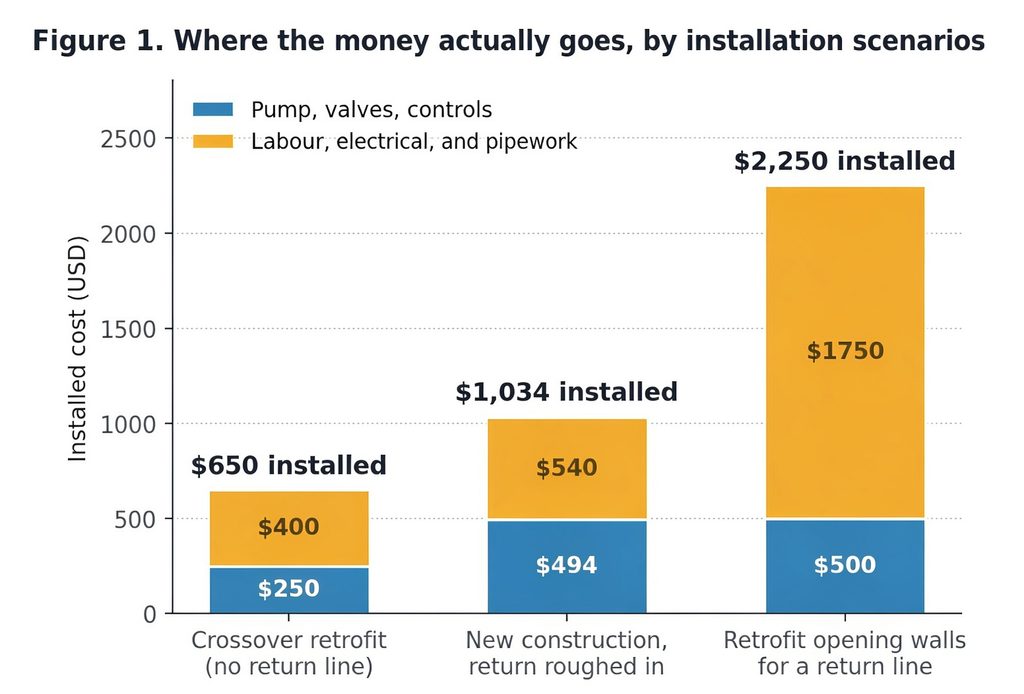
Two things consistently surprise buyers of a hot water recirculating pump. The first is that the electrical work is a real line item: a new GFCI-protected circuit is a licensed electrician’s job in most jurisdictions, and it is quoted separately from the plumbing. The second is that the cheapest install — a crossover valve under one sink — is also the one most likely to produce a callback, because it puts warm water into the cold line at that fixture.
How long does a hot water recirculating pump last?
Eight to fifteen years is the honest range for a residential unit, and the layout matters less than the operating conditions. Wet-rotor designs, where the pumped water lubricates the bearings, generally reach the top of the range and need no lubrication. Dry-rotor designs need scheduled lubrication and usually fail at the shaft seal first.
Four things shorten the life more than anything else:
- Dry running or a loop that was never properly purged — the bearings score within minutes.
- Continuous operation at high temperature, which cooks the windings and dries out seals.
- Rapid cycling. A temperature control with too tight a dead-band will switch the pump on and off every couple of minutes, which wears a circulator out inside a year.
- Hard water. Scale on the impeller reduces flow, and the usual response — fitting a bigger pump — makes the erosion problem worse.
Maintenance on a hot water recirculating pump is light and worth doing on a schedule: quarterly, look for drips at the body and unions; annually, listen for bearing noise, clean the strainer, and confirm the pump still reaches its shut-off temperature. In hard water areas, descale the impeller rather than upsizing the pump.
What are the drawbacks of a recirculating pump?
Five drawbacks show up consistently. The useful question is not whether they exist — they do — but which ones a good installation removes.
Continuous heat loss from the loop. Bare ¾” copper carrying 120°F water through a 55°F space loses roughly 27 Btu per hour per foot, so a 300-foot run radiates about 8,100 Btu/h. Insulation removes most of this; nothing else does.
Warm water in the cold line. Specific to crossover systems, and it gets worse as the internal check valve wears. A dedicated return line removes it entirely.
Erosion in older copper. Sustained high velocity scours thin-walled tubing from the inside. Correct sizing and a balancing valve remove it.
Reduced efficiency on modern heaters. Heat pump and condensing units prefer cold inlet water; return water at 105-110°F shrinks the temperature lift and drags the coefficient of performance down.
A temperature band bacteria like. Legionella grows best between 95°F and 115°F. Store at 140°F or above, hold the return at 124°F or above, and use a mixing valve to deliver 120°F or less at the tap.
Three of the five are decided at installation — pipe insulation, return layout and pump sizing. That is why the placement discussion is not academic, and why the same hot water recirculating pump can be a good buy in one house and a mistake in the one next door.
What are the common problems with hot water recirculating pumps?
Most callbacks on a hot water recirculating pump trace back to where and how it was installed, not to the pump itself. The list below is what service technicians find, in roughly the order they find it.
Flow arrow reversed. The pump runs and nothing gets hot. This is a five-minute fix and one of the most common commissioning faults.
Air lock. The pump hums and moves nothing, because nobody purged the loop after filling.
No check valve, or one fitted backwards. Water flows backwards through the pump whenever a tap opens, producing short cycling and lukewarm cold water.
Undersized pump. The far bathroom still waits, because the pump cannot overcome the head loss of the loop.
Oversized pump. Noise, cavitation, and eventually pinhole leaks in copper — the classic consequence of sizing up to be safe.
No balancing valves, or valves left at the installer’s default. The branches nearest the plant over-circulate while the distant ones starve.
Warm water at the ice maker or kitchen cold tap. The crossover thermostat is set too high.
The acceptance test is simple and worth insisting on at handover: hot water should reach a fixture in under 10 seconds, 10 to 30 seconds is acceptable, and anything past 30 seconds is not.
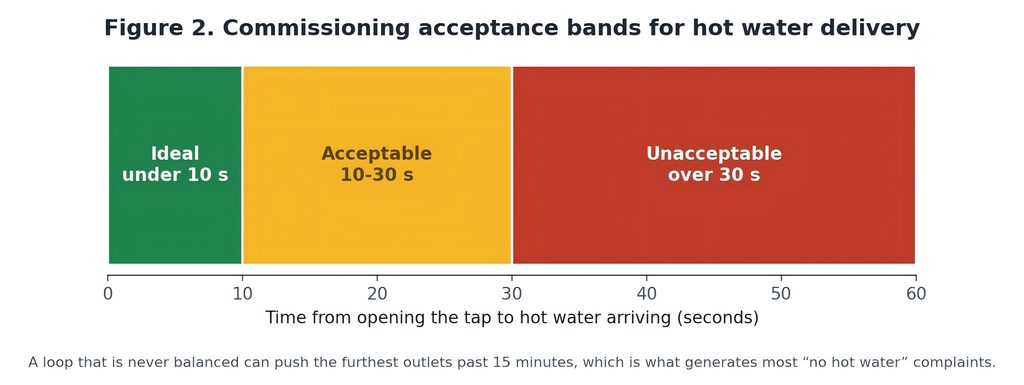
There is a safety dimension too. When a loop is badly balanced and hot water arrives slowly, occupants turn the tap fully to hot, then get a slug of full-temperature water mid-shower. Long delivery delays are what turn into thermal shock complaints.
Two cases: one house, one building
A house first. A 2,400 sq ft two-storey home, heater in the garage, main bedroom about 70 feet away. No return line, so a crossover valve goes under the farthest vanity and the pump mounts beside the heater on a short return leg, below the water line, with a check valve and isolation valves either side: about $720 installed. Wait drops from roughly 70 seconds to under 20. Two years on, the vanity cold tap runs briefly warm each morning — the crossover thermostat was set too high at commissioning, and it is a ten-minute adjustment. Illustrative case built from the cost and delivery figures above.
Now a building. Across build-to-rent and serviced apartment schemes, a pattern repeats at around month twelve: return-loop temperatures below 50°C, outlets in the furthest apartments failing to reach 50°C within a minute, and a difficult conversation between operator and contractor. The cause is consistent — loops sized for flow rate rather than delivered temperature, and double-regulating valves left where the installer put them because balancing a return properly takes a flow meter and a day of iterative work. Fixing it later means pump upgrades, added valves and recommissioning, all of which cost more than doing the balancing once.
Getting it right the first time
Put a hot water recirculating pump on the return side, below the water line of the heater, pointing at the heater, with a check valve downstream, isolation valves on both sides and an air release valve on the inlet. Put the sensor where a person can reach it. Insulate everything. Balance the branches and record the time-to-hot at the furthest fixture before signing off.
Do that and the hot water recirculating pump runs for a decade or more. Skip any of it and you have bought a humming noise with a higher gas bill attached.
FAQ
- Where should a hot water recirculating pump be installed?
- On the return side of the loop, inside the recirculation line, below the water level of the water heater, with the flow arrow pointing toward the heater. With a dedicated return line it mounts near the heater and the sensor goes at the far end of the supply run; with a crossover valve it mounts at the end of the hot water line, usually under the farthest sink.
- What is the average cost to install a recirculating pump?
- About $899 to the builder and $1,034 to the consumer for a code-compliant residential system with on-demand controls, per the Home Innovation Research Labs January 2025 cost analysis. A crossover retrofit runs $400 to $900; retrofits that open walls to add a return line run $1,500 to $3,000. More than half the total is labour and electrical work, not the pump.
- What are the drawbacks of a recirculating pump?
- Continuous heat loss from the loop, warm water in the cold line on crossover systems, erosion of older copper at high velocity, lower efficiency on heat pump and condensing water heaters, and a Legionella-friendly temperature band if the loop is set too low. Insulation, correct sizing and proper storage temperature address most of them.
- What are the common problems with hot water recirculating pumps?
- Reversed flow arrow, air lock from an unpurged loop, missing or backwards check valve, undersized or oversized pump, unbalanced branches that leave distant fixtures cold, and a crossover thermostat set too high. Most are installation faults rather than product faults.
- How long does a hot water recirculating pump last?
- Eight to fifteen years for residential units, with wet-rotor designs generally outlasting dry-rotor ones. Dry running, continuous high-temperature operation, rapid cycling and hard water scale are what cut that short.
- Can I install a hot water recirculating pump myself?
- A crossover kit at the water heater is within reach of a competent homeowner, but the pump needs a GFCI-protected circuit, and pump sizing, balancing and any work on a tankless heater belong to a licensed professional. Local code in most jurisdictions requires a permit for the electrical work.
Data sources
California Energy Commission, HERS Verified Single Dwelling Unit Hot Water System Distribution, Certificate of Installation CF2R-PLB-22-H — pump and control placement on the dedicated return line or at the end of the supply run; check valve between pump and heater; isolation valves both sides; automatic air release valve on the inlet side; standby power ≤1 W; maximum 5 minutes of pump operation per activation in a single dwelling.
Home Innovation Research Labs / NAHB, 2024 IECC Cost Analysis for Single-Family Homes, January 13, 2025 — itemised installed cost of a compact recirculation system: $899 to builder, $1,034 to consumer.
Idronics issue 33, July 2023 — heat loss of bare ¾” copper tubing, approximately 27 Btu/hr/ft at a 65°F water-to-air temperature difference; 8,100 Btu/h for a 300 ft loop.
Commissioning and Troubleshooting DHW Systems, Part 4, PHC Pro — delivery time acceptance bands (under 10 s ideal, 10-30 s acceptable, over 30 s unacceptable); balancing valves must restrict flow on branches near the plant; thermal shock risk from long delivery delays.
Build-to-Rent Hot Water: The Month-Twelve Failure Pattern — return-loop temperatures below 50°C and furthest outlets failing to reach 50°C within one minute; cause traced to loops sized for flow rather than delivered temperature and double-regulating valves left at installer defaults.
Residential circulator installation instructions (potable-water cartridge circulators) — motor shaft horizontal or vertical with motor up; bronze or stainless housings for potable water; fill and pressurise before start-up; do not run dry.
CalNEXT / TRC, Report ET25SWE0050, 2025 — median recirculation loop heat loss of 93 W per apartment; heat pump water heater system COP 1.4 under continuous recirculation versus 2.5 with demand control.
NREL / DOE Building America, Control Retrofits for Multifamily DHW Recirculation Systems, Brooklyn NY (NREL/FS-5500-64542) — demand control and temperature modulation savings; pump runtime ≤14 minutes/day.
ASHRAE Standard 188 and WHO Legionella guidance; ASSE 1017 / ASSE 1070 point-of-use temperature limits.
U.S. DOE, Efficient New Homes Single-Family National Program Requirements, Version 2 (Rev. 3), 2025 — 0.5 gal stored volume, 0.6 gal field verification; demand-type controls required.
References
1.Anticipating Challenges with In-Building Disinfection for Control of Opportunistic Pathogens
Abstract: ASHRAE 188 targets Legionella control. Hot water recirculation improves disinfection yet raises energy use, scaling and corrosion risks for premise plumbing systems.
2.Optimization of Electric Hot Water Recirculation Systems for Comfort, Energy and Public Health
Abstract: Recirculation systems offer instant hot water but raise energy cost. Demand controls cut pump run time and energy waste, while temperature strategy balances Legionella risk and chlorine residual.
Abstract: This ACS study tests recirculation efficiency and Legionella growth. Recirculation reduces efficiency; temperature and pipe insulation jointly shape pathogen growth zones.
4.Analysis and simulation of the circulation pump operation
Abstract: Hourly control simulation for DHW recirculation pumps. Timed control reduces energy consumption ≥60% and prevents water stagnation and Legionella growth.