
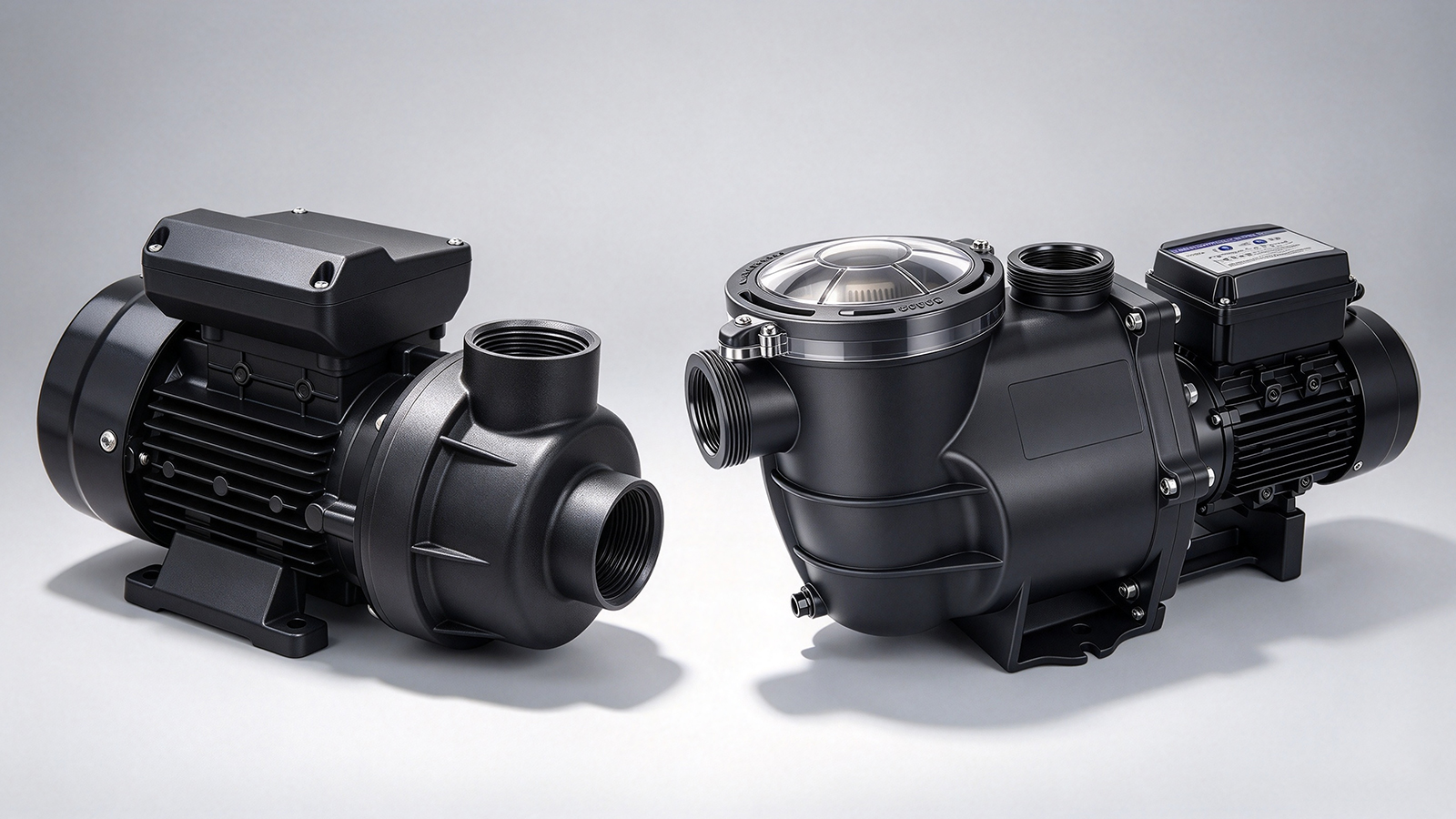
Inground Pool Pump vs Above Ground Pool Pump: The Differences That Actually Matter
America has about 10.4 million residential swimming pools, and roughly 41% of them — a little over 4 million — are above-ground rather than in-ground. That is a lot of pumps, and it explains why “can I run this pump on that pool?” is one of the questions pool counters hear most often once the weather turns.
Here is the short version. An inground pool pump and an above ground pool pump are built for two different hydraulic jobs. From three feet away they look alike, and in most real backyards they are not interchangeable. Knowing why takes ten minutes and can save you a few hundred dollars plus a summer of green water.
The 30-second answer
An above ground pool pump is a smaller, non-self-priming pump that sits at or below the pool’s water line and relies on gravity to feed it. An inground pump is a bigger, self-priming machine that can sit above the water line, pull water up and hold its prime between cycles.
That single sentence settles most of the above ground pool pump vs inground question. Head pressure, horsepower, pipe size, run time, price, and how often you have to walk outside and re-fill the strainer basket all come out of it.
What each pump actually is
An above ground pool pump, in plain terms
Most above-ground units are a motor bolted to a strainer housing with an impeller inside. Water arrives by gravity because the pump sits lower than the pool surface, gets flung outward by the impeller, and leaves under pressure toward the filter. There is no real lift and no ability to suck air out of a line.
That is why the manual for something like the Hayward Power-Flo LX states flatly that it is not self-priming and must be installed below the pool water line. Not a flaw — the design. Non-self-priming is cheaper and simpler, and adequate when gravity does half the work.
Sizes run from about 1/4 HP on the little all-in-one sand filter units up to 1.5 HP on a full-size above ground pool pump for a 24- or 30-foot round pool. Nearly all plug into a 115-volt outdoor outlet, use 1.5-inch flexible hose with clamps, and draw from a single skimmer. That simplicity is the real selling point of the above ground pool pump category: fewer parts, fewer failure points, and a swap you can finish in an afternoon.

An inground pool pump, in plain terms
An inground pump has to pull water up out of a pool that sits below it, sometimes through a long run of pipe past a main drain and several skimmers, then push it through a filter, maybe a heater, maybe a salt cell, and back through multiple return jets. That needs a self-priming design: it can evacuate air from the suction line, build a vacuum, and draw water up on its own.
Self-priming pumps are larger, run 1 to 3 HP, usually on 230 volts with a dedicated circuit, and connect to rigid 2-inch Schedule 40 PVC with unions. Since July 19, 2021, U.S. federal efficiency rules have covered them as a distinct category, tested and rated separately from non-self-priming models. That regulatory split is a useful tell: if a spec sheet calls a pump self-priming, it is being sold into the in-ground world, and no above ground pool pump belongs in that slot.
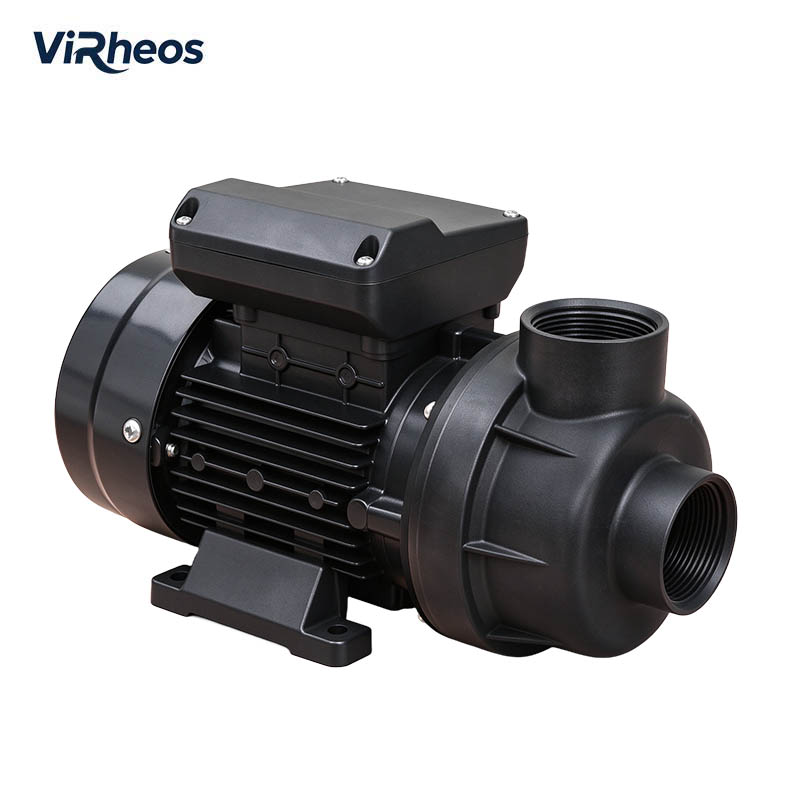
Side-by-side comparison
The table below compresses the differences buyers actually run into. Ranges reflect typical residential equipment, not extremes.
| Attribute | Above ground pool pump | Inground pool pump |
| Federal pump class | Non-self-priming pool filter pump | Self-priming pool filter pump |
| Typical motor size | 0.25–1.5 HP | 1–3 HP, variable speed is now the norm |
| Flow at working head | 30–80 GPM | 60–120+ GPM |
| Typical system head | 25–35 ft | 40–60 ft |
| Priming | Needs flooded suction; usually loses prime when shut off | Self-primes; holds prime between cycles |
| Plumbing | 1.5 in flexible hose with clamps or collars | 2 in rigid Schedule 40 PVC with unions |
| Voltage | 115 V, standard outdoor GFCI outlet | 115/230 V, usually a dedicated 230 V circuit |
| Filter and add-ons | Small sand or cartridge filter, sometimes built into the pump | Larger sand, cartridge or DE filter, plus heater, chlorinator, cleaner, spa jets |
| Typical run time | 4–8 hours a day, seasonal use | 8–12 hours a day, often year-round |
| Service life | Roughly 3–8 years | Roughly 8–15 years |
| Purchase price | About $150–$800 | About $800–$2,500 installed for variable speed |
| Noise at filtration speed | Noticeable, single-speed hum | Much quieter at low RPM |
| Certification and savings | ENERGY STAR certified above-ground models exist, savings around $80 over the product’s life | ENERGY STAR certified models save around $290 over the product’s life |
Sources for the table: U.S. DOE efficiency classes under 10 CFR 431.465; ENERGY STAR pool pump specification and 2022 fact sheet; EIA Electric Power Monthly (2025); HomeAdvisor 2025–2026 replacement cost data; manufacturer published performance tables.
Why priming is the difference you feel first
If you have ever stood over a pump with a garden hose at 7 a.m., you already know this part. It is the biggest day-to-day difference between the two categories.
An above ground pool pump sits below the water line, so the suction hose stays full while it runs. Shut it off and gravity drains that hose back into the pool unless something holds the water in place. Restart it dry and the impeller spins in air: no flow, and a few dry minutes is hard on the seal.
Hence the start-up ritual: open the lid, fill the strainer housing, check the O-ring is seated, start the pump, watch for a steady stream. With a good seal most units pick up prime in one to three minutes. If they do not, air is getting in — a dry or nicked O-ring, a loose collar, a cracked hose, or water below the skimmer.
Inground pumps usually skip all of that. They hold prime from one cycle to the next. When an in-ground pump starts losing prime, that is a symptom, not a feature: suspect a suction-side air leak, a worn shaft seal, or a flattened lid O-ring.
Two practical notes. First, a check valve on the suction line of an above ground pool pump will hold water in the hose between cycles and cut down on the re-priming routine. Second, low water level is the number one reason a healthy pump suddenly will not prime. Check the water before you take anything apart.
Horsepower is the number on the box. Flow is the number that matters.

Pump marketing leads with horsepower. It is a poor guide, and real test data shows why.
An independent bench test of a Pentair SuperFlo variable speed pump on 1.5-inch plumbing recorded 17 GPM at 1,500 RPM while drawing 265 watts, and 82 GPM at 3,450 RPM while drawing 2,220 watts. Same pump, same pipes, one speed apart: halving the speed cut power draw to roughly one eighth.
That relationship is why variable speed saves so much money on filtration: filtration needs flow, not force, and slow-and-long beats fast-and-short. It is also why horsepower alone tells you so little. A 1.5 HP above ground pool pump with a clean filter and short hoses can out-move a tired 2 HP in-ground pump fighting a clogged filter and 60 feet of head.
What matters is GPM at your system’s head — the total resistance from pipe friction, elbows, filter, heater and elevation change. Trade references put typical above-ground systems around 25–35 feet of head and residential in-ground systems around 40–60 feet. Read the pump curve at your number, not the HP sticker. That goes for an inground pump and an above ground pool pump alike.
Where each pump earns its keep
Jobs an above ground pool pump handles well
- Seasonal backyard pools up to roughly 15,000–18,000 gallons, usually 15 to 30 feet round or oval
- Single-skimmer circulation with the pump beside the pool and below water level
- Small sand or cartridge filters whose rated flow the pump will not exceed
- Suction-side cleaners and manual vacuuming
- Budget replacements, where a $300–$500 pump beats a $1,500 upgrade on a pool used four months a year
Jobs that need an inground pump
- Pools with a main drain, several skimmers, and multiple return lines
- Systems with a heater, salt chlorinator, or spa jets
- Waterfalls and deck jets needing a high-flow burst part of the day
- Equipment pads above the water line or a long way from it — a job no above ground pool pump is rated for
- Year-round operation, where energy use dominates total cost
Can you swap one for the other?
Going the wrong direction is where people get burned.
Putting an above ground pool pump on an in-ground pool almost always under-pumps it. You get weak returns, a filter that never sees enough flow, warm spots, and algae in the corners. The pump will run all day and still not turn the water over.
Going the other way is also a problem. A 2 HP in-ground pump on a small above-ground pool will out-run the filter’s rated flow and the 1.5-inch plumbing. Filters have a maximum GPM stamped on the label for a reason, and flexible hose plus small fittings were not built for that pressure. You get noise, leaks at the collars, and a filter that can be damaged.
There is one legitimate exception. If your equipment pad sits below the pool’s water line and the flow matches the filter rating, a non-self-priming above ground pool pump can work on some in-ground installations, because gravity does the priming for you. It is uncommon, and worth confirming with a professional before you buy.
Sizing without the guesswork
Forget horsepower for a moment and do four things in order.
- Get your pool volume.Rectangular: length × width × average depth × 7.5. Round: diameter × diameter × average depth × 5.9. Oval: length × width × average depth × 6.7. Use the average depth, not the deep end — a 3-to-6-foot pool averages 4.5 feet.
- Set a turnover target.One full turnover every 8 hours is the residential norm. Divide pool gallons by 480 (the minutes in 8 hours) for your GPM target. A 13,000-gallon pool needs about 27 GPM; a 20,000-gallon pool about 42 GPM.
- Check your filter’s maximum flow.Every filter has a rated GPM on its label and your pump must not exceed it. This is the step people skip, and the one that damages equipment.
- Check your plumbing.About 42 GPM is the practical ceiling for 1.5-inch pipe; about 73 GPM for 2-inch. Above that you are buying noise and friction, not flow. Most above ground pool pump installations sit in the 10,000–15,000 gallon row below.
The table below puts those numbers next to running cost, using the 2025 U.S. residential average of 17.30 cents per kWh from the Energy Information Administration [4], and assuming 8 hours a day for single-speed pumps and 12 hours a day at low speed for variable speed.
| Pool size and example | 8-hour turnover target | Typical pump | Plumbing | Single-speed, annual | Variable-speed, annual |
| 5,000–8,000 gal (15 ft round, 42 in wall) | 10–17 GPM | 0.25–0.75 HP above ground pool pump or integral sand filter unit | 1.5 in hose | $150–$250 | Rarely offered at this size |
| 10,000–15,000 gal (24 ft round, 52 in wall) | 21–31 GPM | 0.75–1.5 HP above ground pool pump | 1.5 in | $450–$650 | $120–$200 |
| 15,000–20,000 gal (small in-ground) | 31–42 GPM | 1.0–1.5 HP self-priming | 2 in | $600–$800 | $150–$250 |
| 25,000–35,000 gal (family in-ground) | 52–73 GPM | 1.5–2.5 HP self-priming, variable speed | 2 in | $700–$1,000 | $180–$320 |
Two caveats matter more than the numbers. Seasonal owners in cold states run maybe 100–150 days a year, so divide those annual figures by about three; a 1 HP pump at 8 hours a day for a 120-day season lands near $200. And rates vary enormously, from about 11.8 cents per kWh in North Dakota to over 40 in Hawaii and about 32.5 in California. A Californian pays roughly three times what a Pacific Northwesterner pays for the same pump.
What the upgrade actually saves
ENERGY STAR’s own figures put certified in-ground pool pumps at 18% less energy than standard models, worth about $290 over the product’s life, and certified above-ground pumps at about 11% less, worth about $80. The same guidance notes a standard in-ground pump can cost around $260 a year to run, often the second largest energy draw in the house.
Those numbers are conservative, and they are the ones to budget with. Manufacturer claims run higher — variable speed literature commonly cites up to 90% savings versus a single-speed pump running 12 hours a day at $0.16 per kWh in a 20,000-gallon pool — but those comparisons assume a worst-case baseline and carry a footnote saying results vary with plumbing, run time, pump size and local rates.
The honest takeaway: on an above ground pool pump that runs four months a year, variable speed pays back slowly and a good single-speed unit is defensible. On an in-ground pool running every day, often with a heater or spa in the loop, variable speed is not really optional. Federal standards pushed the market there, and several states require it on replacements.
Replacement costs land in a wide band: roughly $700 to $4,000 depending on the pump and whether wiring or plumbing changes, with variable-speed units in the $800–$2,500 range. Pumps last 8 to 15 years, and the standard rule of thumb is to replace rather than repair once a repair quote exceeds half the price of a new unit.
How to run an above ground pool pump, step by step
This is the routine that keeps a pump alive and the water clear. It takes about ten minutes a week.
- Place it correctly.Level pad or pavers, outdoors, a few inches off the ground, below the pool’s water line, as close to the pool as the hoses allow. Plug into an outdoor GFCI outlet. Never indoors or in a closed space.
- Connect the hoses.Pool outlet to pump inlet, pump outlet to filter inlet, filter return to pool. Hand-tighten the collars and add a small turn with a wrench — overtightening cracks plastic. Keep runs short and free of kinks.
- Prime before every cold start.This is the step that makes an above ground pool pump different from the one on an in-ground pool. Fill the strainer housing to the brim. Check the lid O-ring is clean, seated and lightly lubricated. Replace the lid, start the pump, watch through the clear lid. Water should be moving within a minute or two. Nothing after three minutes? Shut it off, refill, and hunt for an air leak rather than letting it run dry.
- Set the run time.Pool gallons ÷ (pump GPM × 60) = hours for one turnover. Most above ground pool pump setups need 5 to 8 hours. Run it during the day if you use a suction cleaner, and consider splitting the run morning and evening in hot weather.
- Weekly checks.Empty the skimmer and pump baskets and glance at the filter gauge. At roughly 8–10 PSI above its clean baseline, backwash a sand filter or rinse a cartridge.
- Monthly and seasonal care.Inspect the lid O-ring and hose collars, keep the motor dry and ventilated, and in freezing climates pull the drain plugs, disconnect the hoses and store the pump indoors. Replace the shaft seal every two to three years if the pump stays in service.
- Know when to stop.Grinding noise, a breaker that keeps tripping, a motor too hot to touch, or water leaking at the motor joint all mean shut it down and get it looked at. A few dry minutes is how a repairable above ground pool pump becomes a replacement.
Mistakes that cost real money
- Buying by horsepower.Size by GPM against your filter and plumbing, then pick the HP that delivers it.
- Ignoring water level.A pool that has dropped below the skimmer will stall any above ground pool pump, no matter how new it is.
- Oversizing “for later.”A bigger pump on small plumbing wastes electricity and can damage the filter.
- Skipping the GFCI.Pumps and water together are exactly why the outlet requirement exists.
- Running dry.A few minutes can cook a mechanical seal.
- Leaving it out in winter.Freezing cracks housings. Drain and store.
Frequently asked questions
- Can I use an above ground pool pump on an in-ground pool?
- Usually no. It is undersized for the volume and the head, and it is not self-priming. It will run long hours and still not turn the water over.
- What size above ground pool pump do I need for a 24-foot round pool?
- A 24-foot round pool with a 52-inch wall holds roughly 13,000 gallons and needs about 27 GPM for an 8-hour turnover. A 0.75 to 1.5 HP unit covers that comfortably, as long as your filter’s rated flow is at or above what the pump delivers.
- Why does my pump lose prime every single day?
- Because it is a non-self-priming pump with nothing holding water in the hose. That is normal for this category. A suction-side check valve and a healthy lid O-ring reduce it a lot, and confirm the water level is high enough.
- Do I need a variable speed pump?
- For an in-ground pool that runs most of the year, yes in practice — federal standards and several state codes point that way, and the energy savings are significant. For a seasonal above ground pool pump running four or five months, a quality single-speed model still makes financial sense.
- Can an above ground pool pump run 24 hours a day?
- It can, but it rarely should. Around-the-clock running is sometimes used short-term to clear algae, and it is expensive on a single-speed unit. Once the water is clear, go back to one turnover a day.
- How many hours a day should I run it?
- Enough for one full turnover: usually 5 to 8 hours above ground, 8 to 12 hours at low speed in ground. Longer at low speed is cheaper than shorter at full speed.
- How long do these pumps last?
- Above-ground units commonly run 3 to 8 years. In-ground pumps typically last 8 to 15 years with decent maintenance, and longer when not run at full speed all day.
The bottom line
Match the pump to the pool and everything else gets easier. An above ground pool pump is a simple gravity-fed machine for smaller seasonal pools: cheaper to buy, cheaper to replace, happy as long as you keep it below the water line with a clean O-ring. An inground pool pump is a self-priming workhorse built for volume, distance and equipment-heavy systems, and it is where variable speed pays for itself.
Start with your pool’s gallonage, work out the GPM you need, check your filter’s limit, then read the pump curve. Do that whether you are buying an above ground pool pump or an inground model, and the HP sticker stops mattering.
References
Abstract: This paper analyzes gas-liquid flow and energy loss in self-priming centrifugal pumps during priming, explaining why self-priming designs can evacuate air and sustain suction lift for in-ground pool applications.
Abstract: It studies reflux hole geometry affecting self-priming time, gas separation and head stability, supporting the hydraulic difference between self-priming in-ground pumps and flooded-suction above-ground pumps.
3.Title: New formula proposal for the determination of variable speed pumps efficiency
Abstract: This article revises pump affinity laws for variable-speed centrifugal pumps, modeling flow-head-power tradeoffs critical for variable-speed pool pump energy savings.