
Pool Cover Pump Basics & Buying Guide
Water sitting on a winter cover is the cheapest way to destroy an expensive cover. One inch of rain across a 20 x 40 ft solid cover is roughly 500 gallons — at about 8.34 lb per gallon, over two tons pressing on straps, anchors and fabric. Three inches after a week of storms is more than six tons.
A pool cover pump exists for exactly that: a small submersible unit that sits on the cover, pulls standing water off and sends it away through a hose. It is not a pool pump — it circulates and filters nothing. It runs for a few minutes after a storm, then stops.
This guide is for the people who buy them in quantity or specify them on projects — contractors, facility teams, distributors, OEM buyers. It covers how a pool cover pump works, the main types, the standards that decide which markets a model can enter, sizing with real numbers, and the habits that separate one lasting two winters from one lasting eight.
What Is a Pool Cover Pump?
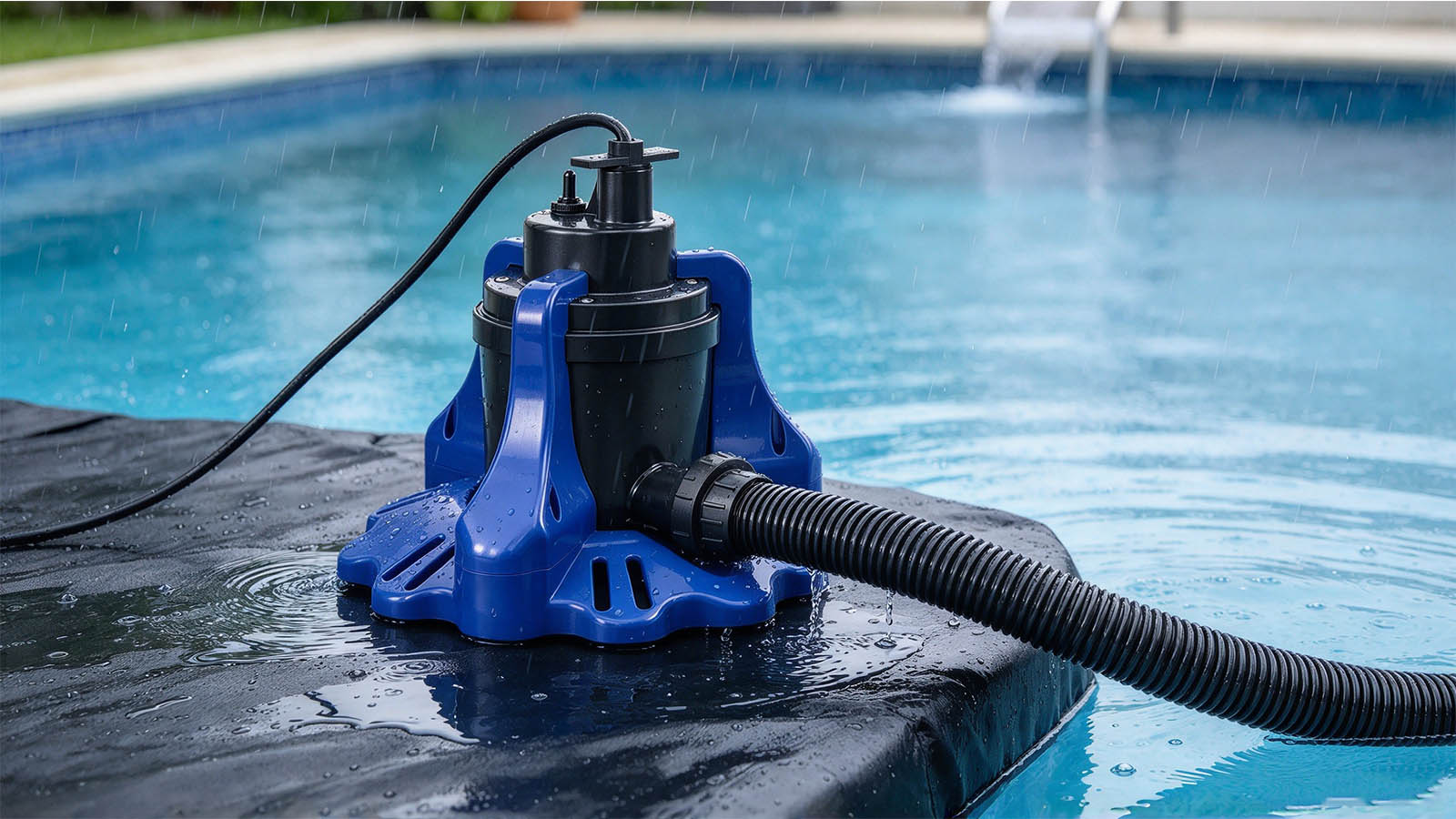
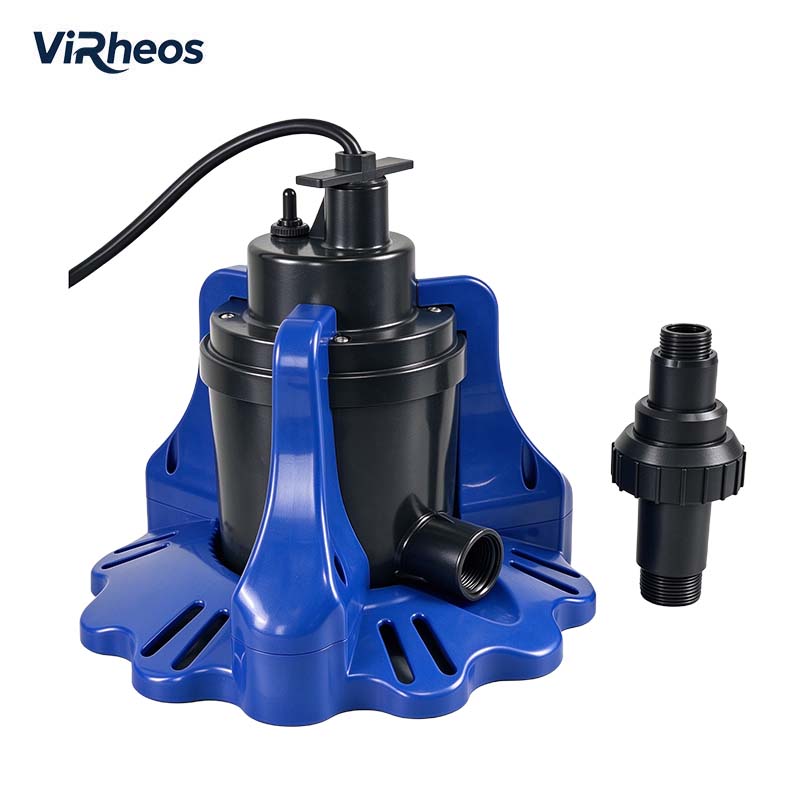
A pool cover pump is a small, low-profile submersible unit that sits directly on a pool cover and removes standing water — rain, snowmelt, spring thaw — without damaging the cover or running dry. Flat base, screened intake underneath, discharge for a garden hose, cord for an outdoor receptacle.
Two design details explain the category. The base is wide and flat because the unit must stay upright on a wet, wrinkled, slightly sloping membrane for weeks. The intake sits low and is screened, because the water is inches deep and full of leaves and grit.
The distinction people get wrong is between this and the main pool pump. A circulation pump moves thousands of litres an hour and is plumbed in. A pool cover pump moves a few hundred gallons, sits loose on the cover, and goes in a shed for summer.
How a Pool Cover Pump Works
The mechanism is as simple as pumping gets — no priming ritual, no plumbing. Water enters the screened intake at the base, the motor spins an impeller, and the water leaves through the discharge and down the hose to a lawn or drain.
What separates a pool cover pump from a generic utility pump is how it starts and stops. The water is shallow, so it must switch on in an inch or two and off before running dry. Solved three ways:
Manual. Plug it in, it runs, unplug it. Simplest and cheapest — and dependent on somebody being there after every storm.
Float switch. A float rises with the water and closes a contact; when the level drops it falls and the pump stops. Typical units start near 1–2 inches and shut off around ⅜–¾ inch.
Electronic sensor. Probes or solid-state sensing switch the motor, some triggering around ⅛–¼ inch, with no moving parts in the water.
The failure modes follow from that choice. Floats sit in dirty water for months and are the part most likely to stick or wear. Electronic sensing removes the moving part but adds a board. Manual units have fewest parts and the highest chance of being left running dry — which is what kills these motors.
What a Pool Cover Pump Actually Does
Protects the cover. Standing water stretches fabric, loads straps and anchors, and can pull fittings out of a deck.
Removes a safety hazard. Shallow water on a cover is a documented entrapment and drowning risk for small children and animals.
Keeps debris from turning into a swamp. A puddle on a dark cover is where leaves and droppings break down into a nutrient soup, which leaches through a seam and becomes algae and a chemistry bill in spring.
Protects the pool structure. On above-ground pools the load goes into top rails and wall structure; on in-ground pools, straight into the deck anchors.
What it does not do: it does not winterise the pool, treat the water, or replace checking the cover after a storm. It removes water.
Types of Pool Cover Pump
Manufacturers describe these units by switching method, build or flow. For a buyer, four distinctions change the specification.
1. Manual vs. automatic
- Manual units are cheaper and simpler, and suit a site visited regularly. Automatic units cost more but run unattended — the only real option for holiday homes, municipal sites and any property nobody checks weekly. Automatic shut-off is also the best protection against dry running.
2. Float switch vs. electronic sensor
- A float is proven and cheap, but it is the most common warranty claim in the category: it sticks, catches debris and wears. Electronic sensing removes the moving part and triggers in shallower water.
3. Submersible vs. deck-mounted
- Nearly everything sold as a pool cover pump is submersible and sits in the water. Some sites instead use a small self-priming pump on the deck with a hose onto the cover — that keeps electrics out of the water, but needs priming and frost protection, and is usually bespoke rather than catalogue.
4. Flow and build class
- Residential units run from a few hundred to around 3,000 gallons per hour, in thermoplastic or stainless housings, typically drawing 50–120 watts. Build quality shows in three places worth checking on a sample: housing sealing, cord and strain relief, and how the intake screen is attached.
Table 1. Pool cover pump types compared
| Type | How it starts / stops | Best suited to | Most common failure | What to check on a sample |
| Manual submersible | Plugged in by hand; stops when unplugged | Sites visited weekly; budget specs; spare backup unit | Left running dry after the water is gone | Thermal overload protection present and rated |
| Automatic, float switch | Mechanical float closes a contact; typically on around 1–2 in, off near ⅜–¾ in | Most residential and light commercial work | Float sticks, jams on debris or wears out | Float travel is free; housing can be opened to clean it |
| Automatic, electronic sensor | Probes or solid-state sensing; some trigger near ⅛–¼ in | Unattended sites; premium and OEM programmes | Control board fault; sensor fouling | Restart behaviour after power cut; sensor cleaning access |
| Deck-mounted centrifugal | Primed and run from the deck, hose onto the cover | Commercial sites, bespoke installs | Loses prime; freezes if left out | Self-priming height, frost drainage, GFCI supply |
Where Pool Cover Pumps Are Used
Residential in-ground pools with solid winter covers — the core market. Mesh covers drain through and rarely need one.
Above-ground pools — the load goes into top rails and wall structure, not just the cover.
Hotels, resorts and municipal pools closing seasonally — off-season covers on public venues carry documented inspection obligations, so unattended automatic operation is usually the only practical arrangement.
Holiday homes and managed rentals — nobody is there to plug a pump in after a 3 am storm.
Spas and small plunge pools — small covers, small volumes, often the same unit at a reduced setting.
Beyond pools — flat roofs, tank and pond covers, tarps over stored materials. The shallow-water auto-shut-off that works on a membrane works on a tarp.
Standards and Safety: What Actually Gets Checked
Cover pumps sit at an awkward intersection: electrical appliances, outdoors, in shallow water, beside a body of water. Three rule sets apply, and importers regularly get two wrong.
Electrical installation first. In the US, receptacles and equipment around pools fall under National Electrical Code Article 680: no receptacle within 6 ft of the pool, at least one GFCI-protected receptacle between 6 and 20 ft, and GFCI protection for receptacles serving pool equipment (NFPA 70, Article 680). The practical rule is fixed — a pool cover pump plugs into a GFCI outdoor receptacle, never an indoor extension cord.
The product is second. Residential cover pumps are evaluated against ANSI/UL 778, the safety standard for motor-operated water pumps. Worth knowing: UL lists submersible pumps under categories such as “Pumps, Motor-Operated Water”, and those listings note the pumps have not been investigated for use near pools or spas — so cover-maker guidance matters as much as the mark on the box (ANSI/UL 778).
The cover is third. ASTM F1346, current edition F1346-23, is the performance specification for safety covers: a 485 lb static load test for pools wider than 8 ft, and a requirement that substantially all standing water be removed within about 30 minutes of rainfall stopping (ASTM F1346-23). That drainage clause is why a pump is part of a compliant installation, not an optional accessory.
For Europe, the standard is EN IEC 60335-2-41, covering pumps up to 250 V single-phase and requiring submersible pumps to meet IPX8 for continuous immersion, with CE marking on top (EN IEC 60335-2-41:2021+A11).
Table 2. Compliance and specification reference
| Requirement | What it says | What to ask a supplier for |
| NEC Article 680 (US installation) | No receptacle within 6 ft of the pool; GFCI-protected receptacle required between 6 and 20 ft | Confirmation the cord and plug suit a GFCI outdoor receptacle; no indoor-extension guidance anywhere in the manual |
| ANSI/UL 778 (US product) | Safety standard for motor-operated water pumps | Listing number and category, plus the exact listed model numbers |
| ASTM F1346-23 (covers) | 485 lb static load for pools over 8 ft; standing water removed within about 30 minutes of rainfall stopping | Confirmation the pump flow can clear the cover within that window at the site’s hose run |
| EN IEC 60335-2-41 (EU product) | Submersible pumps must meet IPX8; up to 250 V single-phase | EU Declaration of Conformity, IPX8 test report, applicable directives |
| Cover maker limits | Many cover makers cap pump flow so the intake cannot grab the fabric — commonly no more than about 20–30 gpm, with a base screen around 6 in across | Written confirmation the model is approved for use on the cover type being supplied |
| IP rating and cord | Continuous immersion duty; cord strain relief and jacket rated for outdoor winter use | IP test report, cord specification, cold-bend rating |
Buying Guide: How to Size a Pool Cover Pump
Sizing a pool cover pump has both a floor and a ceiling — and the ceiling is the part most buyers miss.
Step 1. Estimate the water you have to move
Work out cover area and how much rain or melt arrives in one event. One inch on a 16 x 32 ft cover is about 320 gallons; on 20 x 40 ft, roughly 500. A three-inch storm on the larger cover is around 1,500 gallons — more than six tons of load.
Step 2. Pick a flow that clears it in a sensible time
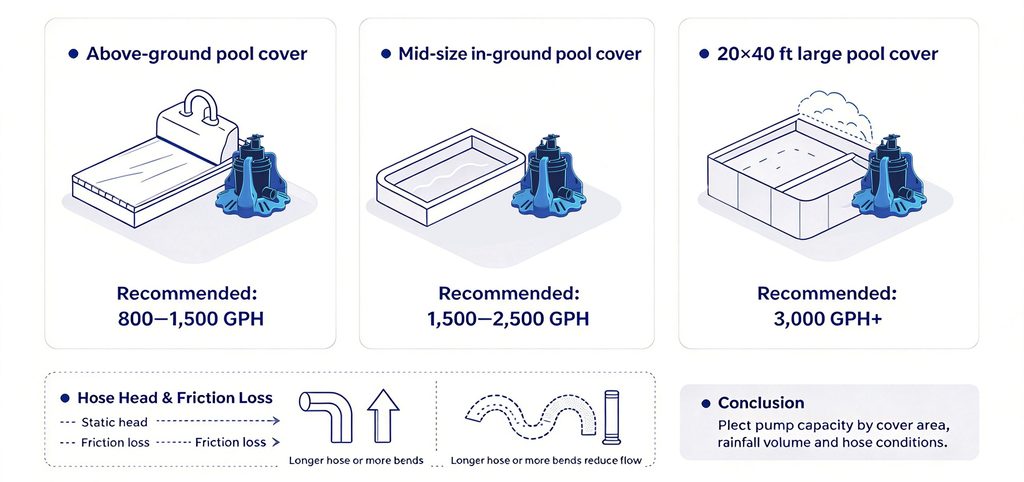
Divide that volume by the rated gallons per hour. 1,500 gallons is about an hour at 1,500 GPH, or close to two hours at 800 GPH. As a guide: above-ground covers to 24 ft are comfortable at 800–1,500 GPH; mid-size in-ground covers run 1,500–2,500 GPH; covers over 20 x 40 ft or heavy snowmelt areas want 3,000 GPH or more.
Step 3. Respect the ceiling
Several cover makers cap the flow of any pump placed on a cover — commonly about 20–30 gpm, or 1,200–1,800 GPH — so the intake cannot grab the fabric or create a vortex. They also specify a base screen, typically around 6 inches across. Too much pump is a real failure mode here.
Step 4. Check the hose run, not just the pump
Rated GPH is measured at essentially zero lift. Every foot of rise to clear a deck, plus friction in a long or kinked hose, cuts the real figure. Read the curve at the actual head.
Step 5. Specify the details that decide service life
Cord length and jacket: 25 ft is typical, some models run to 33 ft. Plan the receptacle distance rather than reaching for an extension cord.
Automatic shut-off or dry-run protection. This is the feature that decides whether the unit survives its first winter.
Freeze behaviour. In cold climates, know at what point the pump comes off the cover — covered below.
Intake screen that can be cleared without dismantling the pump, plus spares — floats, screens, impellers and cords as available parts, not a whole-unit replacement.
A Worked Example
A 20 x 40 ft solid cover on a northern property. A three-day storm drops three inches: about 1,500 gallons, roughly 12,500 lb of load on the straps.
A 1,500 GPH automatic pool cover pump at the low point clears that in about an hour. The electricity is trivial: a typical residential unit draws 50–120 watts, so an hour costs a few cents and a full season of intermittent use lands in single-digit dollars. Set that against the price of a cover, or one anchor pulled out of a deck.
The same cover with an 800 GPH manual unit is different: nearly two hours of run time, and only if somebody is there to start it. In practice the water sits for days, the cover sags further, and the low point moves — which is why pumps found mid-winter are often on a wrinkle instead of in the water.
Using a Pool Cover Pump: The Routine That Prevents Most Failures
Set-up
Skim the worst of the leaves first. Most “the pump isn’t working” callouts are a leaf mat over the intake.
Set the pool cover pump at the true low point, flat on the cover and stable — these units are light, and one that tips draws air and looks exactly like a mechanical fault.
Attach the hose securely, run it well away from the pool and the house, and plug into a GFCI outdoor receptacle — never an indoor extension cord.
Watch the first two minutes: a humming motor is not proof water is moving. Airlocks show up right here.
Through the season
After each load of rain or melt, re-check the low point. Covers shift, and a pump out of the deepest pocket drains partway then short-cycles.
Check the cord and plug each season; months outdoors on an abrasive deck is hard on them.
After pumping, check the pool water level — an unattended automatic unit can move more pool water than expected.
Cold weather
Freeze damage is the most common way a working pump becomes a replacement purchase. Practical thresholds:
32–25°F: leave it in place; if manual, run it every 12 hours or so. Confirm an automatic unit is cycling.
25–20°F: run a manual unit every 6–8 hours, or take it off. Make sure the hose drains completely after each cycle.
Sustained below 20°F for more than about 48 hours: remove the pump. Residual water freezes between cycles and ice expansion can crack the casing or jam the impeller.
Frozen into ice? Do not chip at it — disconnect, wait for the thaw, and remove water by hand meanwhile.
End of season
Drain pump and hose completely, rinse off, store indoors. A unit stored wet and frozen rarely makes another winter.
Coil the cord loosely; tight coils damage conductors over time.
Test it before the next season, not on the first storm night — and clear the intake screen through leaf fall.
Frequently Asked Questions
1. How many gallons per hour do I need?
- Enough to clear a storm load in an hour or two: 800–1,500 GPH for above-ground covers to 24 ft, 1,500–2,500 GPH for mid-size in-ground, 3,000 GPH or more for large covers or heavy snowmelt — provided the cover maker’s cap is not lower.
2. Can I use a normal pool pump or a sump pump instead?
- Not really. A circulation pump is plumbed in, not built to sit on a membrane. A sump pump wants deeper water to stay primed and is damaged running dry in an inch. Both work badly and fail early.
3. How long do pool cover pumps last?
- Three to five winters is typical with proper storage; well-kept units are reported to reach five to eight seasons, budget manual units often two to three. On solid covers under near-continuous duty some installers report two to four years. Keep a spare — it is a wear item.
4. Do I need one with a mesh cover?
- Usually not. Mesh covers drain through the fabric, so standing water rarely accumulates. Solid covers hold everything on top, and are why this category exists.
5. What kills these pumps?
- In order: dry running, freezing, a clogged intake, and tipping. None is a motor fault. If a pool cover pump will not move water, check it is flat, the screen is clear and the hose is not kinked before assuming it failed.
6. Can it stay on the cover all winter?
- Yes in mild climates, with conditions in cold ones. It must be rated for continuous outdoor use and supplied from a GFCI receptacle. In freezing regions it comes off below about 20°F sustained, and always before an extended hard freeze.
Bringing It Together
A pool cover pump is a small purchase protecting a large one. What matters is not the highest number on the box — it is a flow rate that clears the cover inside a sensible window, sits under the cover maker’s own limit, and is matched to a GFCI supply and a hose run that delivers it.
Two things separate a pool cover pump that lasts from one that does not. The switch — automatic shut-off or dry-run protection, because running dry destroys these motors. And the operator: place it at the low point, clear the screen, take it off before a hard freeze, store it dry.
Sourcing for a programme rather than buying one? Send a manufacturer the cover sizes you support, typical storm load per market, the lowest sustained temperature the unit must survive, power supply and plug type, and the certification package per destination. A competent engineering team returns a flow rating, switch type, cord and hose specification and compliance files — and you avoid the two mistakes behind most returns: too little pool cover pump for the cover, and too much for the fabric.
References
1.Title: The design and safety of swimming pool covers
Abstract: This multidisciplinary study evaluates pool cover hazards, including entrapment risks from standing water on winter covers and child drowning epidemiology via engineering and ergonomic testing.
2.Title: Preventing drowning through design – the contribution of human factors
Abstract: Presents human-factor design frameworks for drowning prevention, covering barriers, pool covers and hazard assessment for unattended residential and seasonal swimming installations.
Abstract: Implements sensor-based automatic pump control to stop dry running, reducing premature motor failure, matching the auto-switch logic of pool cover pumps.
4.Title: Model Based Fault Diagnosis in a Centrifugal Pump Application using Structural Analysis
Abstract: A structural-analysis fault detection method for centrifugal pumps identifies common faults such as blockage, air lock and abnormal running conditions.